
Battery & Electrical
Slow Crank: Starter or Battery?
Slow cranking can come from a weak battery, cable resistance, or a worn starter. Learn how Hillside drivers can recognize clues and request the right tests.
By the team at Rios Auto Service, Hillside, IL · · 9 min read
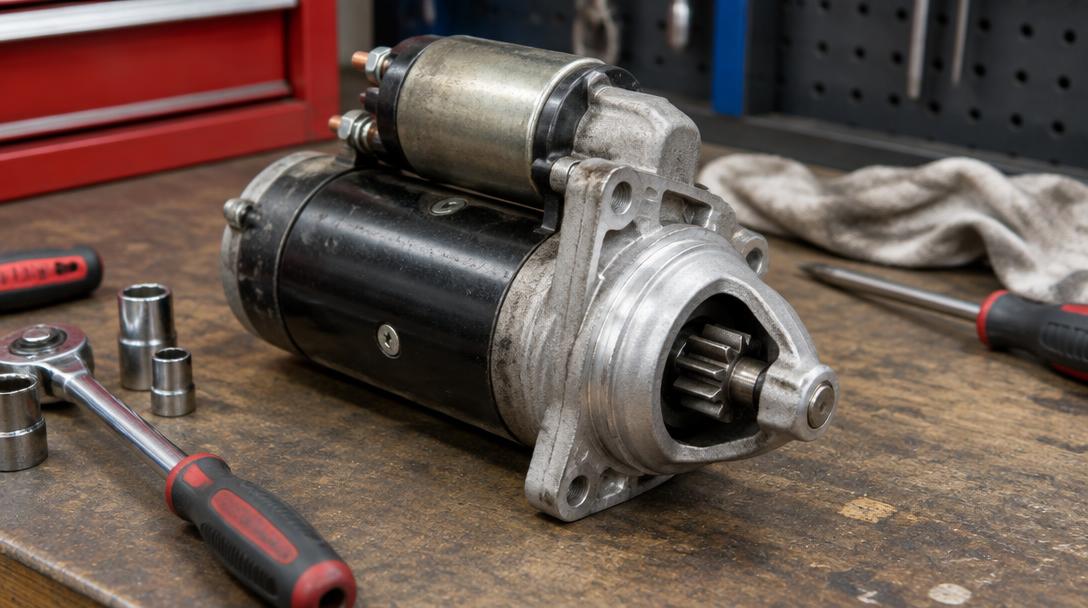
Quick answer: Slow cranking can come from a weak or undercharged battery, resistance in the power or ground cables, a worn starter, or excessive mechanical resistance. Sound alone cannot reliably separate them: battery testing, voltage-drop measurements during cranking, and starter-current testing provide a much stronger answer than replacing whichever part seems most likely.
First, make sure the engine is actually cranking slowly
Cranking is the starter physically turning the engine before the engine runs on its own. A slow crank sounds labored: the familiar turning rhythm drags, pauses, or seems weaker than usual. That is different from an engine turning at normal speed for several extra seconds before finally firing.
The distinction changes the diagnostic direction. Normal-speed cranking without starting points toward a different set of questions, such as fuel delivery or engine control. A single click with no rotation also needs its own evaluation. Tell the shop what moves and what you hear rather than using “won't start” for every possible symptom.
A short recording can help if you can make it safely while parked. Do not keep operating the starter just to capture a better example. One ordinary starting attempt, within the owner's manual's limits, is enough. Note whether the engine eventually starts and whether subsequent starts return to their usual speed.
This article concerns vehicles that use a conventional starter to crank the engine. Some hybrids and other powertrains start the engine differently, so their diagnostic procedure may not follow the same pattern. Identify the vehicle and powertrain before applying advice intended for a traditional starting system.
How the battery, cables, and starter share the work
The battery stores electrical energy. The starter converts electrical power into the torque needed to rotate the engine. Between them are cables, connections, grounds, and switching components. All must work together under a brief but demanding load; a weak link anywhere along that path can reduce cranking speed.
A battery can have enough energy to illuminate the dashboard yet fail to supply the much larger demand of the starter. That is why bright interior lights do not clear the battery. Bosch identifies a slow engine start as a warning sign and describes visual and performance checks in its battery-testing overview.
A starter can also deteriorate internally. Worn contacts, brushes, bearings, or other internal faults may interfere with operation, sometimes inconsistently. But the starter should receive an adequate electrical supply before it is judged defective. A sound motor cannot perform normally if its supply voltage collapses across a poor connection.
The engine itself is the load being turned. Incorrect oil viscosity, extreme cold, or a mechanical fault can increase the effort required. This is why a diagnosis that considers only two replacement parts—battery or starter—can miss the actual problem. The question is where useful cranking power is being lost or excessive resistance is being added.
What the starting pattern can tell you
Slow cranking on the first start of the day suggests checking battery charge and condition, especially if later starts seem normal. It does not prove the battery is defective. Temperature, time parked, accessory use, and the length of the preceding drive all change the conditions surrounding that first attempt.
A problem that appears only after a hot engine is shut down for a short stop deserves different attention. Heat-sensitive starter components or connections are possibilities, but neither can be diagnosed from the pattern alone. Tell the technician how long the engine had been running and how long it sat before the sluggish restart.
If cranking improves substantially with a properly performed boost, available electrical power is implicated, but the battery is not automatically guilty. A boost can affect the electrical supply and, depending on where connections are made, parts of the current path. It is useful evidence rather than a conclusive parts test.
Listen for changes rather than assigning a diagnosis to a sound. Grinding, a hard clunk, or an abruptly stopping engine warrants stopping the attempts and seeking help. A repetitive click is different from a steadily rotating but slow engine. Describing those differences can prevent a repair discussion from starting with the wrong symptom.
Why Hillside winter mornings expose borderline systems
Cold conditions make a marginal starting system easier to notice. Battery output decreases while the engine may become harder to turn. NHTSA's winter-driving advice recommends battery and charging-system checks and recognizes that cold weather changes starting demands. The symptom may appear suddenly even when deterioration has been gradual.
Lubricant behavior is part of that picture. The Department of Energy explains that cold fluids increase engine and driveline friction in its cold-weather guidance. Use the oil specification and viscosity approved for your engine and conditions, rather than choosing a thicker oil because the vehicle is older or a thinner oil as a starting-system shortcut.
Short errands between Hillside and Bellwood can also leave less opportunity to restore battery charge, particularly when winter electrical loads are high. A battery that begins the next morning undercharged has less margin. A longer commute does not guarantee full charge, however, and traffic on I-290 is not a controlled charging test.
Road salt and moisture give technicians additional reasons to inspect exposed cable connections and engine or body grounds. That does not make salt the explanation for every slow start. The location and condition of the actual circuit matter more than the season. Weather helps reproduce the symptom; electrical measurements locate the restriction.
Safe observations you can make in the driveway
With the vehicle securely parked and switched off, review recent service and the owner's manual. Was the correct battery installed? Was an oil change just completed? Did the symptom start immediately afterward or gradually over several weeks? Those details help organize testing without asking you to loosen connections or crawl underneath the vehicle.
Look only where access is straightforward and safe. A damaged battery case, leakage, loose mounting, visibly damaged cable insulation, or a displaced connection deserves attention. Interstate's battery-maintenance guidance emphasizes proper battery care. Inspection is not permission to touch residue, bridge terminals with a tool, or work near a running engine.
Record whether the problem occurs cold, hot, or both, and whether it follows a long parking period. Also note warning lights and whether electrical power cuts out during the attempt. These observations are more useful than repeatedly checking whether the headlights “look bright enough,” which cannot measure battery performance under starter load.
Avoid crawling under the car to strike the starter, bridging starter terminals, or asking someone to crank while you reach into the engine compartment. Those shortcuts can expose you to unexpected movement, electrical arcing, and moving parts. A starter circuit carries substantial current even though the battery is a low-voltage source.
The tests that separate battery weakness from cable loss
A resting battery-voltage measurement can suggest charge level under appropriate conditions, but it does not by itself establish usable starting capacity. Recent charging can affect the reading, and battery chemistry and temperature matter. A battery can show a plausible voltage at rest and still fail when substantial current is demanded.
Battery testing should therefore consider charge level, rated specifications, condition, and temperature. If charging is needed before an accurate assessment, that step matters. A low-charge result should not automatically become a replacement recommendation, while a battery that fails a properly conducted test should not be excused merely because the dashboard lights work.
Next comes the circuit under load. Voltage-drop testing measures how much voltage is lost along a particular cable or connection while current is flowing. Both the positive supply path and the ground return path need consideration. A restriction can exist inside a cable or at a mating surface that looks ordinary from the outside.
This is different from measuring resistance on an inactive circuit with a basic meter. Starter circuits operate at high current, so a small unwanted resistance can matter greatly during cranking. Loaded measurements and manufacturer specifications give context. Replacing the starter without checking those paths risks bolting a new motor onto the same restricted supply.
When starter-current testing becomes useful
Once the battery and cable paths are known to be suitable, current draw and cranking speed help evaluate the starter and its mechanical load. These readings belong together. A single current number, without battery voltage, temperature, engine condition, and vehicle specifications, can be misleading rather than decisive.
A struggling starter drawing unusually high current may have an internal problem, but excessive engine resistance can also increase demand. Low current with poor rotation may involve internal contact problems or inadequate supply. The technician needs to interpret the whole pattern, not use a universal amperage cutoff found online.
Intermittent trouble may need testing under the conditions that produce it. A starter that performs normally on a cool morning may behave differently after a hot restart. Explain the stop-and-start sequence accurately so the shop can consider reproduction rather than relying only on an easy start when the vehicle first arrives.
After a repair, verification should address the original complaint. If the problem was slow hot cranking, a normal cold start alone is incomplete evidence. Ask what changed in the measured results and whether the relevant starting condition was rechecked. That is a practical way to connect the repair to the symptom you brought in.
When to stop trying and get help
Follow the owner's manual's limits for starting attempts and rest intervals. Repeated long attempts can overheat the starter and further discharge the battery. If the cranking speed keeps dropping, continuing until the vehicle produces only clicks generally adds stress without revealing which component started the problem.
Stop immediately for smoke, burning odors, melted insulation, a swollen or leaking battery, or unusual mechanical noises. Do not touch a suspect connection to check whether it is hot. A battery suspected of being frozen should not be charged or jumped. Arrange safe assistance rather than experimenting with another boost.
Even if the engine eventually runs normally, a recurring slow crank deserves prompt evaluation before another commute or essential trip. Starting once is not a guarantee it will restart after a stop near Loyola University Medical Center or a shopping errand. Plan around the unreliability rather than counting on one more successful attempt.
Talking through the findings at Rios Auto Service
Rios Auto Service is an independent, family-run shop owned by Juan Rios at 4218 Roosevelt Rd, Hillside, IL 60162. Its battery and electrical service is the relevant place to discuss slow cranking. Bring the pattern you observed, including temperature, parking time, recent work, and any recording made safely.
Ask for an honest inspection and to see what was found before authorizing replacement parts. Specifically, ask whether the battery was tested in a suitable state of charge, whether both cable paths were checked under load, and what evidence points to the starter if replacement is proposed. The aim is a justified repair, not an unnecessary list of components.
Walk-ins are welcome Monday through Friday, 8 AM–6 PM, and Saturday, 8 AM–4 PM; Sunday is closed. Call (708) 632-4808 or use the contact page. If there are signs of an active electrical or mechanical hazard, do not drive solely to get the vehicle to the shop.
Frequently asked questions about slow cranking
Can my battery be bad if the radio still works?
Yes. The radio requires far less current than starting the engine. Small electrical loads operating normally do not establish that the battery can deliver starting power. A battery performance test, interpreted with its charge level and temperature, is more useful than judging accessory operation.
Does a successful jump prove I need a battery?
No. It shows that the starting conditions changed enough for the engine to turn successfully. Battery charge, battery health, cable connections, and the boost connection points all matter. Treat the improvement as a diagnostic clue, not a final instruction to replace a part.
Will changing the starter fix every slow crank?
No. A weak battery, excessive cable voltage loss, or an engine that is unusually hard to turn can remain after starter replacement. Testing the supply and the load first helps avoid an expensive guess. Even an old starter should be judged by evidence rather than age alone.
Is one sluggish start on a very cold morning harmless?
Not necessarily. Cold may explain why a borderline system became noticeable, but it does not establish whether the system is healthy. Note the conditions and arrange testing if the symptom recurs, worsens, or is accompanied by warning signs. Avoid repeated starting attempts simply to see whether it happens again.
Related question
For the broader replacement-timing question, read How Long Car Batteries Last in Illinois.