
Battery & Electrical
Alternator or Battery? How to Tell
A weak battery and a charging fault can look alike. Learn which symptoms help Hillside drivers tell them apart and why testing both prevents guesswork.
By the team at Rios Auto Service, Hillside, IL · · 9 min read
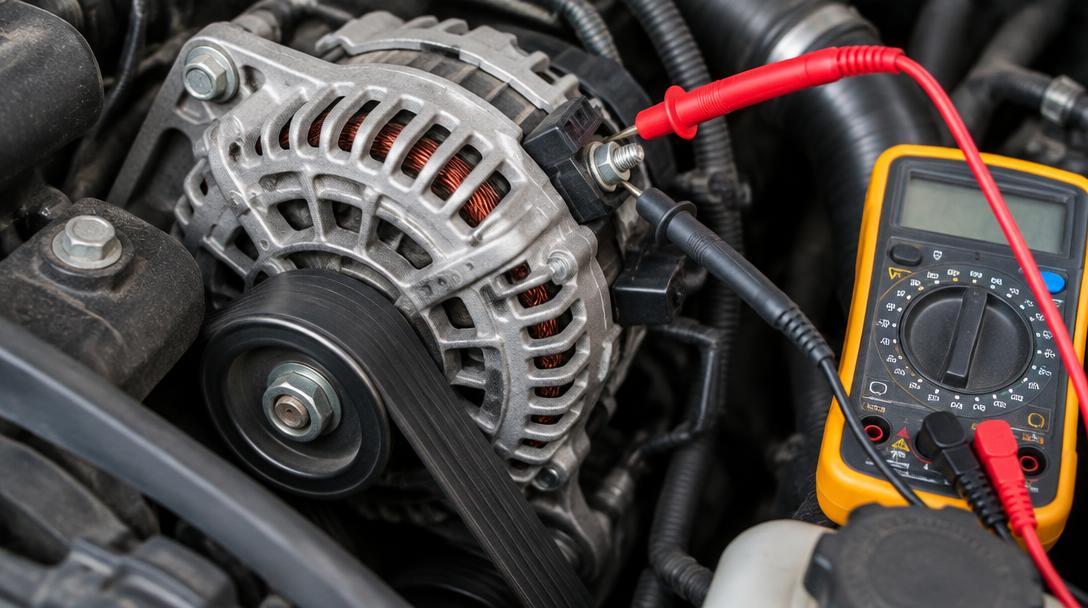
Quick answer: A battery supplies stored energy for starting, while the alternator supplies electrical power and replenishes the battery when a conventional engine is running. Trouble mainly before starting can suggest a battery problem, while a charging warning during operation points toward the charging system—but either symptom needs testing because cables, controls, and the battery itself can imitate an alternator failure.
Two components with different jobs, one shared circuit
The battery and alternator depend on each other, which is why replacing the wrong one is easy. The battery provides substantial current to crank the engine. After the engine starts, a belt-driven alternator converts mechanical energy into electrical energy. It supports the vehicle’s electrical loads and, under the system’s control, restores charge to the battery.
The battery also helps stabilize the electrical supply. It is not simply disconnected from the job once the engine runs. Meanwhile, the alternator’s output is not necessarily constant. Many newer vehicles adjust charging according to temperature, battery condition, load, and driving conditions. A changing dashboard voltage reading is therefore not automatically evidence of a failing alternator.
This discussion applies primarily to conventional combustion-engine vehicles with an alternator. Many hybrids and electric vehicles maintain their low-voltage battery through a DC-to-DC converter instead. Their diagnosis and safety procedures differ. Confirm your vehicle’s system before applying an alternator test described for a different powertrain.
A depleted battery and a failed battery are also different conditions. A healthy battery can be discharged by inadequate charging or by a load left on. A damaged or worn battery may no longer provide adequate starting performance even after appropriate charging. Testing needs to distinguish available charge from the battery’s underlying ability to do its job.
Clues that lean toward the battery, without proving it
A vehicle that struggles to start after sitting but behaves normally once running may have insufficient stored energy. That makes battery condition worth checking. It does not rule out a charging problem that left the battery undercharged during the previous trip. The starting event tells you when the shortage became noticeable, not necessarily when it began.
Normal cabin lights do not clear the battery. A starter requires much more current than a small interior lamp. Similarly, the fact that a battery accepts some charge does not prove it retains sufficient capacity. Bosch’s battery-check guidance includes visual inspection and performance testing, illustrating why a quick look alone cannot settle the question 1.
Age and service history add context but are not verdicts. A recently installed battery can be discharged, unsuitable for the vehicle, or affected by an unresolved system fault. An older battery may remain serviceable. Bring the installation receipt if you have it, especially when the current symptoms appeared shortly after replacement or other electrical work.
A successful jump-start is another clue with limits. It demonstrates that supplemental electrical support helped under those circumstances. It does not establish whether the original battery is defective, whether the alternator replenishes it properly, or whether a poor connection influenced the outcome. Jump-start safety is a separate subject; follow the vehicle manufacturer’s procedure rather than improvising.
Clues that call for a charging-system inspection
A battery-shaped warning light that remains on after the engine starts usually concerns the charging system, not a simple instruction to buy a battery. Brief illumination during the normal key-on lamp check is different. Read the exact warning message and consult the owner’s manual, because symbols and response instructions vary by vehicle.
Electrical functions that deteriorate while the engine is running can indicate inadequate charging, although other faults can cause similar behavior. Interstate notes that flickering headlights during idling can be associated with alternator and battery trouble 2. Treat that observation as a reason for testing, not a way to identify one component without measurements.
If an engine starts with assistance but stops soon afterward, charging failure is one possibility. It is not proof, and deliberately repeating the sequence can strand you or create a dangerous stall. A battery with internal damage, a poor electrical connection, or an unrelated engine problem can complicate that pattern.
Do not assume the alternator itself is bad just because the charging system is not working. A damaged belt, faulty wiring, a poor ground, a fuse or fusible-link problem, or an issue with charging controls can interrupt the same process. The question is whether electrical output is being generated, commanded, and delivered correctly.
Noise adds context but is not a dependable separator. A whine or squeal can come from several belt-driven components. Never put hands, clothing, or a listening tool near a running belt to find its source. Tell the technician when the sound occurs and whether it changes with electrical load or engine speed.
Why Hillside winter driving blurs the symptoms
Chicago winters make a marginal electrical system more obvious. NHTSA explains that cold reduces available battery power while increasing the power required to start an engine 3. A battery that managed in mild weather may struggle during the first cold morning, even when no new component failure occurred overnight.
Short trips between Hillside and Westchester can compound the problem. Starting consumes stored energy, and a brief trip may not provide enough opportunity to replace it under the prevailing conditions. A driver may blame the battery because the car will not restart, although the bigger picture includes trip length, accessory use, and charging performance.
The Department of Energy identifies heater fans, defrosters, and heated seats as additional cold-weather electrical loads 4. Those loads are normal and often necessary. Their presence does not mean the alternator is defective; the system should be evaluated with the actual operating conditions in mind, including repeated starts and existing battery charge.
I-290 congestion is useful context, not an alternator test. Output capability varies with engine speed and system design, while electrical demand changes with accessory use. Conversely, a longer highway drive is not a guaranteed cure for a deeply discharged battery. It may need controlled charging and reassessment rather than another commute intended as a repair.
What you can safely check before calling
Record the order of events. Did a warning appear while driving, followed by a difficult restart? Did the vehicle run normally yesterday but fail to start today? Did the trouble begin after a battery replacement? A short timeline often helps more than a statement that “the electrical system is acting strange.”
With the vehicle switched off and secured, look for obvious battery damage, a displaced cable, or a visibly damaged drive belt if it is readily visible without removing covers. Keep your hands away from residue and do not pull on cables. Fans may operate unexpectedly, and some systems remain electrically active after shutdown.
If the battery is swollen, leaking, unusually hot, or accompanied by a strong sulfur-like smell, stop investigating. Do not charge, jump, or disconnect it as an experiment. Avoid sparks and seek professional help. A damaged battery is a safety issue before it is a diagnostic puzzle.
An owner comfortable with a multimeter may be able to measure voltage at approved low-voltage points following the manual, but that measurement has limits. Never bridge terminals with a tool, use the meter’s current setting across the battery, or reach near moving components. If access is awkward, leave the measurement to a technician.
A rested conventional lead-acid battery near 12.6 volts is often well charged, but temperature, chemistry, recent charging, and vehicle activity affect interpretation. A low reading indicates a charging-state concern; it does not explain the cause. A seemingly normal reading does not establish that the battery can supply adequate current under starting load.
Avoid diagnosing a modern charging system with one universal running-voltage cutoff. Managed charging can intentionally vary output, and a displayed value may not equal a direct measurement at the relevant test point. The correct reference is the manufacturer’s operating strategy and test procedure, not a single number remembered from an older vehicle.
Never disconnect a battery cable with the engine running
The old “pull a cable and see whether it keeps running” trick is not a safe alternator test. Removing the battery from an operating electrical system can create damaging voltage disturbances. It also puts your hands near a live connection and, depending on layout, moving engine components. Neither outcome is worth an inconclusive shortcut.
Do not test output by creating sparks, shorting connections, or removing charging-system fuses while the engine runs. Do not bypass a battery sensor or disconnect control wiring to force a particular dashboard reading. Modern systems depend on information and connections that a crude test can disturb.
Replacing the battery first “because it is easier” is another weak test. A charged replacement can temporarily hide inadequate charging, then become depleted itself. Replacing the alternator without checking delivery through the wiring can leave the original fault untouched. Good diagnosis follows energy through the system instead of swapping whichever component seems more likely.
What testing should settle before parts are approved
A useful inspection begins with battery type, condition, and charge level. An undercharged battery may need appropriate charging before its health can be assessed reliably. The technician should use the correct rating and test method for the installed battery rather than interpret an unsuitable test as a definitive failure.
The charging system then needs evaluation under relevant operating conditions. That may include commanded versus actual output, performance with electrical loads, belt condition, and voltage losses through positive and ground paths. Depending on symptoms, testing for unwanted AC ripple can help assess alternator rectification. These are targeted procedures, not instructions for driveway experimentation.
The important outcome is a clear explanation of each result. Is the battery undercharged but otherwise serviceable? Is it unable to deliver acceptable performance after charging? Is the alternator producing output that fails to reach the battery? More than one fault can exist, especially when a charging problem has repeatedly left the battery discharged.
Rios Auto Service is an independent, family-run business owned by Juan Rios at 4218 Roosevelt Rd, Hillside. Its battery and electrical services are the relevant starting point for this concern. Ask for an honest inspection and an explanation of what the findings support, with the evidence shown where practical and no unrelated upsell.
Walk-ins are welcome. The shop is open Monday–Friday, 8 AM–6 PM, and Saturday, 8 AM–4 PM; Sunday is closed. Call (708) 632-4808 or use the contact page to describe the warning lights and starting history. If the vehicle is losing electrical power while running, do not assume it can safely make the drive to Roosevelt Road.
Battery-versus-alternator questions
Can I keep driving with the battery light on?
Do not assume you have a predictable amount of driving time left. If charging has stopped, remaining operation depends on available battery energy and electrical demand. Reach a safe stopping place and follow the owner’s manual. If the warning comes with overheating, steering changes, smoke, or a burning smell, stop safely and arrange assistance rather than continuing.
Could both the battery and alternator need attention?
Yes, but each recommendation should have supporting evidence. An inadequate charging system can repeatedly discharge a battery, and repeated deep discharge can harm a starting battery. That relationship does not justify automatically replacing both. Ask which tests establish each component’s condition and what verification will be performed after the repair.
Does a new battery rule out a battery problem?
No. It might be undercharged, incorrectly specified, poorly connected, or affected by another fault. Recent installation is important information, not proof of health. Some vehicles also require a model-specific battery-management procedure after replacement. The appropriate follow-up depends on the vehicle, but testing the installed battery and its connections remains necessary.
What if testing is normal but the trouble returns overnight?
Tell the shop the exact parking interval and whether the vehicle was used normally beforehand. A battery that passes testing and a charging system that operates correctly do not explain every loss of stored energy. An intermittent fault or excessive parked electrical consumption may require a different investigation rather than another battery or alternator replacement.
Related question
For trouble that appears after the vehicle sits, read Parasitic Drain: Battery Dead Every Morning.