
Battery & Electrical
Corroded Battery Terminals
Corroded battery terminals can interrupt starting and charging. Learn what Hillside drivers can inspect safely and when damaged connections need repair.
By the team at Rios Auto Service, Hillside, IL · · 9 min read
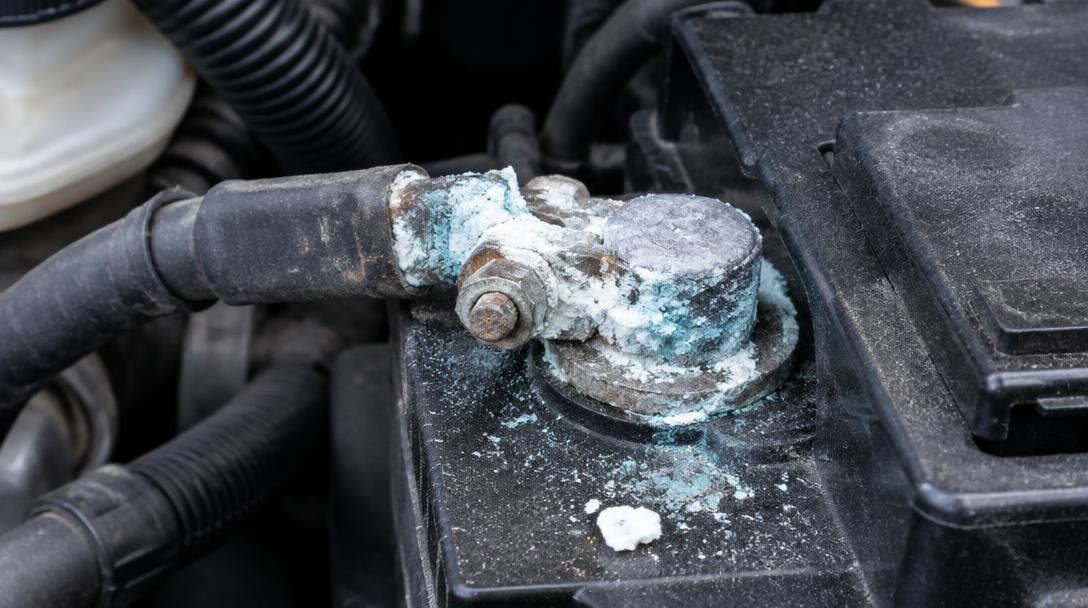
Quick answer: White, blue, or green buildup around a battery terminal can interfere with the connection between the battery and its cable. A small deposit does not automatically mean the battery is bad, but heavy corrosion, damaged cables, leakage, or repeated starting trouble deserves professional attention rather than a quick cosmetic cleanup.
What that crust around the battery connection is
A battery terminal is a high-current connection, not merely a place to attach a cable. The metal surfaces need secure contact so starting current can move with little resistance. Deposits around that joint can hide deterioration, prevent a sound connection, or indicate that nearby materials have been exposed to corrosive conditions.
The powder is not ordinary driveway dirt. Battery-related chemical reactions and moisture can produce deposits on terminal hardware and surrounding metals. Their appearance varies with the materials involved. White crust and blue-green material are familiar examples, but color alone cannot establish whether a battery is leaking, charging incorrectly, or simply overdue for connection maintenance.
Interstate’s battery-corrosion guidance emphasizes eye protection, gloves, ventilation, and careful cleaning. That safety framing matters more than finding the strongest household cleaner. Treat unknown residue as potentially hazardous, avoid skin contact, and keep children and pets away from the work area.
Visible corrosion and a defective battery are different findings. A serviceable battery may have dirty connections, while a clean-looking battery may have an internal problem. The goal is to determine whether the entire connection remains electrically and mechanically sound, then assess the battery separately if the symptoms require it.
Why a small connection can cause a large problem
Starting an engine requires substantial current for a short period. A connection with increased resistance can behave acceptably under a small load but lose too much voltage when the starter operates. That helps explain why interior lights may work even though the engine will not crank normally.
The same connection participates in charging. If the path between the battery and the vehicle’s electrical system is compromised, a battery may not receive or deliver energy as expected. Simply replacing the battery without evaluating the connection risks leaving the original restriction in place.
Resistance can also produce heat under load. Discolored hardware, melted insulation, or a hot connection is more serious than a light coating of surface residue. Do not use your hand as a temperature probe. If you notice smoke, a burning smell, or visible melting, stop operating the vehicle and seek help.
A terminal can look clean at its exposed edges while corrosion remains between mating surfaces. Conversely, a dramatic-looking deposit on nearby hardware does not measure voltage loss. Proper inspection and electrical testing answer different questions; a good diagnosis uses both rather than treating appearance as the entire story.
Western-suburb weather adds inspection reasons, not a diagnosis
Chicago-area winter driving brings moisture, road spray, and salt into the vehicle’s environment. Exposed connections and grounds elsewhere on the vehicle can suffer from that exposure. However, it would be inaccurate to blame every deposit at an underhood battery terminal directly on salt from Roosevelt Road.
Battery venting, previous service, damaged seals, incompatible hardware, and moisture around the connection can all matter. The pattern and location of corrosion help a technician decide what to investigate. A recurring deposit at the same post deserves more thought than repeatedly brushing it away without examining the surrounding parts.
Pothole impacts on local roads are another reason to keep mounting hardware intact. A battery should be securely retained by its intended hold-down, not supported by the cables. Movement can strain connections and damage the case. Do not improvise a clamp or wedge material against the battery as a substitute for the correct mounting arrangement.
For someone traveling between Bellwood and Hillside on brief winter errands, a marginal connection may become noticeable during repeated starts. The driving pattern does not prove corrosion is responsible, but it gives useful context. Record when the symptom occurs and whether the vehicle’s electrical power seems to cut out abruptly.
Begin with a visual check, not a wrench
Park on a stable surface, apply the parking brake, switch the vehicle off, and follow the owner’s manual’s shutdown instructions. Keep the key or remote away as directed. Some vehicles retain electrical activity after shutdown, and hybrids or electric vehicles may be ready to move without obvious engine noise.
Locate the battery only if access is straightforward. If covers, seats, or specialized panels must be removed, leave the inspection to someone familiar with that vehicle. Remote jump-start posts are not necessarily the battery itself, and a clean remote post does not establish the condition of hidden battery connections.
Look without touching. Note residue, damaged insulation, a cracked terminal clamp, an obviously displaced hold-down, or wetness near the case. Take a clear photograph from a safe position if you want to show a mechanic. Do not reach near fans or belts; some electric fans can operate unexpectedly.
Do not deliberately wiggle a heavily corroded terminal to see whether it is loose. A weakened clamp or post may fail, and creating a spark near a battery is unsafe. If you cannot identify the positive and negative connections confidently, that alone is a good reason to stop before attempting service.
When cleaning is reasonable and when it is not
Minor external buildup on an accessible, undamaged conventional starting battery may be a manageable maintenance task for an experienced owner who has the correct instructions and protective equipment. That is a narrower situation than “there is white powder under the hood.” The battery, cable, access, and shutdown procedure all have to be suitable.
Do not attempt cleaning when the battery is swollen, leaking, cracked, unusually hot, or suspected to be frozen. Significant cable deterioration, missing hardware, or residue entering a complex fuse assembly also calls for professional evaluation. Cleaning cannot repair a broken case, rebuild damaged cable strands, or restore a terminal that no longer clamps properly.
Modern vehicles can require specific precautions when battery power is interrupted. Stored settings, security functions, and control-system procedures may be affected. An improvised memory-saver connection can keep circuits energized while you think the vehicle is disconnected, so do not add one casually to a do-it-yourself procedure.
If you do not have an applicable manufacturer procedure, the safest owner-level action is observation and arranging service. Choosing not to disturb a hazardous connection is sensible maintenance, not neglect. The visible deposit gives you a reason to investigate; it does not create an obligation to handle battery chemicals yourself.
What controlled terminal cleaning should accomplish
For a suitable vehicle, a proper procedure isolates power in the sequence specified by the manufacturer and prevents tools from bridging the positive connection to grounded metal. On conventional negative-ground vehicles, disconnecting negative first and reconnecting it last reduces an important short-circuit risk, but vehicle-specific instructions still govern the job.
Cleaning should remove contamination from the intended contact surfaces without sending liquid or debris into battery openings, electronics, or surrounding components. Avoid compressed air that spreads residue. Do not pour a household mixture across the entire engine compartment, and never allow a neutralizing solution to enter the battery.
The finished joint needs sound hardware and the specified tightening torque. Too loose can leave resistance and movement; too tight can damage the clamp or post. A clamp that bottoms out without gripping is not fixed by ever more force. It may require an appropriate replacement part.
Any protective product belongs where its instructions permit it. Coating exposed hardware after a clean, secure connection is different from trapping contamination between the electrical contact surfaces. The job is complete only when the connection is mechanically sound and the original symptom has been evaluated, not when the case looks tidier.
Why corrosion sometimes returns quickly
A small amount of residue can recur with time, but rapid or heavy recurrence deserves investigation. An imperfect seal around a post, continuing exposure to moisture, damaged hardware, or a charging concern may be contributing. The location of new deposits and the time since cleaning are useful details to record.
Corrosion can also travel into a cable under its insulation. A freshly cleaned terminal may hide stiff, swollen, or deteriorated cable material farther back. Repair decisions should consider the condition of the whole affected section, not just the exposed ring or clamp that is easiest to polish.
A technician may use a voltage-drop test under load to assess how much voltage is being lost across a connection or cable. That is different from merely checking battery voltage with the engine off. It helps connect an observed defect to an actual electrical restriction rather than assuming that all visible residue is causing the complaint.
Interstate recommends regular terminal and cable inspection alongside battery testing. Keeping a dated photograph after service can help show whether a deposit is gradually accumulating or returning unusually fast. There is no benefit in repeatedly removing cables just to see whether the surfaces still look shiny.
Deciding whether to drive or arrange help
A light deposit without symptoms usually allows time to schedule an inspection, provided the battery appears intact and secure. Avoid treating that general guidance as clearance for a visibly damaged connection. The severity of the condition and the vehicle’s behavior matter more than the amount of white powder alone.
Repeated loss of power, unreliable starting, a visibly loose or broken terminal, or damaged cable insulation calls for prompt attention. If there is smoke, active arcing, strong fumes, or a hot and distorted battery, do not continue operating or attempt a jump-start. Move people away and request appropriate help.
Bosch describes visual inspection, performance testing, and charging checks as different parts of battery evaluation. That broader approach helps avoid two opposite mistakes: replacing a sound battery because its terminals are dirty, or cleaning terminals while ignoring a battery that is physically unsafe.
Before seasonal travel, include the accessible battery area in your maintenance review. NHTSA’s winter preparation guidance recommends checking the battery and charging system. For Westchester and Broadview drivers, doing that before a demanding trip is more useful than discovering a compromised connection while preparing to leave a crowded parking lot.
Getting the connection evaluated in Hillside
Rios Auto Service provides battery and electrical service at 4218 Roosevelt Rd, Hillside, IL 60162. The independent, family-run shop is owned by Juan Rios. Explain whether you noticed buildup during a routine look under the hood or after an actual interruption in starting or electrical power.
Ask for an honest inspection and to see what was found. Useful questions include whether the clamp is still sound, whether the cable is affected beyond its exposed end, and whether the battery needs testing after the connection is addressed. Those questions keep a repair discussion specific and avoid a parts list based only on appearance.
Walk-ins are welcome Monday through Friday, 8 AM–6 PM, and Saturday, 8 AM–4 PM; Sunday is closed. Call (708) 632-4808 or use the contact page. Do not drive a vehicle with an active electrical hazard merely to reach the shop; arrange safe assistance instead.
Frequently asked questions about terminal corrosion
Does white powder mean I need a new battery?
Not necessarily. External deposits can occur on a battery that remains usable. The battery’s physical condition, test results, and the condition of its connections determine the appropriate response. Leakage or a damaged case changes the situation substantially. Cleaning should never be used to disguise a defect that makes the battery unsafe.
Can I pour soda over the terminals?
It is not a controlled repair method. Sugary liquid can leave residue and spread contamination into places it does not belong. Follow an appropriate battery-cleaning procedure instead, or have the connection serviced. The important tasks are safe isolation, effective cleaning, hardware inspection, and correct reassembly, not producing a visible fizz.
Why is there corrosion on only one connection?
Different local conditions and materials can produce an uneven pattern. One-sided corrosion is useful inspection information, but it is not a reliable stand-alone test for overcharging, undercharging, or battery failure. Tell the technician which connection was affected and how quickly deposits returned after any previous cleaning.
Will protective spray fix a loose terminal?
No. A coating cannot restore mechanical grip or replace damaged metal. The connection must be clean, sound, and tightened correctly before any suitable protective product is considered. If the clamp has stretched, cracked, or lost material, it needs an appropriate repair rather than another layer of spray.
Related question
If a vehicle will not start away from home, read Jump-Starting Safely in a Parking Lot before deciding whether a boost is appropriate.