
Battery & Electrical
Battery Registration on Newer Cars
Battery registration tells a newer car that its battery has been replaced. Hillside drivers can learn when a reset, coding, or neither is needed.
By the team at Rios Auto Service, Hillside, IL · · 9 min read
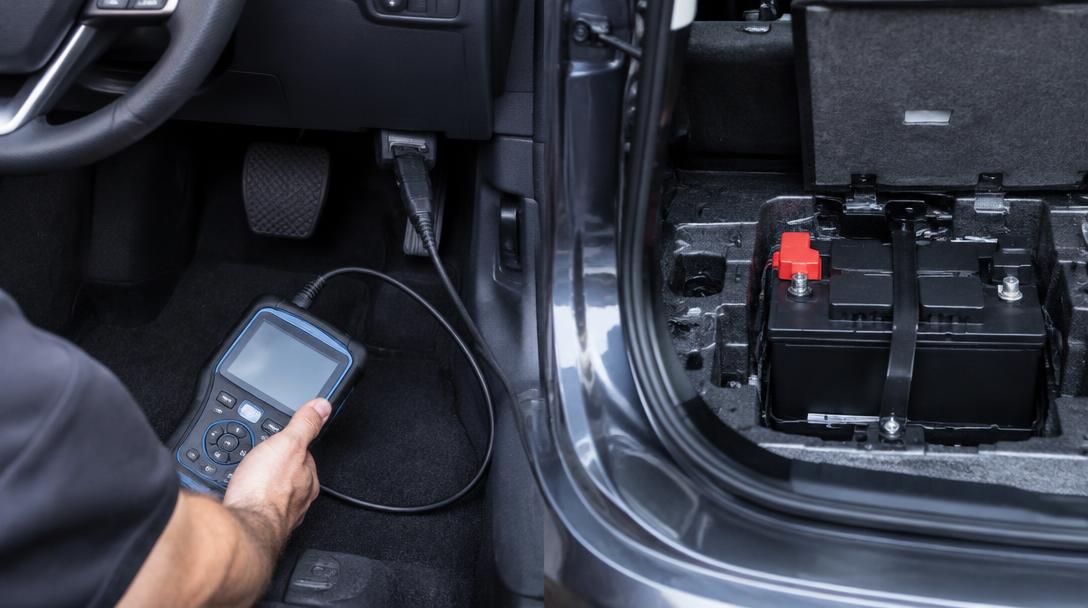
Quick answer: Battery registration is a vehicle-specific procedure that tells the battery-management system a replacement battery has been installed. Some cars require a diagnostic-tool function, some specify a manual reset or learning period, and others require no registration at all. The correct answer comes from the exact vehicle's service information, not simply its age or brand.
Why installing the battery may not finish the job
Years ago, many battery replacements ended after fitting the right battery and securing its connections. On some newer vehicles, there is an electronic step as well. The car may track battery use and adjust electrical management around what it believes is still the original, aging battery.
Replacing the physical battery does not necessarily update that stored information. Registration, adaptation, or a sensor reset can establish a new starting point. The terminology varies between manufacturers, which is why two repair estimates can use different words for related work. Ask what the actual procedure does rather than judging it by its label alone.
Ford describes a battery-management system that preserves battery power when the engine is off. Such systems illustrate why the battery is no longer just an isolated box under the hood. It participates in a larger strategy for electrical loads, available energy, and reliable starting.
This does not mean every newer car needs paid programming. Nor does it mean a battery cannot be replaced outside a dealership. It means the replacement process should be checked against the manufacturer's instructions for that particular vehicle. Skipping that lookup invites both unnecessary charges and genuinely incomplete work.
What the car is trying to keep track of
A battery sensor may measure current, voltage, and temperature, with the exact arrangement depending on the vehicle. The control system uses that information to estimate charge level and available battery performance. Those estimates can influence charging requests, accessory operation, and whether automatic stop-start is permitted.
The system does not directly look inside the battery and count every chemical change. It works from measurements and learned information. If the physical battery changes but the stored history does not, the assumptions behind energy management may no longer fit. A specified replacement reset helps align the electronic record with the installed part.
Registration is not a repair for a defective battery. It cannot restore missing capacity, correct a loose cable, or make an unsuitable replacement compatible. Think of it as completing the installation record, not increasing the battery's physical strength. The new battery must already be correct and in suitable condition.
It also is not the same as clearing every warning light. A successful replacement routine may leave unrelated faults that need separate attention. Conversely, the absence of a dashboard warning does not prove registration was completed. The useful evidence is the required procedure and its documented outcome, not whether the instrument panel looks calm.
Registration, coding, and learning are different steps
Registration commonly records that a battery has been renewed. Coding or configuration, where supported, identifies characteristics such as battery technology or capacity. A learning period lets a system update estimates from measurements over time. One vehicle may require more than one of these steps, while another uses only one.
Suppose the old battery and replacement have the same approved specification. The car may need only a replacement reset. If an approved change in capacity or technology is being made, configuration may also be necessary. An unsupported change does not become acceptable just because a scan tool offers a menu that looks relevant.
A relearn after reconnection is another source of confusion. Clocks, window initialization, steering-related calibrations, and idle adaptations can have separate instructions. Their presence does not establish that the battery-management reset happened. Ask the shop to distinguish battery-specific work from other procedures needed because electrical power was interrupted.
An owner's manual may describe a manual reset on one model and a learning period on another. Service information may reserve additional procedures for diagnostic equipment. Broad internet advice often collapses those differences into “all cars need coding” or “just disconnect it longer.” Neither is a reliable rule.
How to establish what your exact vehicle needs
Start with the year, make, model, powertrain, and vehicle identification number. Equipment can vary within a model year, and the original battery type may differ between engines or electrical packages. A recommendation based only on the badge on the grille is not specific enough to settle the question.
One Ford owner's-manual resource explicitly provides a battery-sensor reset after installation. That is evidence that a manual procedure exists for that application, not permission to apply the same sequence to every Ford. The resource itself cautions that vehicle equipment and manual versions can differ.
Look for sections covering the 12-volt battery, battery replacement, battery sensor, power management, and automatic stop-start. If the owner's information does not resolve the issue, the next step is application-specific service information. Silence in one short manual section is not proof that no workshop procedure exists.
Before authorizing a replacement, ask three practical questions: Is a reset required for this vehicle? Does the proposed battery match the specified type and capacity? What confirmation will show the procedure was completed? A clear answer should describe the task without turning it into mysterious software work.
Correct battery selection comes before any reset
The replacement must fit the tray and hold-down, present the terminals correctly, and meet the vehicle's electrical requirements. Venting matters where the battery is installed inside a passenger or luggage compartment. Physical fit is only one part of compatibility, especially when the car uses frequent automatic restarts.
Absorbent glass mat, enhanced flooded, and conventional flooded batteries are not automatically interchangeable. Use the specified technology or an explicitly approved alternative. A battery that starts the engine today may still be unsuitable for the vehicle's cycling demands or charging strategy. Registration cannot erase that mismatch.
Bosch's battery-check guidance emphasizes inspecting condition and testing performance as part of battery service. That remains important even when electronic procedures are involved. A new part should not be assumed healthy solely because it has never been installed before.
The sensor and its wiring also need to remain correctly connected. On vehicles with a current sensor at the battery connection, accessory wiring or charger connections may need designated points so current is measured as intended. Follow the vehicle instructions; do not relocate wiring based on a generic photograph from a different model.
Why this matters during Hillside driving
Consider a Westchester driver whose routine includes short trips along Wolf Road, repeated stops, and time parked between errands. The vehicle may manage electrical demand aggressively because opportunities to replenish charge vary. Accurate battery information helps that management system make decisions using the correct starting assumptions.
In Chicago winter conditions, the same driver may use heated glass, lights, and a strong blower during nearly every trip. NHTSA recommends checking the battery and charging system before winter. Completing a required replacement reset is part of following the vehicle's replacement process, not a substitute for that basic readiness check.
Automatic stop-start may remain unavailable temporarily after replacement for reasons other than a missed reset. Battery charge, temperature, cabin heating demand, and other manufacturer-defined conditions can prevent an automatic engine stop. One commute on I-290 is not a controlled verification of every enabling condition.
Avoid treating a disabled convenience feature as proof of one particular mistake. Record when the behavior began and whether any warning message appears. The sensible sequence is to verify battery specification, installation, required electronic procedures, and current system status. That is more useful than repeatedly resetting a system without finding out what it needs.
Safe owner checks and the limits of DIY
You can safely gather paperwork, photograph an accessible battery label with the engine off, and review the owner's manual. Note the part number, battery technology, rated capacity if shown, and replacement date. Do not pull apart trim, remove a seat, or disturb a protected terminal solely to find a label.
A generic code reader is not necessarily capable of battery registration. Reading engine trouble codes and performing a manufacturer-specific service function are different capabilities. Even a tool with a battery menu may support only certain models or modules. Confirm coverage before buying hardware or paying for a subscription.
Do not copy a manual reset sequence from a similar-looking vehicle unless its instructions explicitly apply to yours. A confirmation light or message may be required, and an incomplete sequence may simply do nothing. Repeating uncertain procedures can create confusion about what was actually completed and when.
Battery work also involves heavy components, high short-circuit current, and potentially hazardous gases or electrolyte. On hybrids and electric vehicles, the low-voltage battery remains separate from high-voltage equipment. Do not touch orange cables, high-voltage covers, or service disconnects. Leave unfamiliar access arrangements and electronic procedures to appropriately equipped personnel.
If the battery was already changed without registration
Do not assume immediate damage. The consequences depend on the vehicle and how its management strategy works. Some systems learn aspects of battery condition over time; others specify a deliberate replacement reset. The right response is to verify the required procedure and complete any missing step, not to predict disaster from a general article.
Gather the installation date, battery receipt, and any details about what was disconnected or configured. If the battery specification changed, say so. A technician needs to know whether the task is simply recording a replacement or also correcting an unsuitable part or configuration. Guessing the previous work makes the next decision harder.
Do not register an old battery as new simply to suppress a message. That tells the system something untrue about the hardware. Likewise, disconnecting the battery to “clear everything” may erase useful evidence without carrying out the proper reset. Preserve warning messages and diagnostic information before changes are made.
After the correct procedure, follow any specified sleep period or verification steps. Some checks are immediate; others depend on operating conditions. Ask what normal behavior should return, what may take time, and what symptoms justify returning. A documented expectation prevents an ordinary learning interval from being mistaken for another failure.
Discussing replacement at Rios Auto Service
Rios Auto Service is an independent, family-run business owned by Juan Rios, located at 4218 Roosevelt Rd, Hillside, IL 60162. Battery and electrical service is among its listed services. When calling about a newer vehicle, provide the exact vehicle details and ask whether its replacement procedure includes registration, configuration, or learning.
Ask for an honest inspection and a clear explanation of what was found before authorizing work. Request the replacement specification and any required electronic steps in the proposed scope. That is a practical way to avoid unnecessary extras without assuming that a genuine registration requirement is an upsell. No particular tool inventory or model coverage should be assumed before discussing the vehicle.
The battery and electrical service page provides the relevant service category. Walk-ins are welcome, and the shop is open Monday–Friday, 8 AM–6 PM, and Saturday, 8 AM–4 PM; Sunday is closed. Call (708) 632-4808 or use the contact page to explain what has been replaced and what remains uncertain.
Questions about battery registration
Does every car built recently need registration?
No. Model year alone does not establish the requirement. Different manufacturers, platforms, and powertrains use different replacement procedures. Check information for the exact vehicle rather than relying on a broad cutoff year. A modern dashboard or automatic stop-start feature is a reason to investigate, not a complete answer.
Is registration the same as registering a warranty?
No. Warranty registration concerns a product purchase and its coverage records. Vehicle battery registration concerns information stored in the car's electronic management system. Completing a manufacturer's online warranty form does not perform a vehicle reset, and a vehicle reset does not necessarily complete any product paperwork.
Can an independent shop perform it?
An independent shop can perform supported procedures with suitable equipment and correct service information. The question is coverage for your particular vehicle, not whether the building has a dealership sign. Ask about the required function before the work begins. Do not assume that every scan tool supports every battery-management system.
Will registration fix a battery that keeps going flat?
Only if a missing or incorrect replacement procedure is actually relevant to the problem. Registration does not recharge a depleted battery or repair electrical faults. Verify the replacement process, but do not use it as a universal explanation for every subsequent starting complaint. Measured results should guide the next step.
Related question
If the concern is identifying the failed component rather than completing a replacement, read Alternator or Battery? How to Tell.