
Battery & Electrical
Parasitic Drain: Battery Dead Every Morning
A battery that dies overnight may have an excessive key-off draw, not just old age. Learn safe checks and when Hillside drivers need electrical diagnosis.
By the team at Rios Auto Service, Hillside, IL · · 9 min read
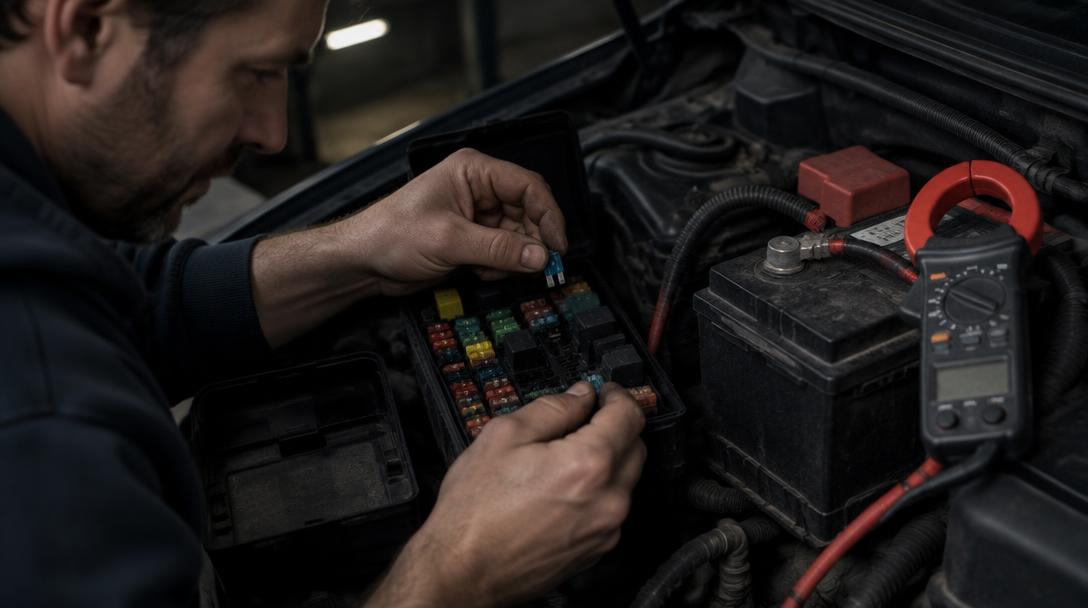
Quick answer: A battery that repeatedly dies overnight may have an excessive electrical draw after the vehicle is switched off, but an undercharged or failing battery can produce the same pattern. The right diagnosis checks battery condition and charging first, then measures key-off current after the vehicle has entered its normal sleep state.
Why an “off” car still uses electricity
Switching off the engine does not disconnect every electrical device. The clock, alarm, remote-entry receiver, and electronic memory functions may still need power. Modern vehicles also finish housekeeping tasks after you leave: modules exchange information, lights time out, and certain systems remain available briefly before settling down.
That background demand is expected. A parasitic-drain problem means consumption is excessive for that vehicle under the conditions being measured. The important distinction is not whether any electricity flows, but whether the amount and duration match the manufacturer's specifications. A measurement taken immediately after opening a door is not necessarily a meaningful sleep-current reading.
Interstate lists lights left on, aftermarket equipment, and nearby key fobs among possible causes of unwanted discharge in its charging and maintenance guidance. Those are useful starting points, not a verdict. A plugged-in device might be harmless in a switched outlet but stay powered continuously in another vehicle's always-live outlet.
An obvious lamp can cause trouble, but some drains leave no visible clue. A relay may remain energized, a module may fail to sleep, or a fault may repeatedly wake a communication network. Finding the responsible circuit is only part of the work; the next question is why that circuit remains active.
Overnight failure does not automatically prove a drain
Imagine two cars parked for twelve hours. One starts with a fully charged, healthy battery. The other starts with a battery already substantially discharged after several brief trips. The same ordinary background demand can leave very different starting reserves by morning. Timing alone cannot distinguish excessive consumption from insufficient stored energy.
Battery condition matters separately from charge level. Charging may restore energy to a serviceable battery, but it cannot necessarily restore capacity lost through deterioration. Conversely, a healthy battery that has been repeatedly discharged should not be condemned solely because a test was performed while it was nearly empty.
A sensible starting point is an inspection and an appropriately interpreted battery test. Bosch describes visual inspection and performance testing in its battery-check overview. Depending on the battery's condition, charging and retesting may be necessary before deciding whether it can support further diagnosis reliably.
The charging system also needs consideration. A vehicle can arrive running yet have failed to replenish the battery adequately. Replacing the battery without checking the overall energy balance may buy a few mornings rather than solve the problem. The goal is to establish whether energy is missing because it never went in, leaked out through a load, or could no longer be stored effectively.
What the pattern looks like around Hillside
A short drive along Roosevelt Road followed by another cold start can leave little opportunity to recover from an earlier discharge. Add a heated rear window, cabin blower, and lights, and a marginal energy balance becomes more noticeable. That does not mean ordinary winter accessories are defective; it means driving history belongs in the diagnosis.
Cold weather also reduces the available starting margin. NHTSA's winter-driving guidance recommends checking the battery and charging system because low temperatures affect battery power and starting demands. An existing key-off draw may therefore become obvious during a Chicago cold spell even if the underlying fault began earlier.
Compare overnight parking with other stops. Does the car start normally after a full workday near a Bellwood Metra station but fail after a shorter night at home? Consider what changes: where the key is stored, whether a charger or camera stays connected, whether the doors lock normally, and whether the vehicle is used differently beforehand.
Those observations are clues, not instructions to leave the vehicle unsecured. Keep normal security precautions in place. A consistent record of parking duration, weather, and accessories gives a technician something better than “it happens sometimes.” If possible, note the last successful start as well as the first failure.
Safe checks before anyone reaches for a meter
Begin with the owner's manual and a walk around the parked vehicle. Look for a dome light, cargo light, or vanity light that remains on longer than expected. Check that doors and the liftgate close normally and that the dashboard does not report an open latch. Do not defeat latches or wedge switches to imitate a closed vehicle.
Remove removable accessories from ordinary power outlets when parked: a phone adapter, portable navigation unit, or plug-in accessory can be an easy variable to eliminate. Follow the device instructions, particularly if a dash camera uses a parking mode. Leave hardwired equipment alone if isolating it requires disturbing wiring or safety-related systems.
Store the key or remote where the manufacturer recommends, rather than immediately beside the parked car. Avoid repeatedly checking the vehicle through its phone app during an observation period. Depending on the vehicle, remote requests can wake systems and change the very behavior you are trying to understand.
Write down recent changes. A new radio, alarm, tracking device, collision repair, water leak, or software update may be relevant, but timing does not prove causation. Tell the shop what changed without assuming the newest part must be guilty. That keeps the investigation open to a preexisting fault or an unrelated battery problem.
Why DIY current testing can create misleading results
An ammeter is not used like a voltmeter. Putting an ordinary meter across a battery while it is configured to measure current can create a short circuit. Starting the engine through a meter connected in series can overload the instrument and its leads. This is not a good trial-and-error task for someone unfamiliar with electrical testing.
Even a correctly connected instrument can disturb the evidence. Disconnecting the battery may reset a stuck module temporarily. Opening a door can wake the network. Pulling and replacing fuses can restart modules, producing current spikes that were not present before. A seemingly successful test may therefore hide an intermittent fault rather than identify it.
A suitable low-current clamp or another manufacturer-appropriate method can help preserve the vehicle's state. Some diagnostic procedures use voltage measurements across installed fuses to narrow down active circuits. Tool resolution, fuse characteristics, temperature, and access all affect interpretation; the procedure must fit the vehicle rather than a generic online checklist.
For an owner, the safest useful contribution is usually observation, not circuit isolation. Do not disconnect an airbag circuit, probe orange high-voltage wiring, or remove random fuses overnight. A missing fuse can disable something important and introduce new trouble codes without proving what originally discharged the battery.
What a meaningful draw measurement establishes
There is no single current limit that fits every vehicle at every moment. Equipment, software, connected services, and the manufacturer's specified sleep interval matter. A brief wake-up event also differs from a constant load. Diagnosis may require watching both the settled current and any recurring activity over a longer period.
Time makes small-looking numbers important. Interstate defines amp-hours as current multiplied by time in its battery glossary. For illustration, a continuous half-amp load uses six amp-hours over twelve hours. That arithmetic describes energy removed; it does not tell you exactly when a particular car will stop starting.
Available reserve depends on charge level, temperature, battery condition, and the engine's starting requirement. A small normal draw may take considerable time to trouble a healthy, charged battery. A larger unintended load can exhaust a weakened one much sooner. Avoid conclusions based on a battery label alone or a universal “acceptable milliamps” number.
Once an abnormal draw is confirmed, testing should identify the circuit and then the actual cause. A module drawing current may be responding correctly to a faulty switch or a message from another module. Replacing the device that appears awake without understanding what woke it can leave the original fault untouched.
When to arrange diagnosis instead of another jump
Repeated overnight failures deserve attention even if the vehicle starts after assistance. Repeated deep discharges can further damage a starting battery, creating a second problem alongside the original draw. A successful restart establishes only that the engine started on that occasion; it does not certify the battery or eliminate an electrical fault.
Stop using the vehicle if you notice smoke, a burning smell, melted wiring, or a hot or visibly damaged battery. Keep away from a swollen, leaking, or potentially frozen battery, and seek professional assistance. Do not charge or jump a battery you suspect is frozen. Those conditions move the situation beyond routine troubleshooting.
An intermittent drain may require the car to remain parked long enough for the symptom to occur. Ask about that possibility before arranging transportation around an appointment. A ten-minute check cannot always reproduce something that happens only after several hours, a particular lock sequence, or an occasional remote-system wake-up.
Bring notes rather than a pile of replacement parts. Useful details include parking duration, accessory use, prior battery tests, how often the battery has gone flat, and whether the problem changed after a repair. If there is an aftermarket device, bring its instructions or installation paperwork if available.
Discussing the problem with Rios Auto Service
Rios Auto Service is an independent, family-run shop owned by Juan Rios at 4218 Roosevelt Rd, Hillside, IL 60162. Its battery and electrical service is the relevant starting point for discussing repeated overnight discharge. Describe the parking pattern and failed starts rather than requesting a battery solely because the car needed a boost.
Ask for an honest inspection and to see the findings before authorizing parts. Useful questions are whether the battery was sufficiently charged for testing, whether excessive key-off consumption was actually measured, and what evidence connects a proposed repair to the symptom. This keeps the conversation focused on solving the failure without unnecessary replacements.
Walk-ins are welcome Monday through Friday, 8 AM–6 PM, and Saturday, 8 AM–4 PM; Sunday is closed. Call (708) 632-4808 or use the contact page to discuss the situation. Mention if the vehicle repeatedly needs assistance so you can plan appropriately rather than assume it will restart after your next stop.
Frequently asked questions about overnight battery drain
Can a new battery still die from a parasitic drain?
Yes. A new battery supplies a fresh reserve, but an excessive load can discharge it too. A temporary improvement after replacement does not prove the old battery was the only problem. If the same overnight pattern returns, ask for testing of charge level, battery health, and key-off consumption rather than assuming another replacement will solve it.
Will a longer drive fix the problem?
It may improve charge level under suitable conditions, but it does not repair an unwanted load. A deeply discharged battery may need appropriate external charging rather than an assumed number of highway miles. Do not use a drive on I-290 as a diagnostic experiment when the vehicle has electrical warning signs or unreliable operation.
Should I disconnect the battery every night?
Not as a substitute for diagnosis. Disconnecting may erase useful evidence, reset vehicle functions, and create manufacturer-specific relearn requirements. It also does not establish why the battery discharged. If temporary isolation is being considered for storage or safety, follow the owner's manual and qualified guidance rather than improvising a daily routine.
Can a drain happen only some nights?
Yes. An intermittent switch, moisture-related fault, accessory mode, or module wake-up may depend on conditions that are not present every evening. Keep the parking routine and symptom notes consistent. A normal reading during one brief inspection does not rule out an occasional problem, which is why longer monitoring can be necessary.
Related question
If the engine still turns but struggles to do so, read Slow Crank: Starter or Battery?.