
Battery & Electrical
Jump-Starting Safely in a Parking Lot
A safe parking-lot jump starts with a damage check and your vehicle’s instructions. Learn when Hillside drivers can try a boost and when to stop.
By the team at Rios Auto Service, Hillside, IL · · 9 min read
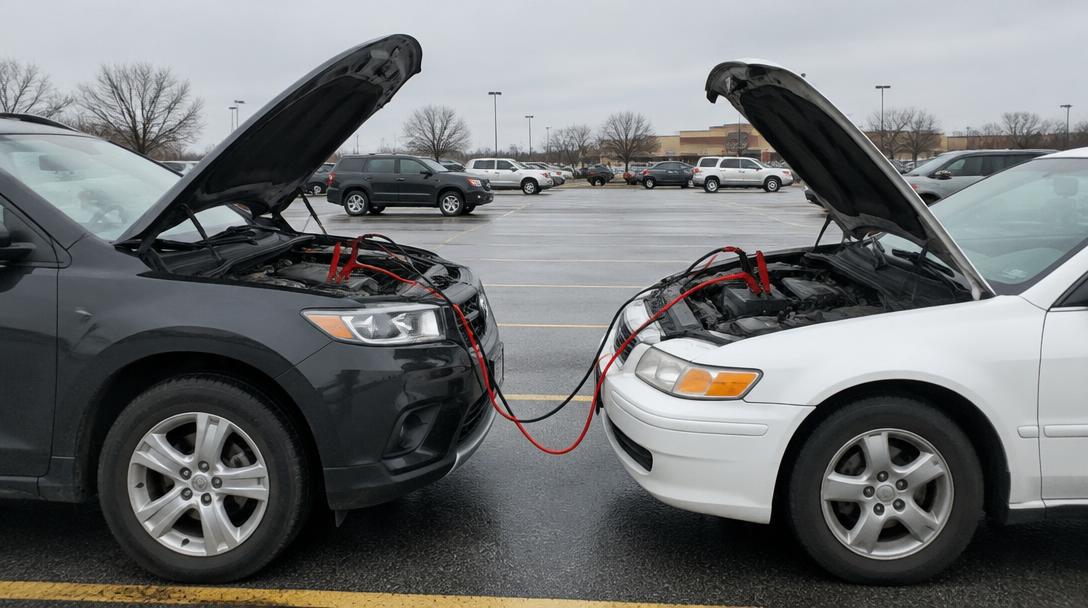
Quick answer: Jump-start only when the parking area is safe, the battery appears undamaged, and your vehicle’s instructions permit it. Use the specified voltage, connection points, and sequence; stop if the battery may be frozen, leaks, smokes, or gives off a strong unusual odor. A successful boost gets the engine running, but it does not establish why the vehicle needed help.
What a parking-lot jump actually does
A jump supplies outside electrical power so a vehicle with insufficient starting power may start. It does not repair a damaged cable, restore a failing charging system, or prove that the battery needs replacement. Think of it as a controlled attempt to restore operation, not a diagnosis or a permanent solution.
The starter needs much more current than the cabin lights. That is why a glowing dome light does not establish that enough power is available to crank the engine. Conversely, normal-speed cranking without the engine firing is not the usual reason to reach for jumper cables. More electrical power may not address that problem.
Battery chemistry also makes this more than a matter of matching colors. Lead-acid batteries can release flammable gas, and incorrect connections can create sparks or damage electronics. Your owner’s manual takes priority over a remembered procedure from an older car. Remote starting terminals, battery-monitoring sensors, and unusual battery locations make the exact vehicle instructions important.
Make the space safe before opening either hood
In a crowded lot near Oakbrook Center or along Roosevelt Road, the first question is whether you can work without standing in a traffic aisle. A disabled car is inconvenient; a person squeezed between moving vehicles is in danger. If the vehicle is exposed to traffic, request assistance rather than trying to complete the jump quickly.
Use parking brakes and the specified parked gear position. Keep the vehicles from touching. Position the donor vehicle only where the cables can reach without stretching or crossing a pedestrian route. Never push a vehicle into traffic to make a short cable reach, and do not stand between vehicles while someone maneuvers into place.
Turn off unnecessary accessories and follow both manuals’ instructions about ignition state before connecting anything. Keep children, pets, loose clothing, and bags away from the work. Remove metal jewelry and wear suitable eye protection. Have enough light to read actual terminal markings rather than guessing beneath a dark hood.
Do not run engines in an enclosed garage or another poorly ventilated space. Outside, consider where exhaust is going and where people are waiting. Snowbanks can obstruct a tailpipe, so check that exhaust can escape before starting. If someone feels dizzy or ill around exhaust, move into fresh air and seek appropriate help.
Chicago cold can turn a routine boost into a stop sign
A discharged battery is more vulnerable to freezing than a charged one. After a hard freeze, do not assume a battery is safe because the case has not obviously split. If freezing is plausible, especially after prolonged discharge in severe cold, stop and have it assessed rather than using a boost to test the theory.
Never jump a visibly cracked, swollen, leaking, or unusually hot battery. Smoke, hissing, strong sulfur-like odor, or damaged cables are also reasons to step away. Do not lean over the battery to investigate a smell. Avoid flames and smoking nearby, and do not try to thaw a battery with direct heat.
NHTSA’s winter-driving guidance recommends checking the battery and charging system before winter travel. That preparation matters for western-suburb drivers making short winter trips: a cold-soaked vehicle and repeated starts leave little margin when available starting power is already low. Still, weather alone does not identify the failed component.
There is no obligation to proceed simply because a helpful stranger has cables. You can decline if their equipment is damaged, the instructions are unavailable, or the location feels unsafe. Moving the repair decision to a safer setting is a successful outcome, even when the engine remains off.
Confirm compatibility before picking up a clamp
Read the jump-start section for your exact vehicle and check the donor vehicle’s instructions too. Confirm the required low-voltage system and whether the donor may be used for this purpose. Do not mix incompatible systems. If you cannot identify the designated terminals and ground point confidently, wait for qualified help.
A battery hidden beneath a seat or luggage-floor panel does not automatically need to be uncovered. Many vehicles provide remote connections under the hood. Use those when directed. A random bolt that looks substantial may be painted, poorly grounded, or attached to a component that cannot safely carry starting current.
Hybrids and electric vehicles need particular care. Their low-voltage system is separate from the propulsion battery, and a vehicle that appears silent may still be ready to move. Never touch orange high-voltage cables or try to connect a jump source to the traction battery. Do not assume an electrified vehicle can serve as a donor.
Inspect the jumper cables before using them. Loose clamps, exposed conductor, melted insulation, or badly damaged jaws are reasons to choose different equipment. Keep the cables away from belts, fans, and hot exhaust parts. Electric cooling fans may operate unexpectedly, so their area is not a safe place to rest a cable.
A conventional cable sequence, with the manual in charge
For many compatible negative-ground, 12-volt conventional vehicles, the familiar sequence begins with both vehicles switched off and secured. This is an overview, not permission to override either manufacturer’s procedure. If either manual calls for different connection points, operating steps, or restrictions, use those instructions instead.
- Connect a red clamp to the disabled vehicle’s designated positive jump terminal.
- Connect the other red clamp to the donor’s designated positive terminal.
- Connect a black clamp to the donor’s designated negative terminal or specified connection.
- Make the final black connection at the disabled vehicle’s specified ground point, away from the battery as directed.
Verify the plus and minus symbols before each connection. Cable color is a useful reminder, not proof of polarity. Never let connected clamps touch each other, and never allow a positive clamp to contact vehicle metal. Do not substitute a fuel-system component, hood latch, or convenient thin bracket for the designated ground.
One Ford owner-manual procedure specifically requires a jump-start ground stud and warns against using the hood latch. Its engine-running instructions are also model-specific. That is a useful illustration of why a generic internet sequence cannot settle every detail for every car in the lot.
Once the connections are secure and routed safely, follow the manuals for starting the donor and then attempting the disabled vehicle. Observe the specified crank duration and waiting intervals. Do not keep the starter engaged through repeated long attempts. Stop for smoke, hot cables, abnormal arcing, or any unexpected behavior rather than trying to force a result.
Disconnect carefully, even after the engine catches
A running engine can make everyone relax too soon. Keep hands and cables clear of moving components while following the required waiting period and removal instructions. In a conventional procedure, removal is the reverse of connection: disabled-vehicle ground first, donor negative next, then donor positive and disabled positive. Your vehicle’s specified sequence remains controlling.
Handle one clamp at a time and prevent the loose ends from contacting each other or metal. Do not reach across belts or a fan to retrieve a poorly routed cable. If routing has become unsafe, get help rather than putting a hand into a moving mechanism. Secure terminal covers afterward and remove every tool before closing the hood.
Interstate’s jumper-cable guidance treats a jump as temporary assistance and recommends follow-up testing. That distinction is easy to miss when the engine finally starts. Before pulling out of the space, look for persistent warning lights, unusual smells, or electrical behavior that suggests the vehicle should not be driven.
Using a portable pack without bypassing its safeguards
A portable jump pack avoids positioning a second vehicle, but it is not automatically suitable for every engine or battery system. Check its voltage, application limits, charge level, cable condition, and operating-temperature instructions. Use both the pack’s manual and the vehicle’s designated jump points; neither replaces the other.
Keep the pack stable and clear of moving or hot parts. Connect and activate it in the manufacturer’s order, observe the allowed starting attempts, and switch it off before removal when instructed. If the pack refuses to operate, check the displayed warning and instructions instead of repeatedly moving the clamps around until something happens.
Some packs have an override for batteries their electronics cannot detect. That setting may disable protective functions and should not be treated as the ordinary next step. If polarity, battery condition, or the reason for refusal is uncertain, stop. Interstate’s portable-jump-starter overview is a useful introduction, but the instructions supplied with your exact pack control its operation.
Decide what happens after the parking-lot rescue
There is no universal drive time that guarantees a deeply discharged battery is fully restored. A brief loop through Hillside or an idle in the parking space may leave it undercharged. Appropriate charging and testing are more informative than assuming that twenty minutes of engine operation has solved the problem.
If the vehicle stalls, the charging warning stays on, or important electrical systems behave abnormally, do not head onto I-290 hoping the drive will fix it. Arrange assistance. A second jump is not a sound plan for a vehicle that cannot reliably remain running, and an expressway shoulder is a much worse place to reassess the situation.
Even when everything seems normal, note what happened before the no-start: lights left on, an extended period parked, recent service, or an unexplained shutdown. Record whether the starter clicked, cranked slowly, or did not respond. Those details help separate an isolated discharge from a problem that needs further investigation without guessing at a replacement part.
Following up with Rios Auto Service in Hillside
Rios Auto Service offers battery and electrical service at 4218 Roosevelt Rd, Hillside, IL 60162. The independent, family-run shop is owned by Juan Rios. Explain that the vehicle needed a parking-lot jump and describe any warning lights or changes after it started.
Ask for an honest inspection and to see what was found before authorizing repairs. Useful questions include whether the battery needs controlled charging before assessment, whether the connections are sound, and whether charging-system checks are indicated. The goal is an explanation tied to the symptom, not replacement of every electrical part that could conceivably be involved.
Walk-ins are welcome Monday through Friday, 8 AM–6 PM, and Saturday, 8 AM–4 PM; Sunday is closed. Call (708) 632-4808 or use the contact page to discuss the situation. Do not drive an electrically unsafe vehicle to the shop merely because a jump got it moving.
Frequently asked questions about parking-lot jumps
Can rain make a jump-start unsafe?
Rain does not automatically prohibit a jump, but standing water, poor visibility, slippery footing, and wet or damaged equipment can make the situation unsuitable. Follow the equipment’s weather restrictions. Never attempt the procedure in floodwater or around submerged electrical equipment. Waiting for safer conditions is better than rushing through unreadable markings.
Does a successful jump mean the battery is bad?
No. It shows that outside power helped restore starting under those conditions. Discharge, connection problems, and other electrical faults still require evaluation. Replacing the battery solely because the engine accepted a boost can leave the actual problem unresolved.
Should I rev the donor engine hard?
Do not improvise engine speed. Some manuals specify a particular operating speed or waiting period; others use different instructions. Excessive revving is not a substitute for compatible equipment and correct connections. If you cannot find the procedure for both vehicles, choose qualified assistance instead.
What if it still will not start?
Stop after the permitted attempts. Recheck the instructions only if it is safe, but do not bypass safeguards, swap polarity, or keep cranking. Normal cranking without ignition may indicate a problem a jump cannot address. Describe the response when requesting help.
Related question
If the engine starts but the instrument panel still behaves strangely, read Flickering Dash Lights and Electrical Gremlins.