
Battery & Electrical
Why Car Batteries Die on the First Cold Snap
Cold weather reduces battery output just as your engine needs more starting power. Learn why Hillside cars fail and what to check before winter arrives.
By the team at Rios Auto Service, Hillside, IL · · 9 min read
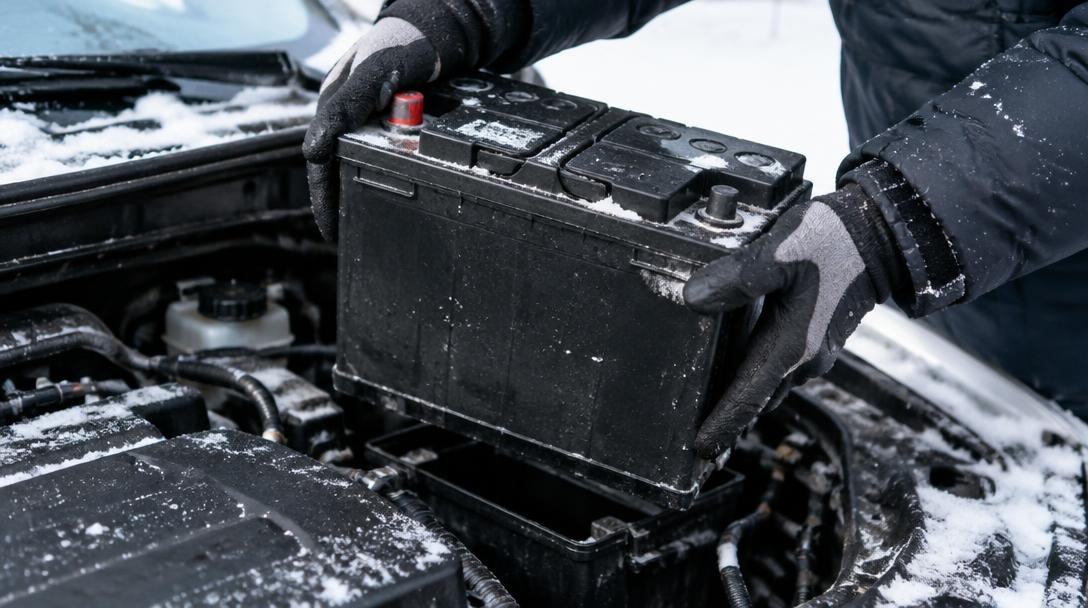
Quick answer: The first cold snap reduces a battery's ability to deliver current while making the engine harder to turn. Often, the weather exposes weakness that was already there rather than ruining a healthy battery overnight. A properly charged battery and a temperature-aware starting test help separate temporary undercharging from a battery that needs replacement.
Why the first freezing morning changes everything
Yesterday the car started outside your house in Hillside. Today the windshield is white, the seat feels like an ice pack, and the engine barely turns. It is tempting to blame the overnight temperature drop for destroying the battery. More often, that cold morning simply asks for more starting power than the battery can still provide.
A conventional starting battery uses chemical reactions to supply electricity. Those reactions slow as the battery gets colder. Meanwhile, cold engine oil resists movement more than warm oil, and the starter has to work against that resistance. Available electrical output falls while the demand for it rises. That is an especially unforgiving combination at the beginning of winter.
NHTSA recommends checking the battery and charging system before winter because cold temperatures reduce battery power. This is not a reason to replace every battery when temperatures fall. It is a reason to find out whether yours has enough reserve for the conditions it will actually face.
Think of the first cold snap as a practical stress test. A battery that comfortably handled a mild September morning may have little margin left on a freezing November morning. The difference can appear sudden from the driver's seat even when the underlying decline has been gradual.
Summer damage can become a winter surprise
Heat and cold affect batteries differently. High temperatures can accelerate internal deterioration, including corrosion of internal components. Cold tends to reveal the resulting loss of starting capability. The battery may have worked throughout summer because the engine was easier to crank, not because its original strength was intact.
Interstate explains that summer heat can shorten battery life and that the effects often become apparent when cold weather arrives. That helps explain the familiar complaint: “It was fine all summer.” Starting successfully is useful information, but it is not a complete measurement of battery health.
A battery also needs adequate charge. Even a serviceable battery can struggle if it has spent weeks partly discharged. Charge level describes how much energy is currently stored. Health describes how much useful performance the battery can still deliver after it is charged. Those are related, but they are not interchangeable.
That distinction matters when deciding what to buy. A low reading after several short trips does not automatically prove permanent failure. Equally, charging a worn battery may restore its voltage without restoring its ability to turn a cold engine. Testing needs to consider both questions rather than treating any disappointing reading as a replacement order.
Short western-suburb trips leave less room for recovery
A winter routine can be surprisingly demanding without covering many miles. You start in Berkeley, run the blower and rear defroster, drive a few minutes, and shut the engine off. Later there is another short trip along Roosevelt Road, followed by another cold start. The battery repeatedly supplies starting energy with limited opportunities to recover it.
The alternator supplies electrical power with the engine running, but available charging depends on vehicle design, engine speed, electrical demand, temperature, and battery acceptance. There is no universal number of minutes that erases every short-trip deficit. Sitting in I-290 traffic with several accessories operating is not the same as completing a controlled recharge.
A car parked outside a Bellwood Metra station also cools thoroughly during the workday. The morning start and evening start may both happen with a cold engine and cold battery. An enclosed garage can moderate that exposure, but it cannot repair a deteriorated battery or guarantee sufficient charge.
Road salt and moisture can affect electrical connections, while pothole impacts and vibration make secure mounting important. Those issues deserve inspection, but they should not distract from this article's central question: does the battery have enough usable starting power when the temperature drops? Weather-related failure usually needs a measured answer, not a seasonal assumption.
What cold-cranking amps actually tell you
Cold-cranking amps, or CCA, is a standardized rating of starting output at a specified cold temperature. It helps compare a battery's starting capability under demanding conditions. It is not a promise that an old or discharged battery can still deliver the number printed on its case.
Interstate describes CCA as the current a battery can provide at zero degrees Fahrenheit for 30 seconds while maintaining the specified minimum voltage. That laboratory definition makes ratings useful, but a vehicle still needs the correct battery type, dimensions, connections, and application rating.
Do not confuse CCA with cranking amps measured at a warmer temperature. Nor should you assume that buying the largest number on a shelf solves every winter starting problem. A battery that does not fit its tray, hold-down, venting arrangement, or vehicle specification is not an upgrade just because its label looks impressive.
The sensible comparison is between the manufacturer's required specification and the tested performance of the installed battery. Ask whether the tester was set for the right battery chemistry and rating standard. A result based on the wrong settings can look authoritative without answering the right question.
Safe checks before the next Hillside cold snap
Start with observations you can make without tools. Notice whether the engine turns more slowly than it did in mild weather. Write down the overnight temperature, how long the car sat, and whether the previous day's driving consisted mostly of short trips. Those details make a winter complaint easier to reproduce.
With the engine off and the vehicle parked safely, look for a visibly damaged case, leakage, or an obviously displaced battery. Keep metal objects and jewelry away from exposed terminals. Do not remove covers, loosen connections, or reach around moving parts just to obtain a better view. Some batteries are hidden beneath seats or luggage-compartment panels and are better left alone.
A cracked, leaking, swollen, or potentially frozen battery is a stop sign. Do not attempt to charge or jump-start it. Freezing risk increases when a lead-acid battery is deeply discharged, so a severely depleted battery after bitter weather deserves particular caution. Have its condition assessed before anyone connects equipment.
If you already know how to use a digital voltmeter safely, a resting-voltage measurement may offer a clue about charge level. It is not a complete health test. Recent charging, temperature, and vehicle activity affect the reading. Never put a meter set to current measurement directly across the battery terminals; that creates a dangerous short-circuit path.
Why a proper winter battery test beats guessing
A useful inspection begins with the battery's condition and correct application. Testing then considers charge, temperature, and starting capability. Depending on the equipment and vehicle, the technician may use an electronic conductance test, a controlled load test, or additional measurements during cranking. Each method has conditions and limitations.
Bosch describes battery checks as a combination of visual inspection and performance testing. That broader approach is more useful than treating a single voltage reading as a complete diagnosis. A battery can show plausible resting voltage and still fail when asked to deliver starter current.
An undercharged battery may need an appropriate recharge before the result is conclusive. Ask whether the recommendation is “replace,” “charge and retest,” or “investigate why charge is low.” Those are different outcomes. The test should also account for whether the battery is conventional flooded, enhanced flooded, or absorbent glass mat.
It is reasonable to ask for the measured result and its meaning in plain English. What was the installed rating? What did the test indicate? Was the battery cold or recently charged? A clear explanation turns an unwelcome winter expense into an understandable decision and avoids replacing a usable battery solely because the calendar says November.
What to do when the car starts reluctantly
One hesitant start is worth noting. Repeated slow starts deserve attention before the car refuses entirely, especially if you depend on it for work or appointments near Hines VA Hospital or Loyola University Medical Center. Choose a time for inspection rather than letting the next freezing morning choose for you.
Avoid repeated, extended cranking attempts. Follow the owner's manual for starting limits and pauses between attempts. Continuing to force a reluctant engine can overheat starting components and further discharge the battery. If it does start, that success does not prove the battery is ready for another cold night.
Do not warm a vehicle in an attached garage, even with the garage door open. Carbon monoxide can accumulate in dangerous ways. Also avoid assuming that an unattended idle session is a reliable battery treatment. If charge is low, a compatible charger used according to the vehicle and charger instructions is a more controlled approach.
This discussion concerns cold-related starting capacity, not every possible no-start. An engine that turns at normal speed but will not run needs a different diagnostic path. Likewise, trouble that continues after a verified healthy, fully charged battery warrants investigation beyond the effect of outside temperature.
Planning a battery visit at Rios Auto Service
Rios Auto Service is an independent, family-run shop owned by Juan Rios at 4218 Roosevelt Rd, Hillside, IL 60162. Battery and electrical work is among its stated services. For a cold-snap concern, the useful request is an assessment of starting readiness, not an automatic battery replacement based on weather alone.
Bring the symptoms, recent driving pattern, and any battery paperwork you have. Ask for an honest inspection, an explanation of what was found, and a distinction between necessary work and optional recommendations. Ask to see relevant results rather than authorizing unrelated replacements. That keeps the discussion focused without assuming a particular test result or promising an outcome before inspection.
You can review the battery and electrical service page before visiting. Walk-ins are welcome; hours are Monday through Friday, 8 AM–6 PM, and Saturday, 8 AM–4 PM, with Sunday closed. Call (708) 632-4808 or use the contact page to discuss the symptoms and your visit.
The goal is straightforward: leave with a reasoned answer about winter starting ability. A battery that needs charging should not be confused with one that cannot meet demand. A battery that has lost useful capacity should not be defended merely because it managed to start yesterday.
Questions drivers ask before the first freeze
Does one cold night permanently ruin a good battery?
Usually, a single ordinary cold night exposes limited charge or existing weakness rather than permanently destroying a sound, charged battery. Extreme conditions and freezing of a deeply discharged battery are different concerns. If the case looks damaged or the battery may be frozen, stop and seek professional assessment before charging.
Will keeping the car in a garage solve the problem?
A garage may reduce temperature exposure and make the next start easier. It does not restore lost capacity or correct chronic undercharging. If the car only starts reliably when sheltered, consider that a useful symptom, not proof that the battery is healthy. Have it tested under an appropriate procedure before relying on outdoor winter parking.
Should I replace the battery before winter just because it is older?
Age helps establish context, but condition and application matter more than a birthday alone. A prewinter inspection can identify weak performance before it disrupts a morning. Keep the purchase date if available, and ask for the test result. Avoid turning a general age guideline into a guarantee that any particular battery is safe or finished.
Can I prevent every cold-weather battery failure?
No test guarantees that a battery will never fail. You can reduce surprises by addressing slow starts, maintaining appropriate charge for your driving pattern, and using the specified battery. Arrange an assessment before severe weather when possible. Preparation is more dependable than repeatedly hoping that one more overnight temperature drop will be harmless.
Related question
For the replacement step that some newer vehicles require, read Battery Registration on Newer Cars.