
Engine Repair & Replacement
Water Pump Failure Warning Signs
Water pump trouble can cause coolant loss, noise, and rising engine temperature. Learn which warning signs Hillside drivers should check and when to stop.
By the team at Rios Auto Service, Hillside, IL · · 9 min read
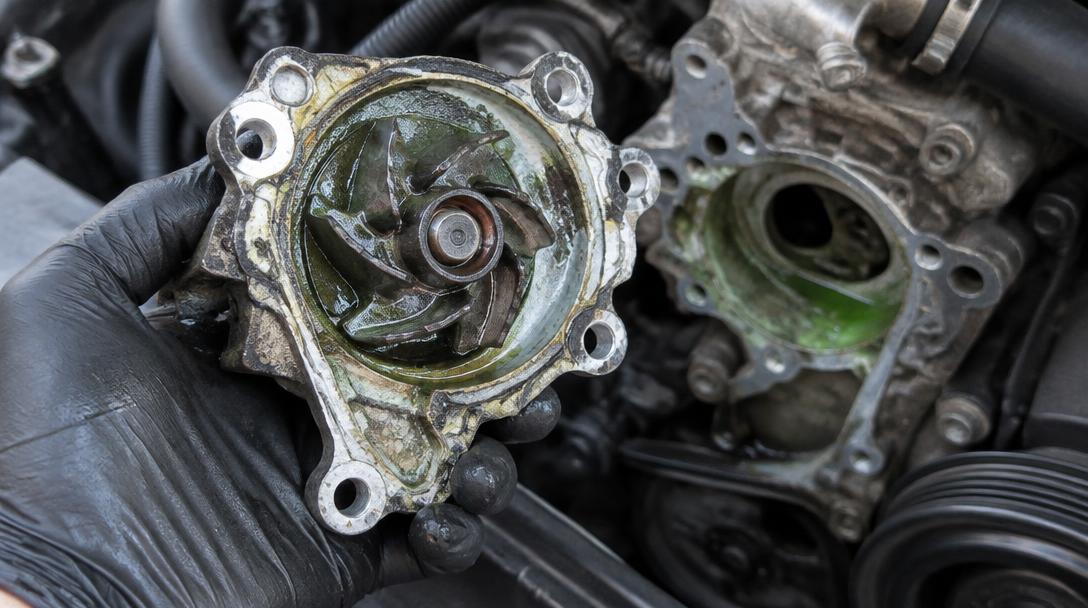
Quick answer: Coolant leaking near the pump, fresh crusty deposits, unusual bearing noise, and rising engine temperature can warn of water pump trouble. None identifies a failed pump by itself, but an overheating warning, steam, or rapid coolant loss means you should stop safely, shut off the engine, and arrange help rather than keep driving.
What the water pump actually does
Your engine makes much more heat than it can safely hold. Coolant carries that heat through passages in the engine and out to the radiator, where air helps release it. The water pump keeps that liquid moving. Without adequate circulation, having coolant in the reservoir is not enough to protect the engine.
Despite its name, the pump normally moves the manufacturer’s specified coolant mixture, not plain water. A conventional pump has an impeller inside a housing, with a shaft, bearing, and seal. Some engines drive it with an external belt; others place it behind covers or inside the engine. Electrically driven pumps introduce another arrangement, with electrical controls as well as mechanical parts.
That variety matters. A driver may see leakage from one design and almost nothing from another. A pump can lose coolant through its seal, develop a worn bearing, or stop circulating properly because its impeller or drive has failed. The warning signs depend on which part has stopped doing its job.
Coolant condition also matters. 1 Bosch’s service guidance describes mineral deposits, incorrect coolant mixtures, and inadequate coolant as contributors to pump damage. That supports using the correct fluid and investigating contamination, not assuming every failed pump simply reached a predictable mileage.
The leak that deserves a second look
A pump-related leak may first appear as a small damp area or dried residue rather than a puddle. Coolant can leave a chalky, colored trail after the liquid evaporates. Depending on the vehicle, you might see it near the pump housing, below a pulley, or along the edge of a cover.
Many conventional pumps have a small drain opening commonly called a weep hole. An ongoing fresh leak from that area can indicate that the shaft seal is no longer containing coolant properly. However, identifying that opening often requires professional access. You do not need to crawl underneath the vehicle to look for it.
Location is a clue, not a verdict. A leaking hose above the pump can run down its housing and make a healthy pump look guilty. Airflow can carry fluid backward, while an underbody shield can collect it and release it somewhere else. A puddle beneath the passenger side does not automatically identify a particular component.
Notice whether the mark returns after the vehicle has been parked in the same place. Photograph the spot with something nearby for scale, but do not touch or taste the fluid. Keep children and animals away. Air-conditioning condensation can also leave water beneath a vehicle, so a puddle alone is not proof of coolant loss.
The useful combination is a new wet area plus a declining cold coolant level. Even then, the source needs tracing. Repeatedly topping up without finding where the coolant goes can conceal the trend until the leak becomes much larger.
Noises that can point toward the pump
A failing pump bearing may produce a rough growl, rumble, or whining sound that changes with engine speed. On an externally driven design, severe bearing wear may also affect pulley alignment. Those are reasons for inspection, not instructions to reach into the belt drive.
Alternators, tensioners, idler pulleys, and other accessories can make similar sounds. A squeal might involve a slipping belt rather than the pump itself. A sound recording taken safely from outside the engine compartment can help explain the complaint, but a recording cannot reliably separate all these possibilities.
Never remove a belt or run an engine without one as a driveway experiment. Depending on the design, that belt may power essential components. Keep hands, clothing, and tools away from moving parts, and remember that an electric cooling fan can start unexpectedly.
A noise that suddenly becomes harsh, accompanies a visible wobble, or arrives with a temperature warning deserves more urgency than a faint sound that has remained unchanged. Do not wait for the pump to become loud enough to hear from inside with the windows closed. Some pump failures are quiet throughout.
Temperature changes are evidence, not a diagnosis
A rising gauge can accompany poor coolant circulation, but it can also result from other cooling-system faults. Likewise, weak cabin heat does not identify a water pump on its own. Air trapped in the system, low coolant, and other problems can change heater performance.
Watch the pattern without deliberately recreating an overheating event. Did the gauge climb at idle, during a longer drive, or immediately after a recent repair? Did a warning message appear before you noticed steam? Those observations help narrow the inspection without risking additional engine damage.
An apparently normal gauge does not make an active coolant leak harmless. Some vehicles display a broad normal range rather than small temperature changes. A reservoir can also hold coolant while circulation elsewhere is compromised. Treat the complete picture as more useful than one reassuring dashboard reading.
For the meaning of your particular symbol or message, use the vehicle’s instructions. 2 Ford’s warning-light guidance illustrates why the owner’s manual matters: warning lamps communicate different conditions, and the response depends on the specific warning rather than its color alone.
Why a Hillside commute can reveal an existing weakness
A marginal pump may first attract attention during a warm afternoon on Roosevelt Road or a slow stretch of I-290. That does not mean traffic created the defect that day. Operating conditions can expose a cooling system that no longer has enough reserve capacity.
Short winter trips present a different challenge for observation. If you mainly travel between Hillside and Bellwood, a slight coolant loss might remain unnoticed because you rarely open the hood between errands. Then a longer journey gives a small problem more time to show itself.
Chicago winters also make underhood inspections less inviting. Months can pass between careful level checks. The practical response is not to blame road salt for every pump failure, but to establish a simple baseline: know the correct cold level and notice when it changes.
Before summer travel, check accessible hoses and belts with the engine off and cool. 3 NHTSA’s summer-driving guidance recommends looking for obvious belt and hose deterioration and checking the cooling system. Those observations can reveal related weaknesses, although they cannot certify the pump’s internal condition.
A driver headed toward Oakbrook Center should not treat a shorter remaining distance as protection. Once an overheating warning appears, the question is where to stop safely, not whether the destination is only a few exits away.
Safe checks you can make at home
Begin with the vehicle parked on level ground and the engine fully cool. Look through the translucent coolant reservoir if your vehicle has one. Compare the level with the markings specified for a cold engine, not a remembered position from when it was hot.
Use your model’s manual to identify the correct reservoir and fluid specification. 4 Manufacturer manual libraries, such as Ford’s, provide model-specific directions. Some vehicles have multiple cooling circuits, so choosing the nearest plastic bottle is not a safe substitute for identifying it.
From above, look for fresh moisture, residue, or an obvious split hose. Use a flashlight without leaning into the engine compartment. Do not loosen a radiator cap or pressurized reservoir cap while the system is hot, and do not pour cold liquid into a hot engine.
Record the cold level, date, mileage, and any warning message. A photo taken from the same angle on another cold morning is often more useful than saying the tank seems lower. If you add fluid under the manual’s directions, record the amount and specification as well.
Stop at observation. Do not test pulley play with the engine running, probe for leaks with your fingers, or support a vehicle with only its emergency jack. Hidden pumps, internal leaks, and electrical pump faults require tools and access beyond these safe owner checks.
When to stop driving and when to book inspection
Steam, an overheating warning, or rapidly escaping coolant calls for a safe stop and engine shutdown. If visibility is affected or the vehicle loses power, concentrate on getting out of traffic without abrupt movements. Once stopped, avoid opening a steaming hood until conditions are safe.
Do not restart simply because the gauge fell after shutdown. Cooling down changes the reading; it does not repair a failed pump. Arrange appropriate roadside assistance if the vehicle cannot be driven safely, and keep occupants away from traffic while following emergency guidance for the location.
A small fresh leak with normal temperature still needs prompt assessment. There is no dependable mileage allowance between the first drip and a larger failure. The inspection should establish both the source and whether continued operation is reasonable, rather than offering a generic number of safe days.
Dry residue from an old repair may be less urgent, but only if the level is stable and no fresh leak or other symptom appears. Cleaning and rechecking can distinguish an old stain from an active problem; that is different from assuming every crusty spot requires a new pump.
Discussing pump concerns at Rios Auto Service
Rios Auto Service provides engine repair and replacement at 4218 Roosevelt Rd in Hillside. The independent, family-run shop is owned by Juan Rios and welcomes walk-ins. Call (708) 632-4808 or use the contact page to explain what you have noticed before deciding how to bring the vehicle in.
Bring your observations rather than a requested part replacement: where fluid appeared, whether the cold level changed, when the noise happens, and whether the engine ever overheated. Mention recent cooling-system work, including any fluid added at home. That history can prevent an old spill from being mistaken for a new leak.
Ask for an evidence-led inspection: show where the fresh leak originates, explain what supports a pump diagnosis, and separate necessary repairs from optional maintenance. That is the useful no-upsell conversation. A pump should not be condemned merely because it is near the wet area or difficult to reach.
A complete discussion should also address the drive arrangement and coolant condition. Replacing a pump without identifying why it failed can leave a contributing problem untouched. Request an explanation of any related part recommendation rather than accepting a package of unexplained extras.
The shop is open Monday through Friday, 8 AM–6 PM, and Saturday, 8 AM–4 PM; Sunday is closed. Walk-in availability does not establish a repair completion time. If the car is already overheating, discuss safe transport rather than trying to arrive before closing.
Frequently asked questions
Can a water pump fail without leaking?
Yes. A drive problem, damaged impeller, or electrical fault can reduce circulation without leaving an obvious external puddle. Conversely, a visible leak can originate elsewhere. Temperature behavior, inspection findings, and the pump’s design all matter when identifying the actual fault.
Does a sweet smell prove the pump is bad?
No. A coolant-like odor may justify checking for leakage, but it does not locate the source. A hose, reservoir, radiator, or spill can produce similar observations. Avoid sniffing close to hot components, and never use smell as a reason to open a hot pressure cap.
Can I use stop-leak instead of replacing a failed pump?
Do not treat an additive as a repair for a worn bearing, damaged drive, or failing seal. Products may also be inappropriate for the vehicle. Ask for the manufacturer’s guidance and a confirmed diagnosis before introducing anything into the cooling system.
Should every small stain lead to pump replacement?
No. An old, dry stain with a stable coolant level is different from ongoing wetness or a new drip. The right next step is to establish whether leakage is active and where it begins. Monitoring is meaningful only when there are clear instructions and a defined reason to reassess.
Related question
For help judging a different kind of fluid loss, read Oil Leaks: Which Ones Can Wait?.