
Engine Repair & Replacement
Overheating in Summer Traffic
Overheating in summer traffic often exposes cooling-system problems. Learn what Hillside drivers should check, when to stop, and why airflow matters.
By the team at Rios Auto Service, Hillside, IL · · 9 min read
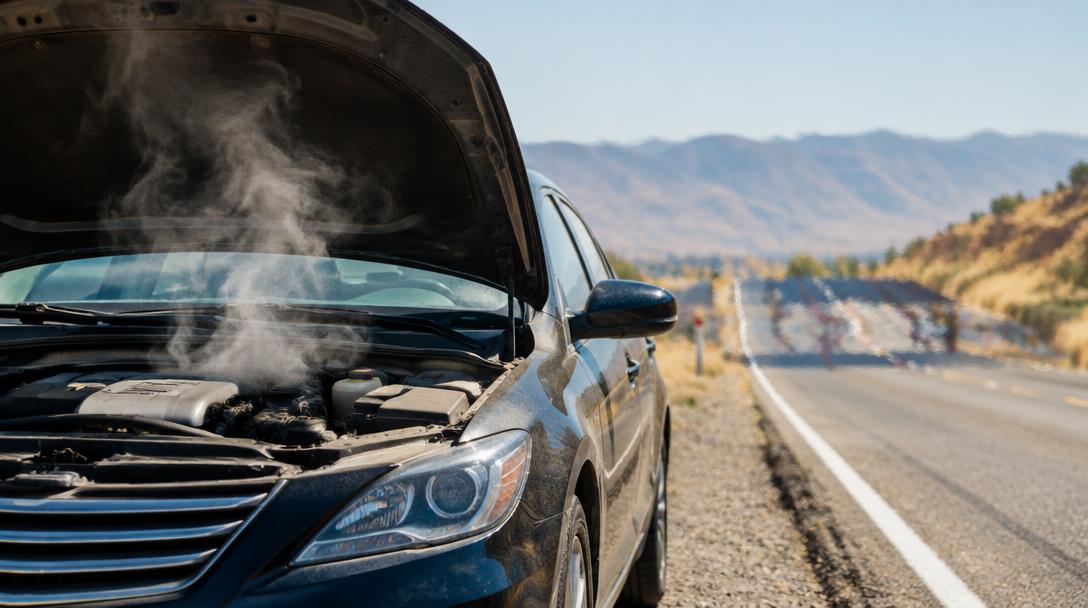
Quick answer: Overheating in summer traffic usually means the cooling system cannot shed enough heat under low-speed, high-temperature conditions; a fan problem, low coolant, or restricted circulation may be responsible. If the temperature warning appears, steam escapes, or the gauge enters its danger zone, move out of traffic safely and shut the engine off rather than trying to finish the trip.
Why a traffic jam exposes a cooling problem
Your engine produces heat whenever it runs. Coolant absorbs some of that heat, carries it through the radiator, and returns to the engine after outside air removes heat from the radiator. The thermostat regulates circulation, while the cooling fan helps move air when road speed cannot provide enough airflow.
At highway speed, air flows through the front of the vehicle. In stopped traffic, that supply drops sharply. A properly functioning cooling system is designed to cope with normal summer driving, including idling. A rising gauge at a red light is therefore not something to dismiss as an unavoidable feature of July.
Hot outside air also reduces the temperature difference available to carry heat away. Meanwhile, operating the air conditioner adds load and puts heat into the air passing through the condenser ahead of the radiator on many vehicles. These conditions can expose a weakness that remained hidden during cooler weather.
The Department of Energy’s hot-weather guidance identifies air conditioning as a significant additional engine load. That does not mean you should routinely drive without cooling the cabin. It means the technician should know whether the temperature climbed with the A/C operating, because that detail helps recreate the conditions.
What the stop-and-go pattern can tell you
A vehicle that gets hot while stopped but settles down once moving gives a useful clue about airflow. An electric fan may not be switching on, may run at only one commanded speed, or may have an electrical supply problem. Some vehicles use a mechanically driven fan whose drive mechanism needs evaluation instead.
That pattern is evidence, not a diagnosis. Low coolant, an obstructed radiator, damaged airflow guides, or circulation problems can also become more noticeable at idle. Replacing a fan because the gauge improves at speed skips the tests that distinguish a failed motor from a wiring or control fault.
Overheating both at speed and while stopped broadens the investigation. The system may be losing coolant, struggling to circulate it, or failing to transfer heat effectively. Recent cooling-system work matters too: some vehicles require a specific filling and air-removal procedure, and trapped air can interfere with normal operation.
A small temperature change is not always overheating. Some vehicles deliberately vary operating temperature, and dashboard displays differ in how they represent it. What matters is a warning, movement outside the normal range specified by the manufacturer, or a substantial change from the vehicle’s usual behavior. Do not choose a universal temperature limit from an unrelated vehicle online.
Summer driving around Hillside makes the pattern easy to miss
An I-290 trip may include steady movement followed by a long queue. The gauge can look normal on the moving stretch, then climb after several minutes of crawling. By the time traffic opens up, the reading may drop again. That temporary recovery does not establish that the fault repaired itself.
The same thing can happen during errands along Roosevelt Road or while waiting to leave Oakbrook Center. Multiple stops, low-speed parking-lot driving, and a hot engine compartment create a different test than a short drive on an open road. Tell the shop how long you had been driving before the change appeared.
Avoid blaming every summer cooling problem on local road salt or potholes. Those exposures can contribute to vehicle wear, but they do not identify the failed component. A technician needs to inspect the actual radiator, connections, wiring, and mounting condition rather than treating the neighborhood as a diagnosis.
If the gauge only rises after a specific length of idle, note that from memory once parked. Do not stare at the dashboard, take photographs while driving, or deliberately sit through another overheating episode to collect better evidence. Existing observations are enough to begin a safe investigation.
What to do when the warning appears
Take a temperature warning seriously even if the car still feels normal. Reduce unnecessary engine load, switch off the air conditioner, and look for a safe place to leave moving traffic. Avoid sudden maneuvers. Once safely stopped, select Park or neutral as appropriate, apply the parking brake, and shut the engine off.
If you cannot reach a safe stopping area immediately, focus on getting out of immediate traffic danger without demanding hard acceleration. Turning the cabin heater up may draw off some heat briefly on some vehicles, but it is not a repair or permission to continue driving. Do not let that old roadside trick delay stopping or endanger passengers in extreme heat.
Steam, coolant spraying, loss of power, or an urgent stop-engine message makes continued operation especially risky. Keep away from escaping steam. Do not lift the hood while steam is pouring out, and never reach into a hot engine compartment to find the leak. Request appropriate roadside assistance instead of attempting a hurried repair beside traffic.
Ford’s overheating owner guidance treats overheating as a condition requiring service. A warning that disappears after shutdown still deserves investigation. Cooling down changes the temperature; it does not explain why the engine became too hot in the first place.
Passenger safety matters as much as engine damage. Do not leave children, vulnerable adults, or pets in a hot vehicle while you inspect it. If the location or heat creates immediate danger, call emergency services and follow their directions about where to wait safely.
Safe checks after the engine is completely cold
There is no reliable universal waiting period that makes every overheated engine safe to open. Follow the owner’s manual and wait until the system is completely cold. A pressurized cap can release scalding coolant even after the dashboard is dark and the engine has stopped making noise.
The warnings in the Ford E-Series owner’s manual illustrate why hot cooling-system caps must not be removed. Your own vehicle’s manual controls the location, coolant specification, and checking procedure. Do not assume every translucent tank is an unpressurized overflow bottle.
On level ground, look at the reservoir markings without opening anything if they are visible. Record whether the cold level is below the indicated range. Low coolant is a finding to investigate, not proof that evaporation is normal. Repeated topping up can hide an ongoing leak until conditions become more demanding.
Look from a safe position for wet areas, dried residue, or a puddle beneath the parked vehicle. Clear water after A/C use may be ordinary condensation; appearance alone cannot positively identify every fluid. Keep children and animals away from suspected coolant, and do not taste it or crawl beneath an unsupported car.
Keep hands, clothing, and tools away from fans and belts. Electric fans can operate unexpectedly, including after shutdown on some vehicles. Looking at a stationary fan is not a functional test, and trying to spin it, bridge a relay, or bypass a control circuit is not an appropriate roadside check.
Why pouring something in rarely settles the question
If your manual permits adding coolant when cold, use the specified product and procedure. Color is not a dependable compatibility guide. Different formulations can share a color, and a bottle labeled for broad use is not automatically correct for every engine. Do not overfill the reservoir.
Avoid adding stop-leak products or mixing whatever fluids happen to be available in the trunk. An improvised additive can complicate diagnosis and may interfere with small cooling passages. If the system has lost enough fluid to overheat, simply restoring the visible level does not establish that it can hold pressure or circulate properly.
Never pour cold water onto a hot engine as a cooling strategy. Keep liquids away from hot components and electrical equipment. Emergency fluid instructions, where provided, are vehicle-specific and do not make a leaking or repeatedly overheating car safe for normal travel.
Do not repeatedly restart the engine to see whether the gauge rises again. Each episode may add damage, and a dashboard reading alone cannot confirm adequate coolant circulation. Arrange inspection before another commute if the car has genuinely overheated, especially when coolant loss or steam was involved.
What a useful cooling-system diagnosis includes
The investigation should begin with the complaint: hot only at idle, hot with A/C, hot after a highway exit, or hot under all conditions. A technician can compare dashboard behavior with scan data and other observations, checking whether the reported temperature makes sense before condemning major components.
A cold inspection may include coolant level and condition, visible leaks, belts, hoses, radiator condition, and the pressure cap. Appropriate pressure testing can help locate leaks that are not obvious in the driveway. The test pressure and procedure need to suit the vehicle; more pressure is not a better test.
Fan operation should be checked against the vehicle’s actual control strategy. Depending on the design, that may involve commanded operation, electrical measurements, or mechanical inspection. A fan that works under one condition might still fail to provide the required airflow under another.
The technician also needs to verify circulation and correct filling, then check that the repair addresses the original low-speed complaint. If evidence points toward internal engine damage, further testing may be justified, but overheating by itself does not automatically mean the engine must be replaced.
For prevention, NHTSA’s summer driving checklist emphasizes checking coolant and inspecting belts and hoses. Maintenance is valuable, but a recently serviced vehicle can still develop a leak or electrical fault. New warning signs deserve attention regardless of the date on the last service receipt.
Getting help without turning a warning into an engine failure
Rios Auto Service offers engine repair and replacement service at 4218 Roosevelt Rd, Hillside, IL 60162. The independent, family-run shop is owned by Juan Rios. Explain the driving conditions, warning messages, and any recent cooling work so the discussion starts with the specific overheating event.
Ask for an honest inspection and to see what was found before approving repairs. A useful explanation connects the evidence to the recommendation: for example, a confirmed leak or a fan that fails its required operating test. Ask which work addresses the complaint and which items are separate maintenance, rather than accepting an unrelated parts list.
Walk-ins are welcome Monday through Friday, 8 AM–6 PM, and Saturday, 8 AM–4 PM; the shop is closed Sunday. Call (708) 632-4808 or use the contact page to discuss next steps. Walk-in availability is not a reason to drive an actively overheating vehicle; arrange safe transportation for it when necessary.
Frequently asked questions about summer overheating
Is overheating normal in a long traffic jam?
No. Normal summer congestion should not push a sound cooling system into an overheat warning. A slight display variation may be normal for a particular vehicle, but a red warning, steam, or movement into the danger range requires action. Do not normalize the problem because the weather is hot.
Can I drive if the gauge goes back down?
A lower reading does not prove the cause is gone. Airflow may have increased, engine load may have fallen, or the sensor may not be representing the whole situation. After genuine overheating, especially with fluid loss, stop driving and arrange evaluation rather than using temporary recovery as a clearance test.
Does turning off the air conditioner fix it?
It can reduce load while you move to a safe stopping place, but it does not repair a fan, leak, or circulation problem. If the vehicle only stays within range with the A/C off, that is useful diagnostic information. It is not an acceptable substitute for finding the fault.
Will every overheating incident ruin the engine?
Not necessarily. The outcome depends on temperature, duration, coolant loss, and the engine’s condition. Promptly stopping can limit harm, but no one can judge internal condition from the gauge alone. Explain how long the warning lasted and whether the engine lost power so any follow-up testing is based on evidence.