
Check Engine Light Diagnostics
Transmission Warning Signs
Slipping, delayed engagement, and harsh shifts can signal transmission trouble. Learn safe checks and when Hillside drivers should stop and seek help.
By the team at Rios Auto Service, Hillside, IL · · 9 min read
Quick answer: Transmission warning signs include delayed engagement, engine speed rising without matching acceleration, repeated harsh shifts, loss of a gear, leaks, and overheating messages. These symptoms do not automatically mean the transmission needs replacement, but loss of drive, severe slipping, smoke, or a stop-driving warning calls for a safe stop and assistance rather than another test drive.
What a transmission problem actually changes
The transmission matches engine output to the speed and load the vehicle needs. In a conventional automatic, fluid pressure, clutches, gears, electronic commands, and often a torque converter work together. A fault anywhere in that chain can change when power reaches the wheels or how smoothly that transfer happens.
Not every vehicle uses the same arrangement. Continuously variable transmissions change ratios differently from geared automatics. Dual-clutch transmissions have their own engagement characteristics, and a manual transmission relies on driver-operated clutch control. Hybrid power-split systems can behave differently again. What sounds unusual in one design may be normal in another.
That makes a change from your vehicle's established behavior especially useful. “It has always held steady engine speed on hills” says something different from “Yesterday it began revving between second and third.” Identify the year, model, mileage, and transmission type when possible rather than comparing the car to a neighbor's completely different vehicle.
Fluid is part of the operating system, not just a lubricant poured around gears. Depending on the design, it helps transmit hydraulic force, manage friction, and remove heat. Car and Driver's transmission-fluid guide explains that different transmission designs require specific fluids. The wrong product can create problems rather than prevent them.
Delayed engagement and slipping deserve precise descriptions
Delayed engagement means you select Drive or Reverse but the expected response does not arrive promptly. The vehicle may sit still, then engage with a bump. Low fluid, pressure-control issues, internal wear, or electronic problems are possible explanations; the delay alone cannot distinguish them.
Keep your foot on the brake during normal selection and do not add throttle to force engagement. When the transmission finally applies, the vehicle could move unexpectedly. A delay that is new, worsening, or followed by a harsh engagement needs prompt evaluation, even if the car eventually drives normally.
Slipping often feels like engine speed increases without the corresponding increase in road speed. It may occur during a shift or while maintaining load. That is different from an intentional downshift, when the engine speeds up and the vehicle responds appropriately. Traction loss on ice can also create a misleading impression of lost propulsion.
Describe what you observed rather than naming a failed component. For example, “The engine raced as I accelerated uphill, but road speed barely changed” gives a technician something to investigate. Repeating hard accelerations to prove the symptom risks adding heat and wear without improving the description.
A vehicle that will not move in a selected range is beyond a routine wait-and-see situation. Do not alternate rapidly between Drive and Reverse or keep revving the engine. Secure the vehicle according to the manual, keep people clear of its path, and arrange appropriate assistance.
Harsh shifts, shudder, and missing gears need context
A sudden bang into gear, a repeated jolt during a particular shift, or a shudder under light acceleration can point toward a transmission-related concern. But worn mounts, driveline joints, engine running problems, and other faults can produce similar sensations. The location you feel a jolt does not establish its source.
Useful distinctions include whether the symptom occurs while selecting a range or while already moving, whether it follows engine speed or road speed, and whether it happens cold or warm. Notice these details during ordinary driving only. Do not perform brake-and-throttle loading tests in a driveway or parking lot.
Some vehicles enter a protective operating mode after detecting a fault. They may stay in one ratio, shift firmly, or limit available power. Drivers sometimes call this “limp mode,” but reduced performance is not a promise that the car can safely finish a commute. It may lack the acceleration needed to merge.
A manual transmission brings a different set of clues: difficulty selecting gears, grinding during engagement, or engine speed rising with the clutch fully released. These can involve the clutch or its actuation system rather than damaged internal gears. Avoid forcing the lever; a diagnosis should distinguish the mechanism involved before recommending a major repair.
Warning messages and heat require vehicle-specific action
Some vehicles display a gear symbol, wrench, transmission-temperature icon, or written powertrain message. Others first illuminate a broader malfunction indicator. Record the exact wording, because “temperature high,” “service required,” and “stop safely” communicate different levels of urgency.
Manufacturer instructions can differ even among vehicles from the same brand. One design may call for idling in a specified range to cool, while another condition may require shutdown. Ford's information-message reference illustrates that different transmission warnings carry different responses. Follow your own manual rather than copying a cooling routine from another model.
Heat can arise from excessive load, slipping, fluid problems, or cooling-system concerns. It can also accelerate deterioration. A temperature warning that disappears after cooling still deserves investigation if it occurred during ordinary use. Cooling down changes the immediate temperature; it does not establish why the warning happened.
Do not open a hot cooling-system cap while investigating overheating. Ford's overheating owner resource reinforces that overheating symptoms warrant attention and service. Smoke, steam, or a strong burning odor should shift your focus from diagnosis to stopping safely and keeping people clear.
Why western-suburb traffic can expose a developing issue
Repeated crawling and acceleration in I-290 congestion can reveal a problem that was less noticeable during steady cruising. The vehicle shifts, manages engagement, and rejects heat under changing conditions. Traffic does not prove the transmission is damaged, but the difference between highway and stop-and-go behavior helps narrow the complaint.
A driver leaving Hillside for Oak Brook might notice smooth operation at first, then a delayed shift once everything warms up. Another might experience a brief cold-start engagement delay after the vehicle sits overnight. These are useful patterns, not reliable shortcuts to a particular repair.
Chicago winter conditions complicate interpretation. Cold fluid and manufacturer warm-up strategies can change early shift behavior, while slippery pavement can produce wheelspin or traction-control intervention. A small change described as normal in the manual differs from a new severe jolt, prolonged delay, or warning message.
NHTSA's winter-driving guidance recommends winter preparation and avoiding unnecessary wheelspin when stuck. Do not repeatedly rock a vehicle between forward and reverse while the wheels are spinning. Follow its recovery instructions; forcing the vehicle out of deep snow can add stress and heat when traction is already limited.
Safe owner checks without opening the transmission
Begin with records and observation. Gather maintenance receipts, note any recent service, and write down when the symptom started. Include whether a fluid change or other repair preceded the behavior, without assuming the timing proves that work caused it. Accurate history helps separate an existing concern from a new one.
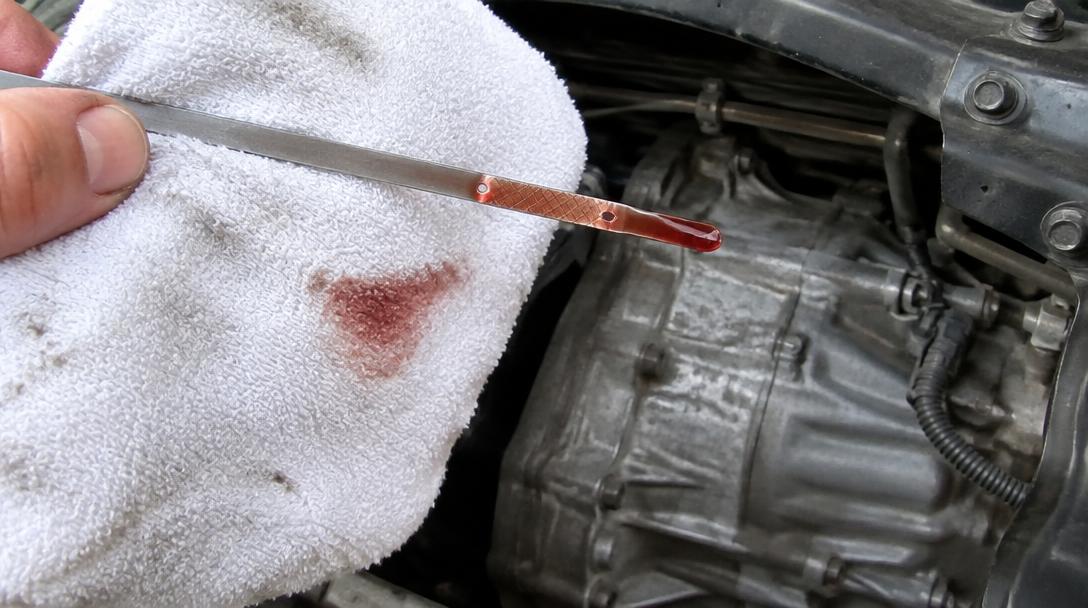
Look for fresh spots where the vehicle normally parks, without crawling underneath it. Transmission fluid is not always red, and a red or brown puddle does not identify its source with certainty. A photograph and the location beneath the vehicle are helpful; touching or tasting unknown fluid is not.
Check fluid yourself only if the owner's manual provides an accessible procedure you can follow safely. Some vehicles have a dipstick with specific temperature and engine-running requirements. Others require a level vehicle, measured fluid temperature, and service equipment. A missing dipstick is not an invitation to remove a plug underneath.
If a permitted check shows low fluid, investigate the reason instead of making topping up a routine habit. Use only the exact specification and procedure required. Overfilling can cause trouble, too. Keep clear of fans and belts, and leave the check to a professional if it requires working near moving or hot components.
Avoid additives marketed as universal cures, improvised flushing, and code clearing before inspection. None can establish whether the problem is hydraulic, electronic, mechanical, or outside the transmission. Preserving the evidence gives the diagnostic process a better starting point than experimenting with products.
Decide urgency by function, not by the next available weekend
Stop driving when propulsion becomes unreliable, the vehicle slips severely, a major leak appears, or a warning instructs you to stop. Smoke or an active burning smell also calls for immediate caution. Move out of traffic if safely possible, then request help rather than trying to reach a preferred parking place miles away.
A mild but repeatable new shift change without warnings may allow time to arrange an inspection. That is not a blanket clearance for highway travel. Consider whether engagement is dependable and whether acceleration remains safe. If you are unsure, describe the symptoms before choosing to drive in.
Do not attempt to reproduce a fault while merging onto I-294 or crossing a busy intersection on Mannheim Road. A transmission that hesitates once can hesitate again at a less forgiving moment. Avoid towing, heavy loads, or demanding trips while an unresolved transmission symptom is awaiting evaluation.
The absence of a warning light does not establish that everything is sound. Some mechanical problems do not immediately produce a dashboard alert. Likewise, a stored transmission-related code is a clue to a circuit or operating condition, not automatic proof that the whole transmission must be replaced.
Starting a diagnostic conversation in Hillside
Rios Auto Service provides check-engine diagnostics at 4218 Roosevelt Rd, Hillside, IL 60162. It is an independent, family-run shop owned by Juan Rios. Explain any shifting complaint before arrival and ask whether the needed evaluation is within the shop's services; do not assume transmission rebuilding is offered.
Ask for an honest inspection and to see what was found. A clear discussion should separate a verified leak, a stored code, and a suspected internal fault rather than treating them as interchangeable conclusions. Ask what testing supports the recommendation and whether a transmission specialist is appropriate. That keeps the conversation about evidence, not unnecessary replacements or unrelated upselling.
Walk-ins are welcome Monday through Friday, 8 AM–6 PM, and Saturday, 8 AM–4 PM; Sunday is closed. Call (708) 632-4808 or use the contact page. Mention loss of drive or an overheating message before setting out. A nearby destination does not make an unsafe vehicle suitable to drive.
Frequently asked questions about transmission symptoms
Does slipping always mean I need a replacement transmission?
No. Fluid level, leaks, control faults, and internal wear can produce overlapping symptoms. Some causes may be addressed without replacing the complete unit, while serious internal damage may require larger decisions. Testing is what separates those possibilities. Continuing to drive while it slips can make the outcome worse.
Will changing the fluid cure a harsh shift?
Not necessarily. Fluid service is maintenance, not a universal repair for pressure-control, wiring, software, or worn-component problems. Establish the cause and confirm the correct service procedure first. A fluid change should not be sold as a guaranteed cure simply because the symptom happens during a shift.
Is higher engine speed normal with a CVT?
It can be. A continuously variable transmission may hold engine speed while vehicle speed changes instead of making conventional stepped shifts. A new loss of acceleration, shudder, warning, or abrupt change from its usual behavior still warrants evaluation. Compare it with its established operation and manufacturer guidance.
Should I clear the warning if the car drives normally again?
Leave the stored information intact until it can be evaluated. An intermittent issue may no longer be active but can still leave useful records. Note when it happened and whether the vehicle was hot, cold, loaded, or in traffic. Normal operation afterward does not prove the cause has disappeared.
Related question
If you are evaluating another vehicle before buying, read Pre-Purchase Inspections for Used Cars.