
Check Engine Light Diagnostics
Free Code Reads vs. Professional Diagnostics
A free code read identifies a reported fault, not always its cause. Hillside drivers can learn what professional testing adds before authorizing repairs.
By the team at Rios Auto Service, Hillside, IL · · 9 min read
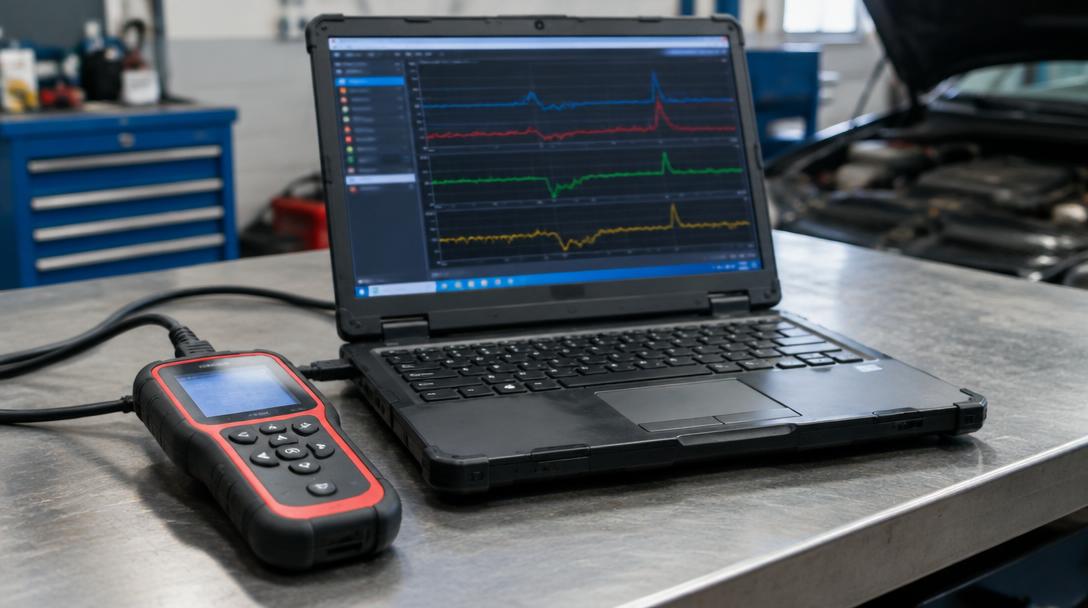
Quick answer: A free code read can tell you which fault the vehicle’s computer reported, but it usually cannot prove which part caused it. Professional diagnostics adds vehicle-specific information, inspection, directed testing, and interpretation so a repair recommendation rests on evidence rather than a code description.
A code is a starting point, not a parts order
Imagine leaving a parking lot in Hillside, noticing the check-engine light, and receiving a printout ten minutes later. The report names a sensor and suggests a replacement. That feels like an answer, especially when you need the car for work. But the printout may identify only the system where the computer detected an unexpected result.
The vehicle monitors electrical signals and operating conditions. When the criteria for a fault are met, it can record a diagnostic trouble code. The code’s definition describes the detected condition. It does not necessarily distinguish a failed component from damaged wiring, an air leak, a mechanical problem, or incorrect information coming from elsewhere.
For example, a lean-mixture code does not automatically establish that an oxygen sensor is defective. The sensor may correctly report excess oxygen while the actual cause lies in unmetered air or inadequate fuel delivery. Buying the named sensor before testing confuses the messenger with the problem it reported.
The EPA’s explanation of on-board diagnostics describes monitoring of emission-related systems and components. That monitoring is valuable, but it is not an automated teardown inspection. A computer can identify that a result falls outside its expectations without knowing every physical reason that result could occur.
What a free read can genuinely help you do
A basic read can preserve an exact code instead of a vague warning-light description. It may also show whether a fault is pending or confirmed and whether certain emissions monitors have completed. Available information depends on the reader, the vehicle, and the service being offered. Ask what the read includes rather than assuming all reports are equivalent.
That information can help you describe the situation when arranging service. “The light came on yesterday, and the report shows this code” is more useful than “the computer says the engine is bad.” It gives the technician a lead while leaving the cause open for investigation.
A free read is especially useful when you treat the report as a record. Keep the full printout or a clear photograph, including every code and any status labels. Do not copy only the first suggested part. Several codes together can tell a different story from one code viewed in isolation.
There is nothing inherently wrong with a no-charge scan. The limitation is the scope, not the price tag. A brief connection to a reader should not be presented as proof of a failed part when no confirming test occurred. Likewise, charging for a scan does not automatically make it a complete diagnosis.
What professional testing adds beyond the connector
Professional diagnosis starts with a defined complaint. Does the engine hesitate only when warm? Does the warning appear after rain? Was a component recently replaced? These questions establish what needs explaining. A useful process connects the customer’s experience with the vehicle’s stored information instead of treating either one as sufficient alone.
A technician may examine freeze-frame information, live readings, manufacturer service procedures, wiring diagrams, and relevant service bulletins. Freeze-frame data can preserve conditions associated with a fault. Live data shows what the computer sees now. Neither is automatically conclusive; each must be interpreted in context and checked against an appropriate test.
Physical testing fills the gaps. Depending on the complaint, that could mean checking an electrical circuit under load, inspecting for an intake leak, measuring pressure, or verifying a component’s response. The purpose is to distinguish competing explanations. Buying a component to find out whether it fixes the car is not the same process.
Bosch’s overview of professional vehicle diagnostics notes that scope depends on the vehicle and fault. That is an important expectation: not every car needs every test. A focused investigation selects tests because their results can change the next decision, not because a long checklist looks impressive.
Why a more expensive scanner is not the whole answer
Basic readers generally focus on standardized emissions-related information. More capable tools may communicate with additional modules, display manufacturer-specific data, or command supported components during tests. Coverage varies. A tool that reads one vehicle’s transmission module may not offer the same access on another make or model.
That access matters, but it still needs interpretation. A displayed voltage is not useful unless someone knows what it should be under those conditions. A component that responds to a command may still fail intermittently. And a communication fault can arise from power, ground, wiring, or network issues rather than a failed module.
A professional also needs reliable service information and suitable measuring equipment. The scanner is one instrument in the investigation, not a machine that independently announces the correct repair. Sometimes the decisive evidence comes from a visual inspection or an electrical measurement rather than the most complicated screen on the tool.
Ask what a test established, not how much the scanner cost. “The circuit lost its supply voltage under load” explains more than “our computer says replace it.” Clear language lets you understand the recommendation without needing to interpret raw waveforms, memorize code families, or purchase equipment yourself.
Western-suburb driving makes the history valuable
A vehicle that hesitates only after sitting in I-290 traffic presents a different testing challenge from one that stumbles immediately after an overnight cold soak. Temperature and operating load can determine whether a fault is present. Mention the pattern even if the warning light is the main reason you booked service.
Short winter trips between Berkeley and Hillside may not reproduce a problem that appears during a longer highway drive. Conversely, a warm shop inspection may miss something that occurs only on a cold morning. A precise description can help plan a useful test rather than a long but uninformative drive.
Salt exposure and potholes provide context for inspecting vulnerable connections or damaged components, but they do not diagnose an electrical failure. “It started after that hard impact on Mannheim Road” is useful history. “The impact definitely ruined the computer” is a conclusion that still needs evidence.
Avoid recreating a dangerous symptom just to collect more details. Do not accelerate hard into traffic, watch a phone app while driving, or continue operating a vehicle that loses power unpredictably. Your observations from ordinary use are enough to begin a conversation; safe testing belongs in the diagnostic plan.
How to use a code report without losing evidence
Before anyone clears information, save the codes, their status, and any available freeze-frame details. Note whether the warning is steady or flashing and whether another dashboard warning appeared. If the reader cannot capture everything, retain what it can and tell the technician exactly what actions were taken.
Clearing codes can remove information that helps explain the original event. Battery disconnection can also reset information and readiness status on many vehicles. A light that stays off briefly afterward does not establish a repair. It may simply mean the computer has not yet repeated the conditions needed to detect the fault.
Keep the engine off during your own visual observations unless the owner’s manual directs otherwise for a specific safe check. You can record fluid-level concerns, visible loose hoses, or recent work without probing connectors or reaching around belts. Do not unplug sensors to see whether the light changes; that can introduce new faults and confusion.
Be cautious about automatic parts recommendations. Bosch discusses common check-engine diagnostic mistakes, including the importance of responding appropriately to the warning. Use a suggested part as a question for the technician, not as an instruction to install it before the cause is established.
Agree on scope before authorizing diagnostic work
Ask what the initial diagnostic authorization covers. Is the shop reviewing the reported engine complaint, investigating multiple warnings, or only retrieving codes? Clarifying the task prevents a mismatch between what you think you purchased and what was actually performed. Do not assume a single charge includes unlimited testing or every system on the vehicle.
Ask how the shop will communicate if the first stage reveals that more testing is necessary. Intermittent faults and difficult access can require additional time. A sensible stopping point gives you the findings so far, the next proposed test, and a chance to authorize or decline further work.
The outcome should explain the evidence and its limits. A technician may confirm a failed circuit, identify a mechanical cause, or report that the symptom could not be reproduced. An honest inconclusive result is better than an unsupported certainty, provided the work performed and useful next steps are clearly described.
Diagnosis and repair authorization should remain distinct decisions. Ask whether a recommendation corrects the demonstrated cause, addresses a separate maintenance need, or requires further confirmation. You can approve the necessary repair without agreeing to unrelated work simply because the vehicle is already at the shop.
What verification should look like
After a repair, the relevant checks should support that the original fault has been corrected. That may involve repeating a measurement, confirming normal data, or reproducing the conditions that previously caused the complaint. Merely erasing the stored code does not test the repair, even if the dashboard looks reassuring.
Some emissions monitors need particular driving conditions before they complete. For drivers facing a testing deadline, Illinois EPA’s vehicle-emissions resources are the appropriate starting point for current program information. Mention the deadline when arranging service rather than asking for the light to be switched off at the last minute.
Keep the diagnostic findings and repair receipt. If the warning returns, those records help separate a recurrence from a new fault. Share whether the symptoms are identical and how long the vehicle operated normally. That saves the next conversation from beginning with an assumption that every check-engine light represents the same problem.
Bringing the right questions to Rios Auto Service
Rios Auto Service provides check-engine diagnostics at 4218 Roosevelt Rd, Hillside, IL 60162. The independent, family-run shop is owned by Juan Rios. Bring any code report, relevant receipts, and a short account of when the problem occurs. A page of useful observations beats a shopping list of guessed parts.
Ask for an honest inspection and to see what was found. Useful questions include what testing supports the recommendation, whether another fault could explain the result, and how the repair can be verified. Keeping the discussion tied to evidence helps avoid unnecessary parts replacement and unrelated upsells.
Walk-ins are welcome Monday through Friday, 8 AM–6 PM, and Saturday, 8 AM–4 PM; Sunday is closed. Call (708) 632-4808 or use the contact page. A flashing light, severe shaking, overheating, or unsafe power loss calls for stopping safely and arranging assistance, not driving farther just to obtain a code read.
Frequently asked questions about code reads
Is a free code read worth getting?
Yes, if it is convenient and you understand its limits. It can document the reported fault and help you communicate with a shop. Save the complete result, avoid unnecessary clearing, and do not treat an automated parts suggestion as confirmation that the named component failed.
Why pay if I already know the code?
Because identifying the code and proving its cause are different tasks. Diagnostic work can include inspection, measurements, service-information research, and testing under relevant conditions. Ask what the proposed work covers so you are authorizing an investigation rather than unknowingly paying only for another basic read.
Can a car have a problem without a code?
Yes. Not every mechanical issue or intermittent symptom meets the computer’s criteria for setting a code. A complaint may still require inspection and testing. Tell the technician what you experience even if a basic reader reports no codes; that result is information, not a clean bill of health.
Does diagnosis always identify the cause immediately?
No. Some faults require specific temperatures, loads, or intermittent conditions that are absent during the visit. The useful result is a documented explanation of what was checked, what was established, and what should happen next. More certainty should come from more evidence, not from a stronger guess.
Related question
For one specific emissions-system concern, read Loose Gas Cap and the EVAP System.