
Check Engine Light Diagnostics
Dashboard Warning Lights Decoded
Dashboard warning lights flag safety and mechanical concerns. Learn which alerts mean stop now and which need prompt inspection for Hillside drivers.
By the team at Rios Auto Service, Hillside, IL · · 8 min read
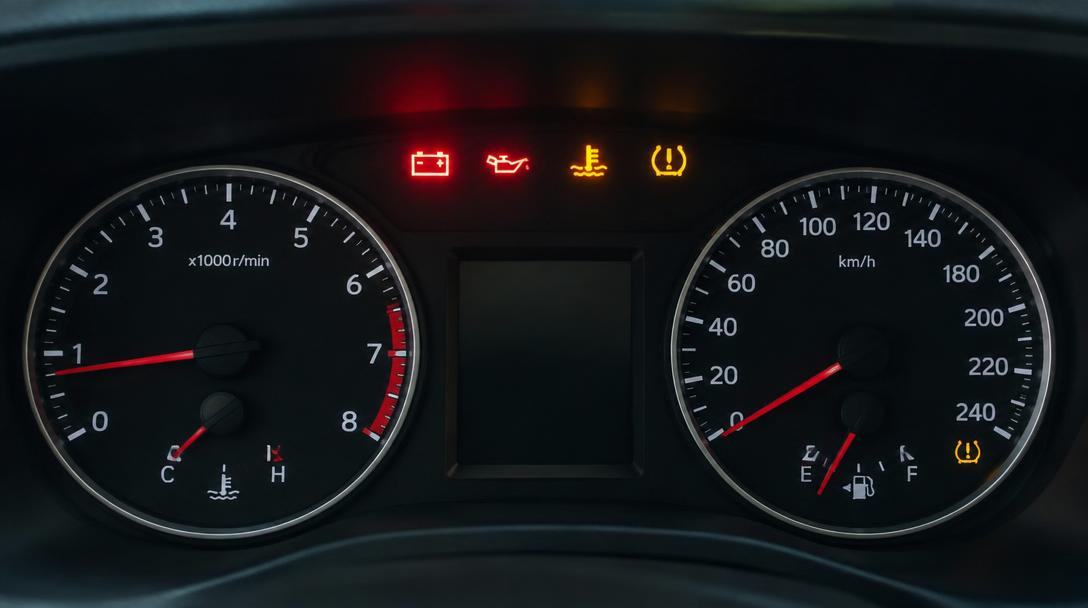
Quick answer: Dashboard warning lights identify a system that needs attention, not necessarily the part that needs replacement. An oil-pressure warning, overheating alert, or brake warning with abnormal braking means stop safely; other symbols may allow a prompt inspection, depending on the owner's manual and how the vehicle behaves.
Read the symbol, message, and vehicle behavior together
A dashboard is a communication panel, not a diagnosis sheet. The outline of a battery concerns the charging system, an oil can commonly concerns oil pressure, and a skidding-car symbol concerns traction or stability control. Those distinctions matter because the first action can be very different for each warning.
Start with the written message beside the icon, if present. “Stop safely,” “service required,” and “system off” are not interchangeable instructions. A photograph taken after parking helps preserve the exact wording. Never try to identify a tiny symbol on your phone while steering through traffic on Roosevelt Road.
Color supplies a useful first clue. Red commonly signals an urgent condition or an important safety reminder, amber usually calls for attention, and green or blue often indicates an operating feature. But color is not permission to continue driving. A red seat-belt reminder and a red oil-pressure warning require different responses, while an amber warning accompanied by loss of control can be urgent.
The Car and Driver dashboard-symbol guide provides a broad visual reference. Your vehicle's own manual remains the better authority for an unfamiliar symbol, especially on hybrids, electric vehicles, and vehicles with multiple driver-assistance packages.
Why lights appear briefly when you start the car
Many warning lamps illuminate during an ignition self-check, then turn off once the engine starts or the system finishes checking itself. An oil-pressure light with the engine stopped is not the same situation as that light appearing while the engine is running. Context changes the meaning.
A light that stays illuminated after its normal startup sequence deserves attention. So does a warning lamp that no longer participates in the self-check described by the manual. Not every model tests every symbol in the same way, so avoid judging the vehicle against a dashboard video from a different year.
Sensors and control modules watch operating conditions, compare signals, and request warnings when something falls outside expected limits. A warning may reflect a real mechanical condition, a sensor or wiring problem, or another system's failure. Calling every warning “just a sensor” skips the very question that needs answering.
Several lights can appear together when systems share information or electrical power. That does not automatically mean several unrelated parts failed simultaneously. Equally, it does not mean the collection of warnings is harmless. The accompanying symptoms and diagnostic information help establish which condition came first.
Oil, temperature, and charging symbols are not maintenance reminders
An oil-can symbol commonly warns about insufficient engine oil pressure. It is different from an oil-life percentage or scheduled oil-change reminder. If the pressure warning appears while driving, move to a safe stopping place and shut the engine off. Continuing to run it can turn a repairable condition into serious damage.
Checking the oil level after the specified waiting period may reveal a low level, but a normal dipstick reading does not prove pressure is adequate. Do not restart repeatedly to see whether the light eventually disappears. Follow the vehicle's instructions and arrange assistance if the warning persists or its cause is uncertain.
A thermometer over waves usually identifies excessive coolant temperature. Stop safely and follow the shutdown instructions for that vehicle. Never open a hot cooling-system cap. Escaping pressurized coolant can cause severe burns, and steam is a reason to stay clear rather than lean over the engine.
A battery-shaped warning during engine operation generally concerns charging, not a direct measurement of whether the battery needs replacement. The vehicle may eventually lose electrical power or stop running. If that warning comes with rising temperature, heavy steering, smoke, or an unusual belt noise, stop safely rather than trying to finish the trip.
Ford's vehicle health alert reference distinguishes oil-pressure, coolant-temperature, and other alerts and emphasizes their separate responses. Use such references to understand the categories, not to substitute another manufacturer's procedure for your own.
Brake, ABS, and airbag warnings carry different meanings
A red brake warning may indicate an applied parking brake, low brake fluid, or another brake-system concern. First verify the parking brake is fully released while safely stationary. If the warning remains, or the pedal feels soft, braking changes, or fluid is leaking, do not continue driving to test it.
An ABS warning usually means the antilock function has a fault. Basic braking may remain, but the vehicle may not manage wheel lock as designed during a hard stop. A red brake warning appearing with ABS requires particular caution and the response specified in the manual. Do not assume normal pedal feel clears the vehicle for travel.
A seated-person-and-circle symbol commonly concerns airbags or the restraint system. A persistent fault warning can mean protection will not function as intended in a crash. A passenger-airbag status indicator, however, can be normal depending on seat occupancy and the vehicle's design. Read the label and manual before treating both displays as the same warning.
These alerts deserve attention even when the car accelerates normally. Their importance concerns stopping and occupant protection, not engine smoothness. Resist the temptation to cover a distracting light or disable its chime; doing so removes information without correcting the underlying condition.
Tire and traction lights during Hillside winters
The horseshoe-shaped symbol with an exclamation point usually belongs to the tire-pressure monitoring system. It is not a tire tread indicator. A steady warning commonly means at least one tire is significantly underinflated, while a flashing sequence followed by steady illumination can identify a system malfunction on many vehicles.
NHTSA's tire-safety guidance explains why pressure checks still matter even with electronic monitoring. Use the cold-pressure specification on the vehicle's tire placard, not the maximum molded into the tire sidewall. If a tire looks flat or the vehicle pulls or thumps, stop safely rather than driving to find an air pump.
Cold weather can lower tire pressure enough to bring on a warning during a morning departure from Bellwood. That does not make the light a false alarm. Measure all tires when cold, adjust them correctly, and investigate a tire that repeatedly loses pressure instead of blaming every recurrence on temperature.
A flashing skidding-car symbol often means traction or stability control is actively intervening. A steady light can indicate a fault or a deliberately disabled function, depending on the symbol and model. On snowy roads, ease your inputs and slow down; the light does not mean the vehicle can overcome limited grip.
NHTSA's winter-driving advice emphasizes preparation and conditions-appropriate driving. Salt spray, slush, and ice may also obstruct driver-assistance sensors on some vehicles. Follow the manual's cleaning instructions without assuming that every persistent assistance warning is merely dirt.
Distinguish convenience indicators from fault warnings
Blue high-beam and green lighting indicators generally report a selected function rather than a mechanical failure. A washer-fluid symbol often means the reservoir needs attention. These displays still matter: high beams can dazzle another driver, and an empty washer reservoir becomes a visibility problem on a salt-covered windshield.
A wrench, maintenance message, or oil-life display can identify scheduled service rather than an immediate breakdown. The meaning is manufacturer-specific; some wrench symbols also report powertrain faults. Read the actual message instead of applying a universal internet legend to every make.
The engine-shaped malfunction indicator deserves its own diagnosis rather than a guess based on the icon. A flashing light with shaking or power loss is more urgent than an otherwise steady light. Likewise, a gear-shaped symbol or transmission message identifies a separate category that needs its exact wording recorded.
Driver-assistance warnings may say a feature is temporarily unavailable, switched off, or malfunctioning. Do not rely on automatic braking, lane support, or adaptive cruise control when the display says the function is unavailable. Continue driving only if you can safely control the vehicle yourself and the manual permits it.
Safe checks before arranging a diagnostic visit
Park away from moving traffic, apply the parking brake, and record the warning's shape, color, and wording. Note whether it appeared at startup, after a pothole impact, during braking, or after twenty minutes in I-290 congestion. Those details are more useful than simply reporting that the dashboard lit up.
Check straightforward items only when safe: an unlatched door, the parking-brake position, or cold tire pressures. Consult the owner's manual before opening reservoirs or touching unfamiliar components. Stay away from hot parts, moving belts, and orange high-voltage cables. Do not crawl beneath an unsupported vehicle to investigate a warning.
Avoid disconnecting the battery or clearing fault codes as a first response. That can erase useful information without repairing anything. If the warning disappears on its own, keep your notes. Intermittent faults often require the conditions surrounding the event to make sense of the stored evidence.
When a warning appears on I-290 or I-294, focus first on reaching a safe place without abrupt maneuvers. Do not stop in a live lane merely to consult the manual. If the vehicle becomes disabled or there is immediate danger, request appropriate emergency or roadside help rather than attempting roadside diagnosis.
Getting warning lights evaluated in Hillside
Rios Auto Service offers check-engine diagnostics at 4218 Roosevelt Rd, Hillside, IL 60162. The independent, family-run shop is owned by Juan Rios. Describe every warning you saw and ask whether the affected system falls within the evaluation needed for your vehicle.
Ask for an honest inspection, an explanation of what the evidence shows, and a chance to see relevant findings. A useful repair discussion separates confirmed defects from possible causes and explains what additional testing would establish. That approach keeps decisions focused on the complaint rather than unrelated add-ons or a replacement based solely on an icon.
Walk-ins are welcome Monday through Friday, 8 AM–6 PM, and Saturday, 8 AM–4 PM; Sunday is closed. Call (708) 632-4808 or use the contact page to describe the warning. Do not drive an unsafe vehicle simply because the shop is nearby. Explain any stop-driving message before deciding how the vehicle should arrive.
Frequently asked questions about dashboard warnings
Can I drive if the warning is amber rather than red?
Not automatically. Amber usually calls for attention, but vehicle behavior and the manual's instructions take priority. Loss of braking, severe shaking, smoke, or sudden steering changes can make an amber warning urgent. If you cannot identify the warning, stop safely and clarify it before continuing.
Why do several warning lights appear at once?
Systems can share electrical supply, sensors, or network information. One problem may therefore disable several features. Separate faults are also possible. Record the sequence and messages rather than assuming the vehicle needs every named system replaced. Diagnosis should establish the relationship among the warnings.
Does restarting the car fix a warning?
A restart can change what the dashboard displays, but it does not prove the cause is repaired. Some intermittent conditions leave stored information even when their lights go out. Do not restart an overheated engine or one with an unresolved oil-pressure warning simply to test whether the symbol returns.
Is a photograph enough for a diagnosis?
It is a helpful starting point, not a complete diagnosis. A photograph identifies the displayed message but cannot establish fluid pressure, wiring condition, or system performance. Pair it with the time, driving conditions, and any changes in braking, steering, temperature, or power.
Related question
For a closer look at delayed engagement, slipping, and gear-related alerts, read Transmission Warning Signs.