
Check Engine Light Diagnostics
Pre-Purchase Inspections for Used Cars
A pre-purchase inspection helps Hillside used-car buyers spot safety issues, hidden wear, and upcoming repairs before committing to a vehicle purchase.
By the team at Rios Auto Service, Hillside, IL · · 9 min read
Quick answer: A pre-purchase inspection is an independent assessment of a used vehicle’s current condition before you agree to buy it. It can uncover safety concerns, deferred maintenance, and evidence of expensive problems, but it cannot guarantee future reliability or replace title and history checks. Arrange it before signing or paying a nonrefundable deposit, and agree on the inspection’s scope first.
Why a clean-looking used car still needs an inspection
A fresh detail tells you someone cleaned the car. It does not tell you whether the brake lines are badly rusted, the engine leaks after warming up, or the suspension has looseness hidden by a smooth parking-lot drive. Likewise, an attractive service history is useful evidence, not proof that everything remains sound today.
An inspection connects several kinds of evidence: physical condition, maintenance records, electronic information, and behavior on a permitted road test. A worn tire may suggest an alignment concern, but checking suspension joints can reveal whether alignment alone would miss the underlying problem. The value is in connecting findings, not simply producing a long checklist.
Consumer Reports recommends a thorough mechanic’s inspection before finalizing a used-car purchase. That advice applies even when the seller seems trustworthy or says the car was already inspected. A seller’s inspection may have served a different purpose, used a narrower checklist, or happened before additional wear developed.
Think of the result as a condition report with limits. A technician usually is not disassembling the engine or removing every interior panel. Intermittent faults may stay quiet during the appointment. Clear documentation of what was checked, what was inaccessible, and what needs further testing makes the report more useful than a simple “good car” verdict.
What a meaningful inspection should cover
Before booking, ask whether the proposed work includes a lift inspection, an authorized road test, electronic checks, and written findings. Confirm that the shop can evaluate that particular vehicle. A conventional gasoline sedan, a modified truck, and a battery-electric vehicle do not require identical knowledge or equipment.
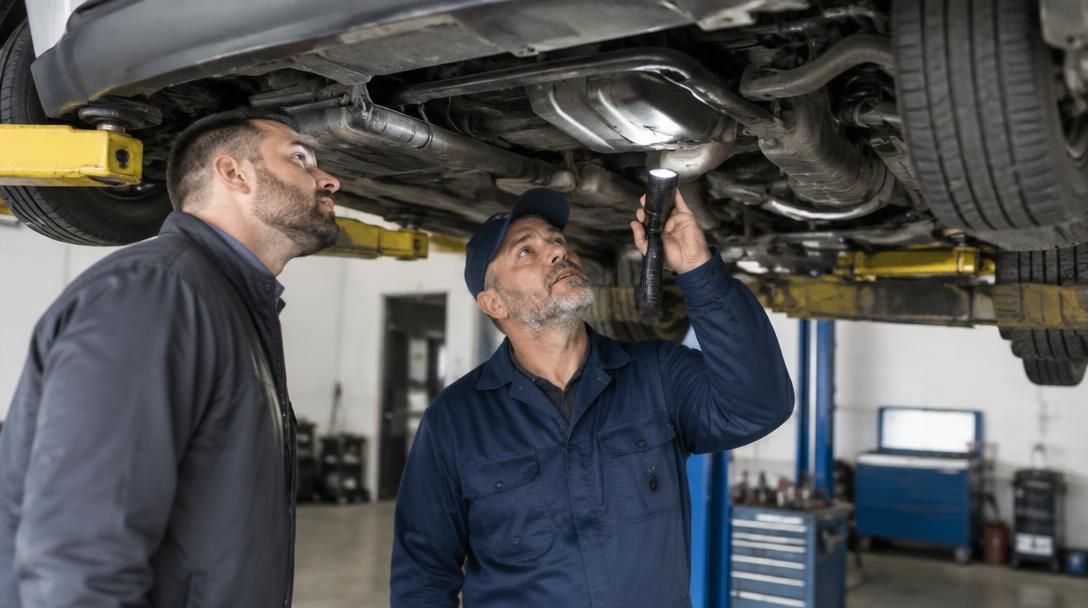
Underneath, the inspection should address accessible structural areas, leaks, steering and suspension components, brake components, tires, exhaust, and visible lines and hoses. Surface oxidation and significant metal loss are different findings. Photographs and a specific location help you understand whether the concern is cosmetic, repairable wear, or a reason to stop considering the vehicle.
Underhood checks can reveal deteriorated hoses, poor repairs, missing hardware, unusual fluid conditions, or leakage. Fluid appearance alone cannot prove an engine or transmission is healthy. If the inspection raises a concern requiring pressure testing, compression testing, or other diagnostic work, request authorization details before anyone goes beyond the agreed scope.
Inside, basic equipment matters too. Test the heating and air conditioning, seat adjustments, windows, locks, wipers, lighting, and accessible safety-belt functions. Broken convenience features can become real ownership expenses. For hybrids and electric vehicles, ask specifically about battery-health assessment; a normal test drive and dashboard range estimate are not a complete traction-battery evaluation.
Why Hillside driving makes the underside important
Chicago winters give used-car buyers a good reason to care about what is underneath the paint. Repeated exposure to moisture and road salt can corrode underbody metal, lines, fasteners, and mounting areas. A car advertised as having low mileage may still have spent many winters outdoors. Mileage and environmental exposure measure different things.
For a vehicle driven around Roosevelt Road, Mannheim Road, or nearby western suburbs, pothole impacts are another relevant inspection concern. Uneven tire wear, bent wheels, damaged tires, and worn suspension parts deserve attention. None proves the previous driver hit a particular pothole; the point is to evaluate the resulting condition rather than guess at its history.
Consider your own use, too. Someone commuting on I-290 needs confidence beyond a five-minute drive around a sales lot. With permission and safe conditions, a road test should include varied speeds and normal braking, not aggressive maneuvers. Heavy traffic may limit what can be assessed, so ask the inspector to note that limitation.
Short winter trips can also leave a vehicle with maintenance needs that its odometer does not make obvious. Compare the manufacturer’s time-based service requirements with dated receipts. A low-mileage car can still have overdue fluids, aged tires, or deteriorated rubber parts. “Barely driven” is a description to investigate, not an automatic advantage.
Safe checks you can do before booking
Start in daylight on level ground with the seller’s permission. Walk around the vehicle and look for mismatched paint, uneven panel gaps, damaged lamps, tire damage, and water inside light housings. These are prompts for closer evaluation, not reliable proof of a crash. Do not crawl underneath a car supported only by a jack.
Open the doors and trunk. Notice damp carpeting, musty odors, heavy deodorizer, or corrosion in unusual interior locations. Flood damage can be difficult to establish from a quick look, and a dry cabin does not rule it out. Tell the inspector what you noticed rather than pulling trim apart at the seller’s location.
Ask to see a genuinely cold start when practical. Listen and observe from a safe position; do not reach near moving belts or fans. Check that dashboard indicators behave according to the owner’s manual. Never open a hot cooling-system cap or touch unfamiliar high-voltage components. If the seller already warmed the engine, simply record that fact.
Bring service receipts and compare their mileage and dates with the odometer. NHTSA’s odometer-fraud guidance recommends comparing the displayed mileage with title and maintenance records. A discrepancy needs an explanation supported by documents. Interior wear can prompt questions, but worn pedals or a pristine steering wheel cannot independently establish the vehicle’s true mileage.
Check the identity and history separately
Compare the vehicle identification number on the car with the documents you are reviewing. Resolve discrepancies before proceeding. A mechanic’s condition inspection does not establish the seller’s legal ownership, clear a lien, or guarantee that a title is transferable. Those are separate checks, and they deserve attention before money changes hands.
Use the VIN for NHTSA’s recall lookup. The tool identifies certain unrepaired safety recalls, but its coverage has limits, including some older recalls and recently announced campaigns. A result showing no open recalls is not a clean bill of health. If a recall appears, ask the manufacturer’s dealer about the remedy and any driving restrictions.
History reports can add useful information about reported accidents, ownership, or title events, but unreported damage may not appear. Compare the report with the physical vehicle and repair paperwork. “No accidents reported” means something different from “never damaged.” A convincing explanation should fit the evidence, not require you to ignore it.
Prior collision repairs deserve particular care when restraint systems are involved. NHTSA has warned used-car buyers about dangerous substandard replacement air-bag inflators. If air bags deployed previously, request repair documentation and discuss whether specialist verification is needed. Do not remove air-bag covers or assume an unlit warning lamp verifies the identity and quality of every installed component.
Why electronic checks are only one part of the picture
A scanner can reveal useful information, but a vehicle without stored engine codes can still have serious mechanical or structural defects. Conversely, a recorded code is a starting point for investigation, not an automatic instruction to replace a named part. The inspection should put electronic findings alongside physical observations and driving behavior.
Ask whether readiness information was checked. Some monitors may be incomplete after a battery disconnect, cleared codes, or certain repairs. That does not prove someone concealed a defect, but it can limit what the inspection establishes. Ask what explanation and follow-up evaluation would be needed before making a buying decision.
For buyers who will register an eligible vehicle in the Illinois emissions-testing area, distinguish an emissions result from an overall condition assessment. A passed emissions test does not evaluate all safety equipment, structural condition, or upcoming maintenance. Keep emissions paperwork as one piece of the purchase file rather than treating it as a substitute for inspection.
Book before committing, and define the next step
Arrange access with the seller before paying for an appointment. Confirm who may drive the vehicle, whether the seller will deliver it, and how additional testing would be authorized. Ask the inspecting shop about scope, expected timing, and charges directly; there is no single inspection package that applies to every vehicle.
If the seller refuses an independent inspection, you do not need to prove dishonesty to decline the purchase. The refusal leaves you with uncertainty you cannot resolve. A rushed deadline, another supposed buyer, or a request to inspect only after purchase should not force you to accept a risk outside your budget.
Do not take a questionable vehicle onto I-290 just to see whether a symptom clears up. Severe brake concerns, significant tire damage, fuel leakage, overheating, or suspected structural failure are reasons to stop the test drive. Discuss safe arrangements with the seller rather than treating the trip to a mechanic as permission to drive an unsafe car.
Turn the findings into a purchase decision
Ask for findings separated into immediate safety needs, repairs needing diagnosis, and maintenance you should budget for. The distinction matters. A car needing ordinary scheduled service is different from one with uncertain structural damage or a major unresolved drivetrain complaint, even if both reports contain several items.
Request estimates where the repair scope is clear, and ask what remains uncertain where it is not. Do not negotiate using an assumed worst-case repair bill presented as fact. Equally, do not let a small discount persuade you to absorb an unknown problem you cannot afford to investigate.
You can accept normal wear, negotiate documented needs, request a follow-up inspection after repairs, or walk away. There is no requirement to find a flawless used car. The practical goal is a vehicle whose known condition, remaining uncertainty, and likely ownership expenses fit your needs without relying on a seller’s reassurance.
Discussing a used-car inspection with Rios Auto Service
Rios Auto Service is an independent, family-run shop owned by Juan Rios at 4218 Roosevelt Rd, Hillside, IL 60162. Its services include check-engine diagnostics. Before bringing a seller’s vehicle, call to discuss whether the requested pre-purchase assessment can be accommodated and what it would include; do not assume a particular package or specialist test is available.
Bring the VIN, listing, service records, and your observations. Ask for an honest assessment, to see what is found, and for explanations that separate necessary work from optional maintenance. Keep the discussion centered on evidence rather than an upsell or a promise that any used vehicle will remain trouble-free.
Walk-ins are welcome, but coordinating with a seller makes advance contact sensible. Hours are Monday–Friday, 8 AM–6 PM, and Saturday, 8 AM–4 PM; Sunday is closed. Call (708) 632-4808 or use the contact page before arranging delivery or committing to a purchase deadline.
Frequently asked questions about pre-purchase inspections
Does a dealer’s inspection make an independent one unnecessary?
No. Ask for the dealer’s written report, then discuss its scope with your chosen inspector. A dealer’s checklist or certification may provide useful information, but it may not answer your questions about current condition, developing problems, or maintenance due soon.
Can an inspection guarantee that the engine will last?
No. It assesses observable condition at that time within an agreed scope. Hidden internal wear and intermittent problems may remain undetected. Ask which findings were verified, which are suspicions, and whether further testing would materially reduce uncertainty before you buy.
Should I inspect an inexpensive older car?
Usually, yes. A modest purchase price does not reduce the importance of safe brakes, tires, and structure. Explain your budget and intended use so the inspection discussion focuses on meaningful risks rather than cosmetic imperfections you are willing to accept.
What if the seller repairs everything on the report?
Request receipts identifying the work performed and consider a follow-up assessment of significant repairs. A promise to “take care of it” is not the same as documented correction. Confirm that the original concern was resolved rather than assuming a new part or cleared warning proves success.
Related question
If a warning appears while you evaluate a vehicle, read Check Engine Light On? What to Do First before deciding what to do next.
Sources
- Consumer Reports — How to Inspect a Used Car to Avoid Costly Repairs (opens in new tab)
- NHTSA — Check for Recalls (opens in new tab)
- NHTSA — Consumer Advisory Tips from NHTSA to Protect Against Odometer Fraud (opens in new tab)
- NHTSA — Consumer Alert on Dangerous Substandard Replacement Air Bags (opens in new tab)