
Check Engine Light Diagnostics
Passing Illinois Emissions with a Check Engine Light
Illinois emissions testing requires more than turning off a warning light. Hillside drivers can learn how repairs, readiness, and retest paperwork fit together.
By the team at Rios Auto Service, Hillside, IL · · 9 min read
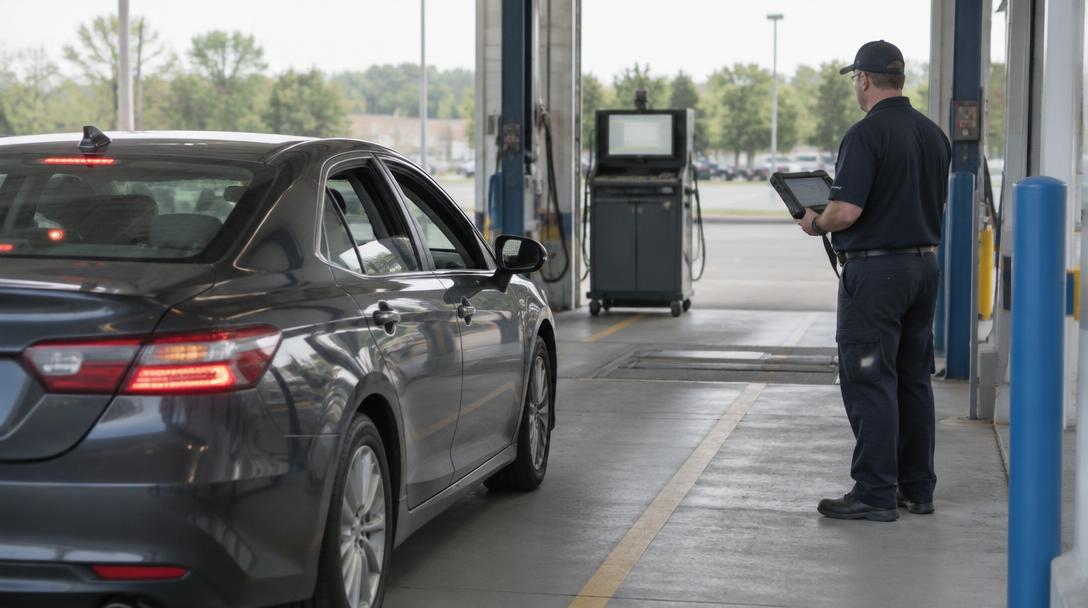
Quick answer: An emissions-related check engine light normally means the vehicle will not pass an Illinois onboard-diagnostics inspection. Repair the underlying fault, verify that the required readiness checks have completed, and bring any required retest documents; clearing codes immediately before testing is not a dependable or legitimate shortcut.
The inspection checks the computer, not just the dashboard
For covered gasoline vehicles, the emissions inspection uses the onboard diagnostic system to evaluate emissions-control operation. The testing equipment communicates through the vehicle's diagnostic connector. A dashboard that looks quiet is therefore only one part of the picture; the computer also reports whether its checks have run.
The engine computer continuously evaluates some conditions and checks others only when specific driving conditions occur. When it detects a qualifying malfunction, it can store a code and command the malfunction indicator lamp on. The inspector is interested in that electronic status, not simply whether the driver sees an illuminated bulb.
The Illinois EPA program overview explains the public-health purpose of testing and directs motorists to current Illinois Air Team information. Use those official resources for eligibility and station details rather than assuming another state's inspection rules apply in Cook or DuPage County.
A healthy-looking tailpipe does not prove the vehicle will pass. Likewise, a smooth-running engine can have an emissions fault. This is why an inspection is different from asking whether the car feels normal on the drive to work. The monitored condition may be invisible to the driver.
Understand failure, rejection, and incomplete readiness
A failure means the inspection identified a condition that does not meet the program's requirements. A rejection commonly means the vehicle could not complete an acceptable inspection, often because too many readiness monitors were incomplete. Those outcomes call for different next steps, even though neither gets you the passing result you wanted.
Readiness is the computer's record that a particular self-test has had an opportunity to run. “Ready” does not mean every component is new. “Not ready” does not automatically mean a component has failed. It means that evaluation has not yet completed under the conditions the vehicle requires.
A monitor can become ready and report a problem, producing a code. That distinction matters: driving until a monitor completes is not itself a repair. If the fault remains, completing the evaluation may simply turn the light back on and confirm why the vehicle needs attention.
Keep the Vehicle Inspection Report after any unsuccessful visit. It tells the next person whether the issue was a detected malfunction, insufficient readiness, or another problem. Saying only “it failed emissions” loses information that can prevent an unnecessary repeat trip or a repair aimed at the wrong issue.
Why clearing codes can create a second obstacle
An erase command can turn off the light temporarily while resetting readiness information. Disconnecting the battery can have a similar effect on many vehicles. Neither action fixes a leaking system, malfunctioning sensor circuit, or damaged emissions component. It may instead remove information useful for diagnosis.
The Illinois Air Team FAQs explicitly explain that clearing codes resets monitors and does not provide a way around the test. A vehicle can be rejected while those checks are incomplete, or fail when the original condition is detected again. Timing a reset is not a repair strategy.
The program currently describes rejection when more than two non-continuous monitors are incomplete on 1996–2000 vehicles, or more than one on 2001-and-newer vehicles. It also requires the catalyst monitor to be ready for a retest following an initial failure for a catalyst code. Confirm current requirements for your specific vehicle before returning.
Do not interpret an allowance for an incomplete monitor as advice to manipulate testing. The practical goal is a repaired vehicle with sufficient verified readiness. Special vehicle conditions and program changes can affect how a particular inspection is handled, so let the official program resolve eligibility questions.
Plan around the notice, not the last available afternoon
For a Hillside driver, the most useful first step is checking the actual test notice and registration deadline. Confirm the vehicle's identity and whether it is due. Do not rely on when a neighbor's car was tested or assume every vehicle in the same household follows the same schedule.
Most covered gasoline passenger vehicles first enter the program after they are four years old, with testing generally following the model-year cycle. Exemptions and special cases exist. Use the official vehicle eligibility tool or contact the program when the notice and your understanding do not match.
Allow time for diagnosis, repair authorization, parts if needed, and post-repair monitoring. Those are separate stages. A repair completed shortly before closing does not necessarily leave enough time for the vehicle's self-tests to finish that evening, and a registration deadline does not change the computer's required operating conditions.
Drivers juggling work near Loyola University Medical Center or errands around Oakbrook Center may be tempted to squeeze a test into an already full day. Checking eligibility, readiness, and current station information first can save more time than choosing whichever route appears shortest on a map.
Why western-suburb driving does not guarantee readiness
The computer may require combinations of engine temperature, speed, load, fuel level, and time since startup before a monitor runs. The exact conditions depend on the vehicle and the monitor. Repeatedly starting the engine in the driveway will not necessarily reproduce them, even if the car becomes warm.
A week of brief trips between Berkeley and Hillside can leave a different operating history from one longer drive. Winter temperature may also prevent some checks from running under otherwise normal use. That is a reason to review vehicle-specific information, not proof that the repaired component is defective.
I-290 traffic is unpredictable, and a generic internet “drive cycle” can invite unsafe maneuvers. Never coast unusually, hold an impractical speed, or abruptly accelerate to satisfy a checklist in public traffic. Road conditions, posted limits, and surrounding drivers take priority over an emissions monitor.
EPA's readiness guidance recognizes that vehicle-specific readiness issues exist. If one monitor remains incomplete after appropriate normal driving, ask for the manufacturer's procedure and applicable technical information. More random miles are not always the most efficient answer.
Safe owner checks before booking a test
Start with the dashboard after a normal startup. Does the engine light complete its lamp check and then go out, or remain on? If it is flashing or the engine runs badly, address the operating problem before considering an emissions visit. Inspection planning never outranks safe vehicle operation.
If you have a compatible scanner and know how to use it, view readiness without selecting erase or reset. Save a report that identifies the vehicle, codes, and monitor status. Generic apps can use different labels, so avoid interpreting one green screen as an official promise that the vehicle will pass.
Check whether recent maintenance involved disconnecting the battery or clearing the computer. Give the date to the technician. If the light returned after an earlier repair, save that information too. These observations help distinguish a monitor that has not run from a recurring fault that needs further investigation.
Remove ordinary plug-in accessories from the diagnostic connector before testing, following their instructions. Air Team describes requirements for devices connected there and exceptions for certain mandated equipment. Do not tamper with an ignition-interlock or other required device; ask the program how its testing procedure applies.
Repair documentation matters after an unsuccessful test
Keep the inspection report together with repair invoices and any completed repair forms. Ask the repairer what must be supplied at retest and whether the required repair data has been submitted. A mechanically successful repair can still be followed by a frustrating visit if required paperwork is missing.
Air Team explains that incomplete repair data can cause a retest rejection. The issue is administrative, but it matters just as much to the day's outcome. Check the report's instructions before leaving for the station rather than hoping an invoice alone replaces every required form.
Do not assume an unsuccessful inspection automatically qualifies the vehicle for a waiver. Waiver eligibility is a separate program decision with its own conditions and documentation. Confirm the current rules directly before authorizing work based on an expectation of qualifying. Avoid relying on an old spending threshold quoted by someone else.
A waiver is not a reason to ignore a safety problem. A car that overheats, loses power, or runs severely rough needs attention regardless of registration paperwork. Keep those concerns separate from the administrative question of whether a particular exemption or waiver is available.
Ask for proof of repair, not just an extinguished light
A useful repair explanation identifies the fault, the tests supporting it, and what was done. The EPA's OBD overview describes stored diagnostic information as a tool for finding malfunctions. It is not an instruction to replace whichever part appears in the code description.
Afterward, ask whether the original condition has been rechecked and which monitors have completed. A cleared light immediately after service cannot prove the repair under all relevant conditions. Sometimes verification requires a cold start or a suitable road test that is not possible at the moment you collect the vehicle.
Ask what normal driving is appropriate and when readiness should be checked again. Get a clear distinction between “the repair is complete,” “the monitor is ready,” and “the vehicle has passed an official inspection.” Those statements describe different milestones. None should be casually substituted for the others.
If the light returns, record when and return with the report. A recurring lamp does not automatically prove that the original repair was unnecessary; multiple conditions may exist. The next step is comparing the new evidence with the earlier findings, not repeatedly clearing memory or buying another guessed component.
Bringing an emissions concern to Rios Auto Service
Rios Auto Service provides check-engine diagnostics at 4218 Roosevelt Rd, Hillside. The independent, family-run shop is owned by Juan Rios. Bring the test notice, any unsuccessful inspection report, recent repair records, and your description of how the vehicle behaves.
Request an honest inspection, findings you can understand, and recommendations supported by tests rather than an upsell. Be clear if you need help with a specific failure or readiness concern. Do not assume that a repair facility is an official emissions inspection station simply because it diagnoses engine warnings.
Walk-ins are welcome. The shop's hours are Monday through Friday, 8 AM–6 PM, and Saturday, 8 AM–4 PM; it is closed Sunday. Call (708) 632-4808 or use the contact page to discuss your situation and what information to bring.
For the official test itself, consult Illinois Air Team for current locations, availability, and program instructions. Shop hours and inspection-station hours are not interchangeable. Separating repair planning from testing logistics helps avoid an unnecessary drive, especially when you have limited time before a registration deadline.
Illinois emissions questions worth clearing up
Can a car pass if the engine light is on but it drives well?
Normal drivability does not cancel an emissions-related malfunction. A commanded engine warning generally means the vehicle will not pass the OBD inspection. Diagnose the fault rather than treating a smooth idle or good fuel economy as evidence that the testing equipment should overlook it.
How many miles should I drive after a repair?
There is no universal mileage that guarantees readiness. Monitor conditions depend on the vehicle, weather, and operating history. Ask for model-specific guidance and have readiness checked. Do not keep driving a vehicle with a flashing light or other serious symptoms merely to accumulate miles.
Is a rejection the same as a failed test?
No. Air Team distinguishes rejections from tests that produce a failure, and explains that rejects do not count as tests for waiver purposes. Read the report carefully. A readiness rejection may call for appropriate monitor completion, while an actual malfunction requires diagnosis and correction.
Related question
For one emissions code that needs careful interpretation, read P0420 Code: Is It Really the Catalytic Converter?.