
Brake Repair
Pads Only or Pads and Rotors?
Pads alone can work when rotors meet the vehicle's specifications. Learn how Hillside drivers can weigh thickness, surface condition, and repair options.
By the team at Rios Auto Service, Hillside, IL · · 9 min read
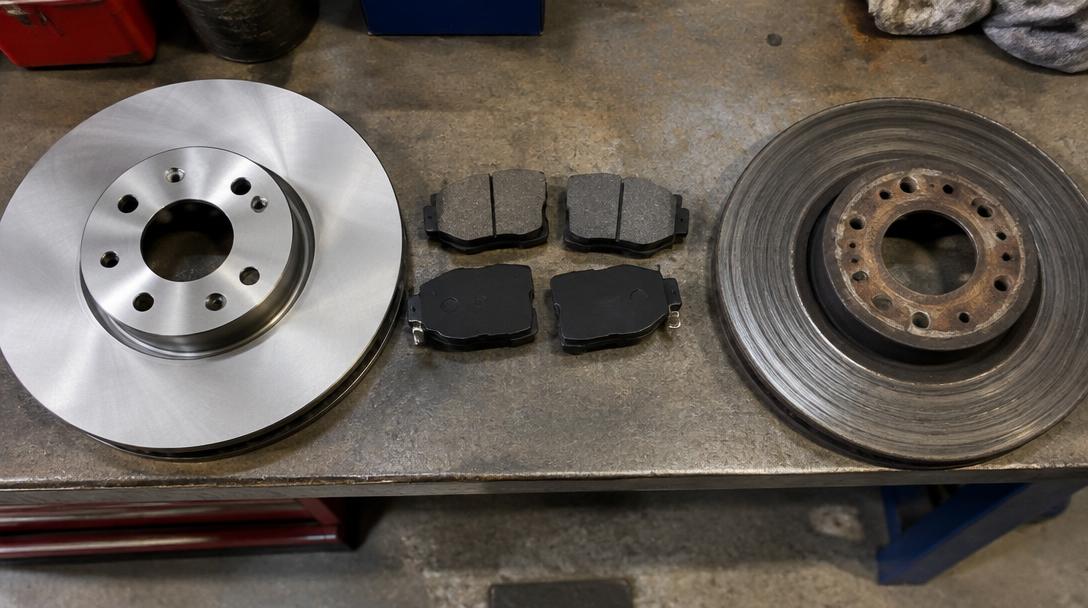
Quick answer: Replacing only the brake pads can be appropriate when the existing rotors meet the vehicle manufacturer's thickness, surface-condition, and runout requirements and the specified repair procedure permits reuse. Replace or appropriately service the rotors when measurements, damage, or manufacturer instructions require it; new pads cannot correct an unsuitable disc. The right choice comes from inspecting both sides of each rotor and measuring the parts, not automatically choosing the cheapest or largest repair package.
Pads and rotors wear together, but not at identical rates
Disc brakes slow a vehicle by squeezing pads against a rotating metal disc. The pads are designed to wear, but the rotor also loses material through use. Its condition matters because it provides the friction surface and absorbs heat during braking. A fresh pad needs a suitable partner to work against.
Different pad materials, driving patterns, vehicle weights, and brake designs create different wear relationships. One vehicle may have serviceable rotors when its pads need replacement. Another may have rotors near their allowable limit at the same point. There is no universal rule that a rotor lasts through exactly two pad changes.
Car and Driver's brake-pad guide explains that friction material gradually wears away and that allowing it to wear out completely can cause additional problems. Catching pad wear before the metal backing contacts the disc can preserve options, although it does not guarantee the rotors remain reusable.
The practical question is not whether a rotor looks old. It is whether that specific part remains suitable for the proposed repair under the applicable specifications. Age and mileage provide context, but measurements and condition determine whether keeping it is defensible.
When a pads-only repair can make sense
Pads-only service is a possibility when the rotors have acceptable thickness, an appropriate friction surface, and geometry within specification. There should be no disqualifying cracking, serious corrosion, or other damage. The vehicle manufacturer's procedure and the replacement pad instructions also need to allow the chosen approach.
A smooth-looking face is helpful but insufficient. A rotor can appear tidy while being too thin, and a visible outer face says little about the hidden inner surface. Likewise, a light wear ridge at the edge does not by itself establish that the rotor has failed. The working surface needs proper measurement.
Existing braking performance matters too. If there is a repeatable vibration, the inspection needs to identify its cause before fitting new pads. Putting fresh friction material against an uneven or unsuitable surface is not a dependable way to cure a complaint. It may simply transfer the problem into the new parts.
Bosch's brake-service guidance describes measuring pads and discs against manufacturer specifications rather than making replacement decisions from appearance alone. For a driver comparing estimates, that is the central distinction: a legitimate pads-only recommendation should rest on findings, just as a pads-and-rotors recommendation should.
Thickness is a limit, not a visual impression
Rotors have application-specific wear limits. Depending on the component and manufacturer information, relevant specifications may include a discard limit and a separate minimum thickness after machining. Those numbers serve different purposes. A part that is barely above its discard limit is not automatically a sensible candidate for resurfacing.
Measurement should avoid being fooled by the unworn lip at the rotor's edge. A suitable brake micrometer measures the worn friction area, and readings at several positions help reveal differences around the disc. The lowest relevant reading matters; averaging thick and thin areas does not make an undersized location acceptable.
A rotor must also have enough usable material for the planned service. Resurfacing removes metal. If correcting the surface would leave the disc below the applicable machining requirement, replacement is the appropriate path. “It can go on the lathe” is not the same as “it can be safely returned to service.”
Do not use a generic thickness number from another model or an online discussion. Even vehicles with the same name can have different brake packages. Ask for the measurement, the matching specification, and whether that specification applies before or after machining. Those details make a recommendation understandable without requiring you to become a brake specialist.
Surface damage can rule out reuse even when thickness passes
A thick rotor can still be unsuitable. Cracks, serious heat damage, deep scoring, or extensive pitting can prevent reliable service. The assessment depends on the rotor design and manufacturer criteria, but remaining thickness alone cannot overrule a damaged structure or an unacceptable friction surface.
Both sides deserve attention. The inner face can deteriorate differently from the outer one, and it is often difficult to see through the wheel. A photo of the accessible side may miss the reason replacement was recommended. Ask to see the specific area that failed inspection rather than judging from one polished-looking face.
Rotor runout and thickness variation are separate considerations. A rotor may have enough material yet fail a geometry check that matters to smooth braking. Bosch's technical disc-brake guidance outlines separate checks for wear, lateral runout, and thickness differences. Each answers a different question about whether the assembly is suitable.
Also ask whether a mounting problem is contributing. Corrosion or debris where the rotor seats on the hub can interfere with correct installation. A new disc is not a substitute for preparing that surface or correcting another fault. Repair quality depends on how the parts are installed, not just on whether the box says new.
Where resurfacing fits between reuse and replacement
Resurfacing is a third option on applications where it is allowed and enough material remains. A brake lathe removes a controlled amount of metal to produce an appropriate surface. It does not add thickness, repair a crack, or reverse structural deterioration.
The decision depends on the required finished thickness, the damage that must be removed, and the vehicle's service instructions. Some rotors will not be suitable candidates. Others may be technically machinable, but the labor and remaining service margin can make replacement the more practical choice.
Ask what “rotor service” means on an estimate. Cleaning an acceptable surface, machining a disc, and replacing it are different jobs. A clear description prevents a pads-only quote that includes no machining from being compared as though it were identical to a quote with new rotors.
There is no need to choose sides in an abstract debate about machining versus replacement. For your car, the useful answer is specific: what condition are these discs in, what does the manufacturer permit, and what condition will they be in after the proposed work? That is more informative than a blanket policy about every vehicle.
What Hillside winters change about the decision
Moisture and road salt expose brake assemblies to corrosion during Chicago-area winters. A light film on an exposed rotor after parking can be very different from deep pitting or a badly reduced contact area. The fact that a vehicle spends winter in Hillside does not automatically condemn its rotors.
A car used for short trips between Berkeley and Hillside may have a different service history from one making longer daily commutes. Time parked outdoors, moisture exposure, and how the brakes are used can affect surface condition. Two cars with similar odometer readings can therefore need different repairs.
Stop-and-go travel on I-290 and repeated stops along Roosevelt Road also make braking history relevant. Tell the shop if the vehicle regularly carries substantial loads or if its usage recently changed. That information adds context, but it should not replace the physical inspection or become an excuse for automatic replacement.
Winter can also affect hardware that allows the pads to move correctly. A restricted pad or sticking caliper component can create uneven wear and extra heat. If that problem remains, either new pads alone or new pads with rotors may wear poorly. The cause of unusual wear needs attention alongside the worn parts.
Safe owner checks before approving brake work
You do not need to remove a wheel to prepare for the conversation. Note the current symptoms, mileage, and date of the last known brake service. Find the old invoice if available; it may say whether the rotors were previously replaced or machined. Unknown history is useful to acknowledge rather than guess.
With the car parked and the brakes cool, you can look through an open wheel for obvious damage, but treat that view as incomplete. Do not touch recently driven brake components, apply oil to a braking surface, or try to smooth grooves yourself. A visual owner check cannot establish reusable rotor thickness.
Ask for findings in plain language: the pad measurements, rotor measurements and limits, condition of both faces, and any abnormal wear pattern. Photographs can help show damage, while written measurements explain defects a photo cannot capture. Neither format alone proves every aspect of the inspection.
Avoid authorizing parts solely because an online calculator says they are due. Conversely, do not refuse rotor work solely because the pads are the component you expected to replace. The strongest decision comes from matching the proposed work to the condition of your actual brake assemblies.
When to arrange inspection rather than keep shopping
If the car is grinding, braking poorly, vibrating strongly, or showing a brake warning, diagnosis takes priority over comparing packages. Ford's owner guidance lists persistent grinding or squealing, braking-related vibration, and other changes as reasons for immediate inspection. Do not wait for a metal-on-metal sound to become louder.
If stopping ability or control is compromised, stop in a safe place and arrange assistance rather than driving between shops for estimates. Smoke or a strong burning smell also calls for caution. An estimate cannot establish that the vehicle is safe to drive without knowing its condition.
For a scheduled pad replacement without urgent symptoms, it is reasonable to ask questions before authorizing additional work. Compare the same axle, parts scope, rotor treatment, and any necessary hardware or caliper correction. A lower total may reflect a smaller job rather than a better value for the same repair.
Talking through the options at Rios Auto Service
Rios Auto Service provides brake repair at 4218 Roosevelt Rd, Hillside, IL 60162. It is an independent, family-run shop owned by Juan Rios. Explain whether you are arranging routine pad service or investigating a change in how the car stops; those are different starting points.
Ask for an honest inspection and to see what was found before choosing pads only or pads and rotors. Request a distinction between work required by measurements or damage and any optional recommendation. That keeps the discussion practical and avoids treating the largest parts list as automatically the best repair.
Walk-ins are welcome Monday through Friday, 8 AM–6 PM, and Saturday, 8 AM–4 PM; Sunday is closed. Call (708) 632-4808 or use the contact page to discuss your concern. Bring previous service records if you have them, but do not drive an unsafe vehicle just to obtain an estimate.
Frequently asked questions about pads and rotors
Do new pads always require new rotors?
No universal rule applies to every vehicle. Existing rotors may be reusable if their measurements and condition meet the applicable requirements and the service procedure allows it. Replacement becomes appropriate when the rotors fail those criteria. Ask for the specific reason rather than accepting either “always” or “never” as an explanation.
Should both rotors on the same axle be replaced together?
Brake friction service is generally planned in matched axle sets to support consistent behavior from side to side, following manufacturer instructions. That does not mean both axles automatically need work. Ask which axle is affected, what was found on each side, and why the proposed scope is appropriate.
Can I wait to replace the rotors after installing pads?
Not if the rotors are already outside service requirements. New pads cannot compensate for insufficient thickness or serious damage. If the existing discs are serviceable, reuse may be reasonable; if they are not, splitting the job into stages does not turn the first stage into an acceptable repair.
Does an edge lip prove I need rotors?
An edge lip shows that the friction area and outer edge have worn differently, but it is not a complete measurement. A small lip can coexist with a worn disc, and a noticeable lip needs context. The decision should consider measured working thickness, both friction faces, geometry, and applicable service limits.
Related question
If the vehicle changes direction during a stop, read Car Pulls to One Side When Braking before assuming pads and rotors explain the whole problem.