
Brake Repair
Brake Line Rust on Older Cars in Cook County
Brake line rust can weaken hydraulic tubing before a leak appears. Learn what Cook County drivers can safely check and when an older car needs inspection.
By the team at Rios Auto Service, Hillside, IL · · 9 min read
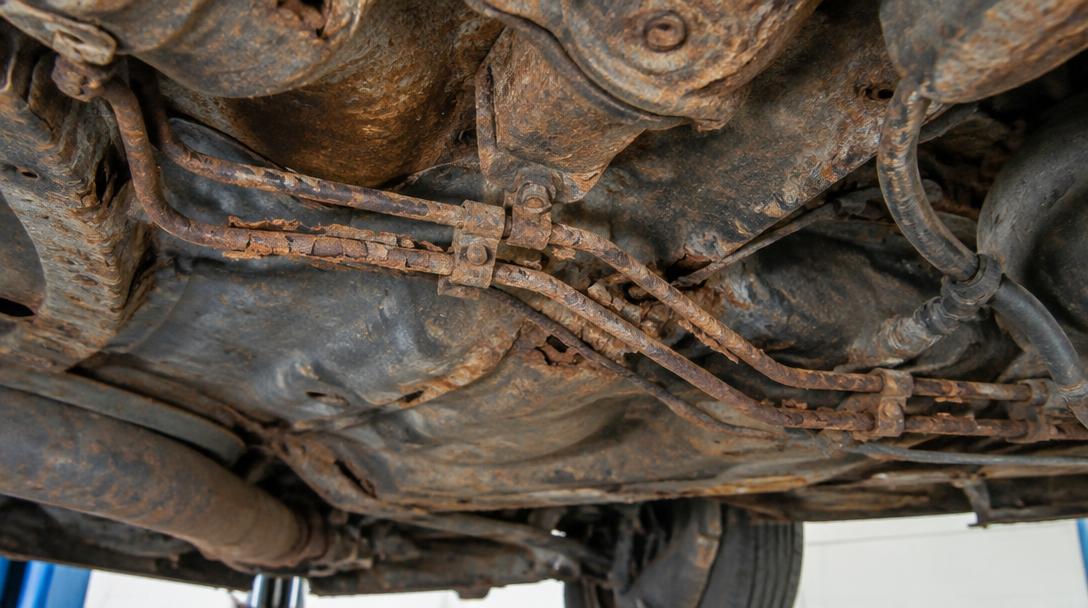
Quick answer: Rust on an older car’s brake lines deserves a close inspection because corrosion can thin hydraulic tubing until it leaks under pressure. Light surface discoloration is not the same as deep pitting or flaking, but visible leakage, falling fluid level, or changed braking means the vehicle should stay parked until professionally evaluated.
Why a narrow steel tube matters so much
The metal brake lines under a car carry pressurized fluid between the master cylinder, hydraulic controls, and wheel brakes. Flexible hoses accommodate movement near the wheels; rigid tubing carries fluid along much of the body. Although the tubing looks small compared with suspension parts, its ability to contain pressure is essential to dependable braking.
Corrosion removes metal. As a steel tube develops pits, the remaining wall can become uneven and thinner. The line may still look continuous from a distance while having a deeply weakened spot near a clip, bend, or union. A rusted surface does not tell you how much sound material remains underneath.
Brake pressure rises during a stop. That is why a weakened line may first reveal itself when the driver brakes firmly rather than while the car sits overnight. A dry driveway is reassuring only in a limited sense: it shows no obvious fluid has collected there, not that every line can safely hold operating pressure.
This article concerns hydraulic tubing, not every rusty component under the car. Surface rust on a bracket and corrosion on a pressure-carrying line have different consequences. A meaningful inspection identifies the component and its function before deciding whether cleaning, monitoring, protective treatment, or replacement is appropriate.
Cook County winters create a long exposure history
Road salt and moisture are familiar parts of winter driving around Hillside, Bellwood, and Maywood. Spray reaches the underside repeatedly, including during trips when the roads look merely wet. Debris can retain moisture around tubing supports and shields. Years of exposure matter more than how clean the vehicle looks after one wash.
A federal recall provides a concrete example. NHTSA’s Subaru brake-line corrosion notice included certain vehicles registered in Illinois and described salt water reaching lines near a protector. It linked excessive corrosion to possible leakage and increased stopping distance. That finding concerns listed vehicles, not every car driven in Cook County.
An older car’s history can cross county lines. A vehicle now parked in Westchester may have spent years elsewhere in the Chicago area, while another recently arrived from a less corrosive climate. Model year alone cannot capture that difference. Ask about previous registration, winter use, storage, and documented underbody maintenance when evaluating exposure.
Long periods of low mileage are not a guarantee of healthy lines. A seldom-used car can retain damp debris in hidden areas, and age-related deterioration continues between trips. Conversely, high mileage does not establish that replacement is automatically needed. Actual condition, routing, material, and the manufacturer’s guidance should drive the decision.
Surface color is not the same as remaining strength
A light, uniform orange film on exposed steel differs from heavy scale, deep pits, swollen sections, or corrosion concentrated beneath a retaining clip. Those distinctions help a technician assess concern, but they do not provide an owner with a reliable visual pass-or-fail rule. Much of the tube may be hidden from ordinary view.
Pay particular attention when an inspection report mentions flaking, pronounced pitting, damaged coating, or wetness. Ask where the finding is and whether neighboring sections have been assessed. A single photograph can document a problem area, but it may not establish the condition of the complete circuit or the concealed side of the line.
Do not scrape a suspect tube with a screwdriver to find “good metal.” Aggressive cleaning can breach an already weakened wall. Likewise, squeezing, bending, or tugging a rusty line is not a safe strength test. The appropriate inspection method depends on access and condition and belongs in a controlled service setting.
An apparently intact coating can also hide localized deterioration at damaged edges or fasteners. The question is not whether the line looks uniformly shiny. It is whether the installed tubing, fittings, supports, and adjoining components remain suitable for service. Appearance supplies clues, not a pressure rating.
Warning signs that change the urgency immediately
Fresh fluid around a tube, fitting, or wheel needs prompt investigation. Brake fluid may be clear, amber, or darkened with age, and its appearance can overlap with other liquids. Do not identify it by taste or by touching it. Keep people and pets away from unexplained drips and tell the mechanic where they appeared.
A dropping reservoir level, red brake warning with the parking brake released, or reduced braking makes this more than a preventive rust discussion. Leave the vehicle parked and arrange professional assistance. Do not add fluid and drive repeatedly while searching for the leak. A hydraulic fault can worsen unpredictably.
Kia’s corrosion campaign questions and answers describe how affected lines can lead to low fluid and warning symptoms after years of exposure. The document also discusses underbody maintenance. Its central lesson is that corrosion can become a functional braking issue, not merely a cosmetic defect beneath an older vehicle.
A car that stopped normally yesterday can still have a developing weakness. Neither a quiet brake system nor a clean dashboard measures the thickness of a corroded tube. If an inspection identifies seriously compromised lines, waiting for the pedal to change is the wrong threshold for taking action.
What you can safely check from outside the car
Start with records. Look for previous brake-line replacement, corrosion inspection notes, recall repairs, and underbody work. Ask whether a prior repair covered one short section or a larger run. A receipt saying “brake service” is too broad to establish that the hydraulic tubing was inspected or renewed.
With the car parked securely on level ground, look for fresh spots beneath it and obvious wetness visible from beside a wheel. If the reservoir is readily accessible, observe the external marks according to the owner’s manual. Avoid opening the cap unnecessarily, and do not handle tubing or unknown fluid.
A phone photograph taken from a safe standing or crouching position can help record what you noticed. Do not crawl under a car held up by its roadside jack. Do not reach near hot exhaust parts or place yourself where the vehicle could move. A proper lift inspection is different from a hurried driveway look.
If nothing is visible, report that accurately: “I did not see a leak.” Avoid translating it into “the lines are fine.” The most vulnerable area may be above a shield, over a fuel tank, or at the back of a clip. Access limitations are part of the reason professional inspection matters.
What a useful corrosion inspection should include
The technician should identify the affected tubing and evaluate accessible routing, attachment points, unions, and adjacent sections. Wetness, pitting, damaged supports, and contact with other components all matter. The inspection should distinguish metal lines from flexible hoses and from unrelated fuel or vapor plumbing nearby.
Bosch’s brake-service overview treats hydraulic components and fluid as part of the braking system rather than focusing only on pads. For an older salt-exposed car, ask specifically about the lines. A wheel-off friction inspection may not automatically reveal a concealed section farther forward or behind an underbody panel.
If access requires removing a shield or another component, discuss that before work begins. Sometimes a visible finding justifies further inspection because the adjoining area shares the same exposure. That is different from assuming every tube needs replacement without evaluating it. The recommendation should explain both the evidence and the uncertainty.
An estimate should identify the affected circuit or routing and any related fittings, supports, or hoses that cannot be safely reused. Corroded connections may complicate disassembly. Ask what happens if an adjoining fitting breaks during removal and how additional authorization will be handled before assuming the first estimate covers every possibility.
Repair means restoring a hydraulic assembly, not covering rust
Paint, tape, sealant, and generic patches cannot restore metal already lost from a pressure line. Protective products may have a legitimate role on suitable components, but they are not a substitute for replacing structurally compromised tubing. Covering heavy scale without assessment can also make future inspection harder.
A proper replacement uses appropriate brake tubing or assemblies, compatible fittings, correct flares, secure supports, and safe routing. The line must avoid abrasion, heat, and interference with moving components. An improvised plumbing compression fitting is not an acceptable substitute for the connection required by the vehicle’s brake system.
Replacing one failed area does not automatically make nearby aged tubing sound. The scope should reflect the rest of the inspection, access, and manufacturer requirements. Sometimes a localized repair is appropriate; sometimes a longer assembly is the responsible choice. The deciding factor should be the condition and approved repair method, not simply the shortest visible leak.
After the hydraulic system is opened, it requires the specified bleeding procedure and verification. Some vehicles need electronic service functions. The finished work should establish a consistent pedal and no leakage, with tubing secured along its proper route. A repaired car should not return to use merely because a puddle has stopped growing.
Prevention and recall checks for western-suburb owners
Follow the manufacturer’s underbody-cleaning guidance to reduce retained winter contamination. Cleaning is preventive care, not a reversal of existing metal loss. Avoid directing a high-pressure stream at deteriorated components or assuming a wash has certified their condition. An already suspicious line needs evaluation before another drive or an aggressive cleaning session.
When arranging routine maintenance, mention that the car has spent years in Chicago winters and ask about accessible brake-line condition. There is no universal birthday at which every line becomes unsafe. Regular documented observations are more useful than an arbitrary replacement interval copied from a different model or climate.
Use the VIN in NHTSA’s recall lookup to check for applicable safety campaigns. A recall for a similar-looking car may not include yours, and a result without an open recall is not an inspection certificate. If a campaign applies, follow the manufacturer’s instructions and dealer repair process.
Keep photographs and invoices so future recommendations have context. A record of which lines were renewed can help avoid confusion when old and newer sections share the underside. Tell the next technician about previous corrosion repairs rather than assuming the service history is obvious from a glance.
Discussing an older car at Rios Auto Service
Rios Auto Service, owned by Juan Rios, is an independent, family-run shop at 4218 Roosevelt Rd, Hillside, IL 60162. For a rust concern, begin with its brake repair service and describe whether you are seeking preventive inspection or already have leakage or changed braking.
An honest discussion should show what was found where it is safely accessible, using photographs when useful, and separate urgent structural deterioration from cosmetic rust. Ask why the recommended repair scope is appropriate. That keeps the conversation focused on the actual hydraulic risk instead of replacing unrelated parts because the car has accumulated winters.
Walk-ins are welcome. Call (708) 632-4808 or use the contact page before bringing a vehicle whose safety is uncertain. The shop is open Monday–Friday, 8 AM–6 PM, and Saturday, 8 AM–4 PM; Sunday is closed. Do not drive a leaking car simply because an inspection location is nearby.
Frequently asked questions about rusty brake lines
Does every rusty brake line need immediate replacement?
No. Surface condition varies, and a competent inspection must distinguish minor discoloration from serious deterioration. However, deep pitting, heavy flaking, or leakage should not be dismissed as normal age. Ask for the specific finding and recommendation rather than accepting either automatic replacement or automatic reassurance.
Can I wait until the line starts leaking?
That is not a safe maintenance plan. Leakage means the system has already lost containment, possibly during a stop. When inspection identifies compromised tubing, act on the condition before a failure. Normal pedal feel does not demonstrate that a rust-weakened line has adequate remaining strength.
Will undercoating save a badly rusted tube?
No coating restores missing metal. A protective treatment may be appropriate for suitable components under an approved procedure, but serious corrosion needs repair rather than concealment. Ask whether the line has been evaluated before any product is applied over it.
Related question
For the separate decision about friction components, read Pads Only or Pads and Rotors?.