
Walk-In Oil Change
Why Your Oil Light Comes On After Short Trips
An oil light after short trips may mean scheduled service or a pressure problem. Hillside drivers should identify the warning before driving farther.
By the team at Rios Auto Service, Hillside, IL · · 9 min read
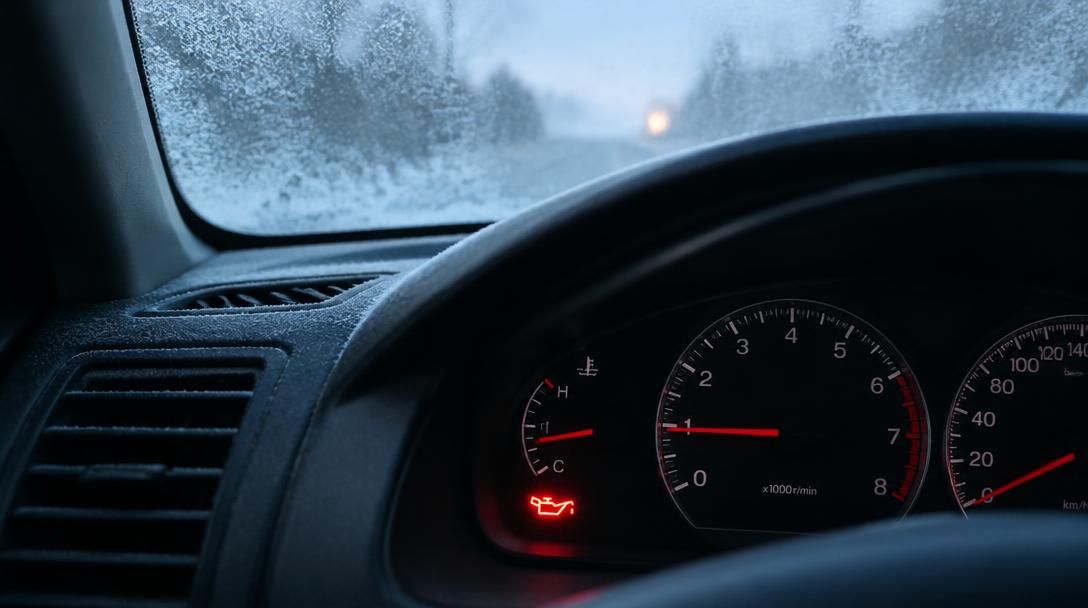
Quick answer: After repeated short trips, an oil-change reminder may appear sooner because the vehicle’s maintenance system accounts for demanding operation. But an oil-pressure warning while the engine runs is not a normal consequence of short trips: pull over safely, shut the engine off, and follow the owner’s manual before operating it again.
First identify which “oil light” you are seeing
Drivers use the same phrase for several very different messages. “Change engine oil soon” generally concerns scheduled maintenance. “Low oil level” concerns the amount in the engine. An oil-can symbol or “low oil pressure” message may mean the engine is not receiving adequate lubrication pressure. Their urgency is not interchangeable.
Do not rely entirely on color. Red commonly signals urgency, but symbols and displays vary by vehicle. Read the wording and find the matching indicator in the owner’s manual. If you cannot identify an oil warning that appears while the engine is running, treat it conservatively rather than assuming it is just a reminder.
A pressure lamp illuminating with the ignition on before startup can be part of the normal check. It should behave as the manual describes once the engine starts. A warning that remains on, returns during operation, or flickers while driving needs attention. There is no universal acceptable delay that applies to every engine.
Honda’s guidance warns that low oil pressure can cause serious mechanical damage almost immediately and instructs drivers to stop safely and shut off the engine. 1 illustrates why a pressure warning must not be treated like an appointment reminder. Use your own vehicle’s instructions for the exact next steps.
Why short trips can bring a service reminder sooner
An engine experiences a cold start each time it begins after cooling down. During warm-up, its operating conditions differ from steady driving at normal temperature. Repeating that cycle without sustained warm operation can make low-mileage use more demanding than the odometer suggests.
Some oil-life systems estimate maintenance timing from operating conditions rather than counting distance alone. Ford describes a monitor that considers use, operating conditions, and time since the previous service. 2 explains why a reminder can arrive earlier than a driver expects after a change in driving routine.
That does not mean the system has necessarily detected contaminated oil or measured pressure. Many monitors are calculated estimates, and their inputs vary. An oil-life percentage is neither an oil-level gauge nor a pressure reading. A low remaining-life number and a low-pressure warning can exist independently.
Another possibility is a bookkeeping problem. If the monitor was not reset after an actual oil change, its next reminder may be early. If someone reset it without completing service, the display may be falsely reassuring. Compare the receipt and current mileage before deciding the warning is evidence of a new mechanical problem.
What short winter errands mean around Hillside
Consider a car driven from a Hillside driveway to a nearby stop on Roosevelt Road, then parked again before a later short errand. The cabin may feel warmer while the engine oil has not spent much time fully warm. Comfortable air from the heater is not a measurement of oil condition or temperature.
The Department of Energy notes that engines take longer to reach efficient operating temperature in cold weather and that short trips are especially affected. 3 explains the temperature issue without establishing a particular oil-change deadline. Chicago winter makes trip length relevant, but it does not make an active pressure warning harmless.
Repeated cold operation can allow moisture and fuel contamination to accumulate when there is insufficient sustained heat to help remove them. The effect depends on the engine and use. It is not possible to diagnose fuel dilution from “I only drive to the station” or from a warning light alone.
A short-distance commute that includes long waits in I-290 traffic also involves more engine-running time than its mileage suggests. Tell a technician about the actual minutes and starts, not just the distance. Conversely, road salt and potholes are not explanations for a pressure warning simply because the light appeared in winter.
Why a real pressure warning may appear at the end of a trip
Oil level and oil pressure are related, but they are not identical. The pump draws oil from the sump and circulates it through engine passages. Too little oil can interrupt that supply, particularly as the vehicle changes direction or speed. A correct level, however, does not prove that circulation pressure is adequate.
A warning may be noticed while braking into a parking space or turning into a driveway. If the level is very low, oil movement can uncover the pickup under some conditions. That timing is useful information, not a diagnosis. Do not reproduce the maneuver deliberately to see whether the light comes back.
A warning at idle after driving can have a different pattern. Oil becomes less viscous as it warms, and an already marginal system may show a pressure problem under particular temperature and speed conditions. Potential causes include mechanical wear or an oil-supply fault, but inspection and measurement are needed to distinguish them.
The pressure switch, sensor, wiring, or related circuitry can also malfunction. That possibility does not justify driving on the assumption that the engine is fine. A false warning and real low pressure may look identical from the driver’s seat. The safe response comes before deciding which explanation is more convenient.
Stop first, then gather useful information
If the pressure warning appears with the engine operating, reach a safe stopping place without continuing unnecessarily, switch off, and follow the manual. On a busy road, prioritize getting people out of traffic danger. Do not stand in an exposed traffic lane to inspect the car.
Avoid repeated restarts or revving the engine to clear the lamp. A warning that disappears at higher speed has not been repaired. Likewise, turning the ignition off and back on can temporarily remove a message without changing the condition that caused it. An engine can suffer damage without dramatic noise.
Once safely parked, note the exact wording, symbol, and circumstances. Was the engine running or already stopped? Did the message occur during a turn, at a stoplight, or immediately after startup? A photograph taken while safely stationary can prevent confusion between an oil reminder and another dashboard indicator.
If you heard knocking, saw a substantial leak, or noticed smoke, report that too. Do not crawl underneath a vehicle supported only by its jack. A roadside inspection should never become an improvised repair beneath hot components or beside moving traffic. Arrange appropriate assistance when continued operation is unsafe.
Check the level only under the correct conditions
On level ground, with the engine off and after the waiting period specified by the manufacturer, check the oil using the approved method. Keep hands and clothing away from hot or moving components. Some vehicles require electronic measurement under particular conditions rather than a conventional dipstick reading.
For a dipstick, follow the wipe, reinsert, and reread procedure in the manual. A sloped parking space or a reading taken too soon can mislead you. If the vehicle has no usable dipstick and the display requires engine operation, do not restart a pressure-warning engine merely to obtain a level reading.
If oil is below the permitted range, add only the correct specified oil, a little at a time, and recheck as directed. Do not overfill. An empty-looking dipstick does not tell you precisely how much oil is missing, so pouring in the engine’s full service capacity is unsafe.
Correcting a low level does not automatically clear the vehicle for driving. Follow its warning-response instructions; if the warning persists or returns, keep the engine off and arrange evaluation. An above-normal or rising level also deserves attention, especially if contamination is suspected. Do not try to cure it by taking a longer drive.
What not to do as a short-trip “fix”
Do not head onto I-294 to warm the engine up while a pressure warning is active. Sustained driving can be part of normal vehicle use, but it is not treatment for an unresolved lubrication fault. First establish that the engine is safe to operate and that its oil level and service requirements are correct.
Avoid substituting thicker oil, additives, or a different filter based on an online guess. They can obscure the original symptom and may conflict with the engine’s requirements. If the warning began immediately after service, bring the receipt and explain the timing. The installed oil, filter, level, and possible leaks deserve checking.
For a maintenance reminder alone, consult the applicable schedule rather than panic or simply reset it. Ford directs owners to vehicle-specific maintenance instructions because requirements vary. 4 reinforces that the manual, not a universal short-trip rule, determines scheduled service.
What a meaningful diagnosis should establish
The first question is whether the complaint is about scheduled maintenance, level, or pressure. After that, diagnosis can address the actual system involved. That may include verifying quantity and specification, looking for leaks, reviewing service history, and checking the warning circuit or actual pressure with the appropriate procedure.
Pressure testing must be interpreted against the engine’s specifications at the required temperature and operating conditions. A single unexplained number does not tell the whole story. Ask whether pressure was measured or whether the conclusion rests only on a fault code or a suspected sensor.
Replacing a sensor is justified when testing supports it, not merely because it is less expensive than an internal repair. Likewise, changing the oil may be due but may not resolve a pressure fault. The useful outcome is a documented explanation that connects the symptom to the finding and the recommended next step.
Bringing the right information to Rios Auto Service
Rios Auto Service provides walk-in oil change service, along with engine repair and check-engine diagnostics, at 4218 Roosevelt Rd, Hillside, IL 60162. The independent, family-run shop is owned by Juan Rios. Describe the exact warning when discussing service; “oil light” alone can hide an important difference in urgency.
Bring the last service receipt, the warning photograph, and a short account of your usual driving. Ask for an honest inspection and to see what was found. Separate routine maintenance from any additional diagnostic recommendation, so the discussion stays tied to evidence rather than unnecessary extras or assumptions about winter driving.
Walk-ins are welcome Monday through Friday, 8 AM–6 PM, and Saturday, 8 AM–4 PM; Sunday is closed. Call (708) 632-4808 or use the contact page. Walk-in availability is not a reason to drive with an active pressure warning; arrange safe assistance instead when the engine should remain off.
Frequently asked questions about oil warnings after short drives
Does a light that goes away mean the problem fixed itself?
No. An intermittent pressure warning still needs attention because the underlying condition may appear only at a particular temperature, speed, or maneuver. Record when it happened, stop safely if it recurs during operation, and follow the manual. Do not conduct test drives to provoke the warning yourself.
Can short trips make the oil level rise?
Fuel contamination can contribute to a rising level in some circumstances, but a level reading alone cannot establish the cause. Measurement conditions also matter. A consistently above-range reading needs evaluation rather than assuming the engine has gained useful extra oil or that a highway drive will solve it.
Is an oil-life reading of zero the same as zero oil?
No. It generally means the calculated service interval has been used up, not that the crankcase is empty. Arrange the required service and continue following level-check instructions. A separate low-pressure warning remains urgent regardless of the remaining-life display, including when that display reads 100 percent.
Will combining errands prevent every oil warning?
No. Combining trips can reduce repeated cold starts and improve efficiency, but it cannot repair a leak, faulty sensor, or mechanical pressure problem. Once the vehicle is confirmed safe, discuss how your routine fits its maintenance instructions. Never use a longer trip as an experiment with a warning active.
Related question
Before your next longer drive, read Oil Change Before a Road Trip from Hillside for a focused pre-trip maintenance discussion.