
Walk-In Oil Change
Hybrid Oil Changes: What's Different
Hybrids still need engine oil changes, even with electric driving. Learn how Hillside trips, calendar limits, and model-specific instructions affect service.
By the team at Rios Auto Service, Hillside, IL · · 8 min read
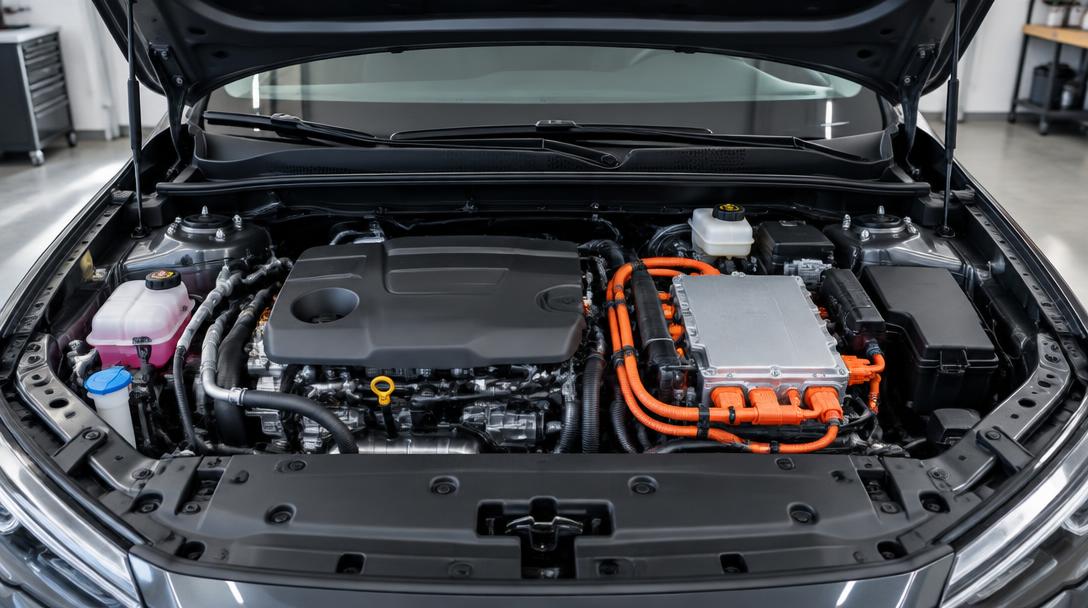
Quick answer: A hybrid with a gasoline engine still needs engine oil and filter changes, even when it spends part of each trip on electric power. The differences are how the engine operates, how the manufacturer accounts for that use, and the shutdown precautions required; follow the exact vehicle's mileage, time, and operating-condition instructions rather than estimating electric miles yourself.
The gasoline engine still has a lubrication job
A hybrid combines electric propulsion with an internal-combustion engine. The electric portion can reduce how often or how hard the engine works, but it does not eliminate the engine's bearings, pistons, camshafts, or other lubricated parts. When the engine runs, it needs oil with the correct properties just as a conventional engine does.
Oil does more than prevent metal surfaces from rubbing directly together. It carries heat away from parts, helps manage contamination, and supports engine systems designed around particular oil characteristics. Those jobs depend on the specified oil and an appropriate service interval, not simply on whether the car gets excellent fuel economy.
The Department of Energy's hybrid overview explains features such as electric assistance, regenerative braking, and engine shutdown when stopped. These features help explain why engine operation differs from odometer mileage. They do not establish a universal maintenance interval for all hybrids.
Also separate a hybrid from a battery-electric vehicle. A fully electric vehicle has no gasoline engine requiring an engine-oil change. A plug-in hybrid does have an engine, even if a driver can complete many daily trips without using it. The badge alone is not enough; identify the actual powertrain.
Less engine running does not mean unlimited oil life
A common shortcut is to subtract estimated electric miles from the odometer and treat the remainder as the only miles that matter. That approach ignores calendar limits, cold starts, warm-up patterns, and whatever assumptions the manufacturer already built into its schedule or oil-life calculation.
Some hybrid engines may remain off through portions of a trip, then start to provide heat, power, or other functions. Depending on the design and conditions, the resulting operating cycle may look very different from a conventional car's continuous drive. The owner does not need to reverse-engineer that behavior to choose an interval.
Time still matters. A vehicle driven infrequently may reach its calendar deadline before reaching its mileage limit. “Whichever comes first” means exactly that when it appears in the applicable schedule. A low odometer reading is not permission to disregard a date-based requirement.
An oil-life display may account for operating conditions, but its capabilities vary. Do not assume it directly tests oil chemistry or automatically knows that a previous owner missed service. It is only as useful as its intended design, correct reset history, and the instructions that explain how to interpret it.
Find the schedule for the exact hybrid
Start with model year, model, engine, and whether the vehicle is a conventional hybrid or plug-in hybrid. Similar-looking models can have different engines and maintenance requirements. A schedule for the nonhybrid version is not automatically transferable, and another driver's interval is not evidence for your car.
Locate the maintenance guide as well as the owner's manual. They may be separate documents. Look for normal operation, special operating conditions, maximum calendar limits, the oil specification, and the filter requirement. If a reminder uses a percentage or message, read the section describing that system too.
Toyota's oil-interval explanation illustrates why details matter: it distinguishes vehicles requiring certain oils from vehicles where those oils are optional and discusses special conditions. Do not turn one manufacturer's example into an instruction for every hybrid in Hillside.
For another brand, go directly to its owner resources. Ford's manual library is an example of a place to find vehicle-specific instructions. Save the correct document or the relevant pages so you do not have to rely on a search result summarizing a different model.
If the vehicle is used and records are missing, establish what is known before calculating the next due date. A reset dashboard reminder proves that someone reset it, not that the oil and filter were replaced. A dated invoice with mileage and product information is much more useful.
What Hillside winter trips can change
Imagine a plug-in hybrid making short errands between Berkeley and Hillside. In mild weather, much of that driving might be electric. In cold weather, the engine may operate differently because of heating needs, battery conditions, and the vehicle's control strategy. There is no single engine-running pattern you can assume from the route.
Repeated brief engine operation can matter because the oil may not remain fully warm long enough to manage moisture and fuel contamination as it would under other conditions. The relevant question is whether the manufacturer's special-condition guidance applies, not whether the trip felt easy from the driver's seat.
Similarly, an I-290 commute includes very different demands on different days. Sustained warmed operation and a sequence of cold starts separated by parking are not the same thing. Describe the real pattern when asking about maintenance: trip length, outdoor temperatures, parking periods, and how often the engine runs.
Chicago winter does not automatically require every hybrid to use the shortest imaginable interval. Nor does a longer drive erase an overdue calendar deadline. Follow the written criteria, and ask for clarification where the wording is unclear. That is more defensible than adding arbitrary service visits or postponing them based on a fuel-economy score.
Avoid running the engine in a garage to “warm the oil.” A hybrid can start its engine unexpectedly while ready, and exhaust creates a carbon-monoxide hazard. Extended idling is not a substitute for following the maintenance schedule, particularly in an enclosed or partly enclosed space.
The right oil is a specification, not a hybrid label
Choose oil according to the viscosity and performance requirements in the vehicle's documentation. Marketing words on a bottle cannot replace those requirements. Some hybrids use low-viscosity oils, but that does not mean the thinnest oil on a store shelf is appropriate for every engine.
Engine systems can depend on a particular oil's flow and performance characteristics. Do not change grades simply because the car is older, because summer has arrived, or because another hybrid uses a different number. If the manual allows alternatives under specified circumstances, follow those conditions rather than improvising.
The filter, fill quantity, drain-plug hardware, and tightening instructions are also vehicle-specific. A hybrid oil change is not automatically a special high-voltage repair, but it still requires the correct parts and procedure. Engine oil is separate from transmission, drive-unit, and cooling-system fluids.
Ask for the oil specification to appear on the service record. That gives the next technician useful information and makes future maintenance easier to track. A vague entry such as “hybrid service” says much less than a record identifying the engine-oil and filter work actually performed.
Safe owner checks start with a fully shut-down car
Silence is not proof that a hybrid is switched off. Before any underhood check, park securely, select the proper parking mode, apply the parking brake, and follow the manual's shutdown and key-handling instructions. A ready indicator can mean the vehicle remains active even when the engine is silent.
High-voltage components are not part of an owner oil-level check. Do not touch orange cables, remove hybrid-system covers, or disconnect a service plug to inspect oil. Toyota's Highlander Hybrid maintenance guide includes explicit high-voltage safety precautions; your own vehicle's warnings deserve the same attention.
Check oil only as the manufacturer directs. Some vehicles have a dipstick; others provide an electronic procedure. Use level ground and the specified engine temperature and waiting time. Repeated readings under inconsistent conditions can create the impression that the level is changing when the method is the real problem.
If topping up is necessary, use the correct oil and avoid overfilling. Do not reach past unfamiliar electrical components or remove covers simply to gain access. If the engine-oil fill or checking point is not obvious, stop and ask someone familiar with that vehicle.
There is no reason to crawl under an unsupported vehicle for a routine owner check. A jack alone is not safe support. Underbody panels, lifting points, and the possibility of unintended vehicle operation make a casual driveway oil change more complicated than pulling a dipstick.
Reminders, invoices, and warning lights mean different things
A maintenance reminder tells you service is due according to that system's rules. An oil-pressure warning can indicate an immediate lubrication problem. Do not treat the second as a routine reminder that can wait until the next convenient Saturday.
If an oil-pressure warning appears with the engine running, stop safely and shut down according to the manual. Do not continue on electric power as a workaround; the engine may start when the system decides it is needed. Arrange assistance when safe operation is uncertain.
After an actual oil change, the reminder should be reset using the correct procedure. Resetting it without doing the work breaks the link between the display and maintenance history. If someone resets it accidentally, retain the true service date and mileage rather than assuming the new display is authoritative.
A useful record includes the date, odometer, oil specification, filter information, and next deadline under the applicable schedule. For plug-in hybrids, notes about usual electric driving can provide context, but they do not replace the odometer or calendar entries required by the manufacturer.
Planning service with Rios Auto Service
Rios Auto Service offers walk-in oil changes at 4218 Roosevelt Rd, Hillside, IL 60162. It is an independent, family-run shop owned by Juan Rios. Bring the correct maintenance guide and any previous receipts, especially if you are unsure whether an earlier reminder reset corresponded to completed service.
Ask for an honest, vehicle-specific discussion of the oil requirement and due date. Request an explanation of any finding and ask to see what supports an additional recommendation. An ordinary oil change should not be presented as proof that unrelated high-voltage work is needed; unfamiliar hybrid concerns require appropriate expertise, not guesswork.
Call (708) 632-4808 or use the contact page to discuss your model and service needs before visiting. Hours are Monday through Friday, 8 AM–6 PM, and Saturday, 8 AM–4 PM; the shop is closed Sunday. Walk-ins are welcome, and a free Wi-Fi waiting area is available.
Frequently asked questions about hybrid oil changes
My plug-in hybrid barely uses gasoline. Can I skip the annual limit?
Not if your vehicle specifies that limit. Electric driving does not cancel a calendar requirement. Check whether the manufacturer provides special instructions for extended electric use, and follow those exact instructions rather than calculating a replacement interval yourself.
Do all hybrids need a special hybrid-branded oil?
No universal hybrid-branded oil requirement applies across all makes. What matters is the specification for the exact engine. A product advertised for hybrids is suitable only if it meets the viscosity and performance requirements stated by the vehicle manufacturer.
Is a quiet hybrid safe to inspect under the hood?
Not merely because it is quiet. A vehicle left ready can start its engine or move under the right conditions. Fully shut it down using the manufacturer's procedure before an owner check, and stay away from high-voltage components regardless.
Does an oil change service the hybrid battery too?
No. Engine-oil service and traction-battery maintenance are different tasks. A receipt should distinguish the work performed. Ask separately about any hybrid-system warning rather than assuming an oil change will diagnose or correct it.
Related question
For work vehicles with demanding daily use, read Rideshare & Delivery Drivers: Oil Change Schedules.