
Walk-In Oil Change
Dark Oil on the Dipstick: Should You Worry?
Dark engine oil alone does not mean engine trouble. Learn what Hillside drivers should check on the dipstick and which changes need prompt attention.
By the team at Rios Auto Service, Hillside, IL · · 8 min read
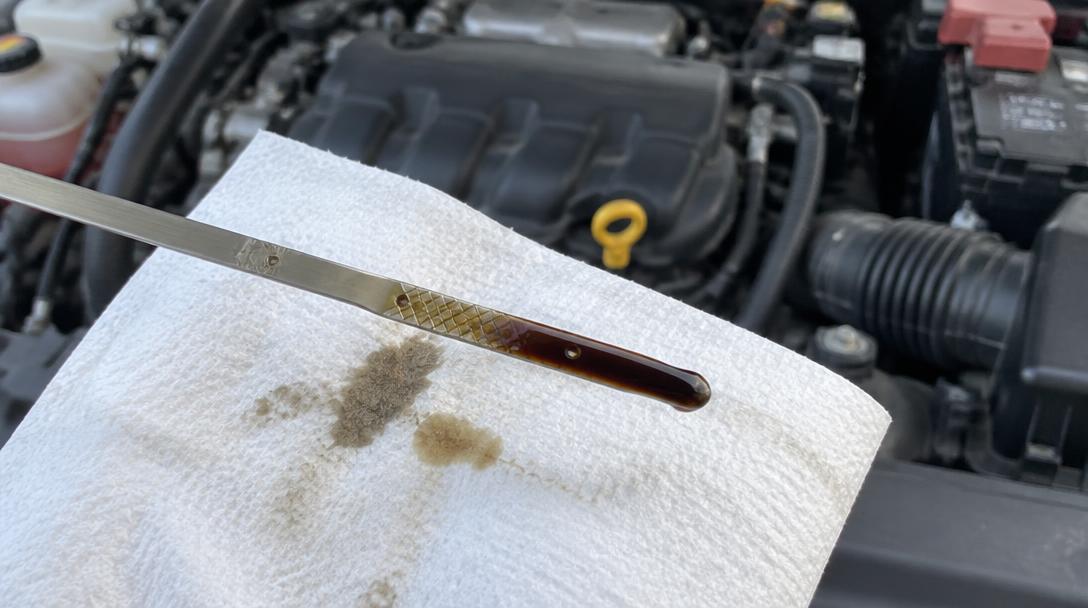
Quick answer: Dark oil on the dipstick is not, by itself, proof that the oil is worn out or the engine needs repair. Check the level, maintenance history, and any changes in appearance or engine behavior; milky oil, visible metallic debris, a rising level, or an oil-pressure warning deserves more attention than ordinary dark brown oil.
Why clean-looking oil does not stay golden
Fresh engine oil often looks amber, but it enters a working engine rather than a clean glass container. Heat, oxidation, suspended combustion byproducts, and small amounts of remaining used oil can change its appearance. Detergent and dispersant additives help manage deposits and keep certain contaminants suspended instead of letting them accumulate on engine surfaces.
That means darkening can accompany normal operation. It does not prove the additives are exhausted, and it does not prove they are still adequate either. Two engines using the same oil may produce different colors because their designs, operating temperatures, fuel systems, and previous maintenance differ. A shade comparison cannot account for all those variables.
Oil also looks different depending on how you view it. A thick drop on the end of the dipstick may appear almost black, while a thin smear of the same sample looks brown. Garage lighting, a stained rag, and the dipstick's own finish can make the comparison even less useful.
The practical starting point is the vehicle's maintenance requirements. Consumer Reports' oil-change guidance emphasizes following the owner's manual and applicable service reminders. Color is a clue to interpret alongside that information, not a replacement for it.
What the dipstick can tell a Hillside driver
The dipstick's main job is to show oil level under the checking conditions specified by the manufacturer. It can also reveal obvious abnormalities. It cannot directly measure oil pressure, remaining additive strength, fuel dilution, or the concentration of microscopic wear metals. Those are different questions requiring different evidence.
Start by separating quantity from condition. Oil can be dark and at the correct level. It can also be relatively clear and dangerously low. A driver who focuses only on color may overlook the more immediately useful finding: the oil no longer reaches the marked operating range.
Likewise, a full reading is not a certificate of engine health. If the level keeps rising without anyone adding oil, another fluid may be entering the crankcase, or the checking method may be inconsistent. Repeat the measurement correctly and arrange evaluation if the increase is confirmed.
Avoid judging oil by how slippery it feels between your fingers. That is not a meaningful viscosity test, and used oil should not be handled unnecessarily. Do not taste it, heat a sample, or try a homemade burn test. None of those shortcuts safely answers the question you actually have.
Why short western-suburb trips complicate the picture
A few miles from Bellwood to a Hillside errand may warm the cabin without bringing the oil fully to operating temperature. Repeated short winter trips can allow moisture and fuel contamination to persist longer than they would during suitable fully warmed operation. This is about the duty cycle, not the name of the town.
The contrast can be surprising. A car driven short distances may show modest mileage while its oil has had demanding service. A car spending longer periods fully warmed on I-294 may accumulate miles faster without the same pattern of repeated cold starts. Neither pattern lets you determine oil condition by its darkness.
Manufacturers may prescribe different maintenance for specific conditions. Toyota's interval explanation, for example, identifies repeated short trips below freezing and extensive idling among special operating conditions. Its numbers apply to the vehicles described, not automatically to every car parked along Roosevelt Road.
Road salt and potholes are not explanations for ordinary dark oil inside a sealed, healthy lubrication system. Salt exposure matters elsewhere on a vehicle, and an impact can cause physical damage, but neither should become a convenient diagnosis for a dark dipstick. Keep the explanation tied to what the engine and oil are actually doing.
A safe check that produces a useful reading
Find the correct procedure before opening the hood. Some vehicles specify a cold check, others a warmed engine followed by a waiting period, and some use an electronic level display instead of a dipstick. Use the instructions for your exact model and engine rather than a remembered routine from another car.
Park on level ground, secure the vehicle, and shut it down as directed. Keep away from hot exhaust components, belts, and fans. On a hybrid, confirm the vehicle is fully off rather than merely quiet. An engine that is not running at that moment can still start if the vehicle remains ready.
For a conventional dipstick procedure, withdraw it, wipe it with a clean lint-free cloth, insert it fully, and withdraw it again to read the marked area. Consumer Reports' dipstick guide explains why level ground and the manufacturer's checking instructions matter. An initial splash mark is not always the actual level.
If the reading is unclear, repeat it rather than guessing. Photograph the result and record the date and odometer reading if something seems unusual. Use consistent checking conditions for future comparisons. A reliable trend is far more informative than three readings taken on different slopes at different temperatures.
Do not add oil just because the existing oil looks dark. Add only if the measured level requires it, using the specified product and small amounts as directed. Overfilling creates a different problem. Secure the dipstick and oil cap before closing the hood, and clean up any spill safely.
Appearance changes that deserve closer attention
Uniform dark brown or black oil is different from oil with obvious foreign material. Visible glitter, flakes, or gritty deposits deserve professional evaluation. A photograph cannot establish the source, and sunlight can create misleading reflections, but repeated visible metallic-looking particles should not be dismissed as normal color change.
Milky or creamy oil on the dipstick also deserves attention, especially when accompanied by coolant loss, overheating, or a rising oil level. Moisture under the filler cap alone can sometimes reflect condensation from short trips. That is not enough to diagnose a failed gasket, and it is not a reason to ignore milky oil throughout the sump.
A strong fuel odor can be another clue, but smell is subjective and cannot quantify dilution. Do not lean into the filler opening or deliberately inhale vapors. Report an odor you noticed incidentally, particularly if the level is increasing or the engine runs poorly. A mechanic can decide whether sampling or other tests make sense.
Thick deposits on accessible surfaces may indicate a maintenance or operating problem, but do not scrape material into the engine. Nor should a dark dipstick automatically trigger an engine flush or chemical additive. The cause and the manufacturer's guidance need to come before a treatment.
Dark oil right after a change is not automatic evidence of a mistake
An oil change drains most service oil, not necessarily every trace held in internal passages and components. Fresh oil can mix with a small residual quantity and darken. Some engines, particularly diesels, can darken oil quickly because of their combustion-related contamination patterns.
If you have doubts after service, check the invoice for the oil specification, quantity, filter, mileage, and date. Verify the level using the proper procedure. Those checks address the work more directly than comparing the dipstick with an online photograph of new oil.
Ask questions calmly if the record is incomplete or the reading is wrong. Dark color alone cannot establish that the oil was not changed. Conversely, a clean-looking sample cannot establish that the correct oil and filter were installed. Documentation and a properly performed inspection carry more weight.
For vehicles with digital maintenance information, the correct owner's resource can clarify both checking and service requirements. Ford's owner-manual library is one example of a manufacturer resource organized around the vehicle. Use your own manufacturer's equivalent if you drive another brand.
When the situation is urgent
A red oil-pressure warning while the engine is running changes the decision completely. Pull over safely and shut the engine off according to the vehicle's instructions. Do not keep driving because the dipstick shows oil or because the oil looks clean. Level and pressure are not the same measurement.
A confirmed very low level, severe knocking, overheating, or sudden major leakage also requires prompt action. If safe operation is uncertain, arrange assistance instead of driving to investigate. Avoid repeatedly restarting the engine to see whether the warning returns; doing so can increase damage if lubrication has failed.
Without those warning signs, ordinary dark oil usually permits a calmer maintenance review. Check when service was last performed and whether the applicable interval has been reached. If the history is unknown, establishing a documented oil and filter service may be more useful than debating the precise shade on the stick.
An oil analysis can help in selected recurring or uncertain cases. A laboratory can assess properties and contaminants that eyesight cannot. It is not required every time oil darkens, and it does not replace immediate action for an active pressure warning. Ask what question the test would answer before paying for one.
Getting a useful inspection at Rios Auto Service
Rios Auto Service is an independent, family-run shop owned by Juan Rios at 4218 Roosevelt Rd, Hillside, IL 60162. Walk-ins are welcome for oil-change service. Bring the last service receipt, the vehicle information, and any photographs showing an unusual reading or change over time.
Ask for an honest inspection based on the level, service requirements, and symptoms rather than color alone. Request that any concerning finding be shown and explained before authorizing additional work. A recommendation should identify the problem it addresses; dark oil by itself is not a reason to approve unrelated repairs or an upsell.
The shop is open Monday through Friday, 8 AM–6 PM, and Saturday, 8 AM–4 PM; Sunday is closed. Call (708) 632-4808 or use the contact page to discuss your concern. A free Wi-Fi waiting area is available, but avoid driving in with an active oil-pressure warning.
Frequently asked questions about dark engine oil
Does black oil mean the engine is damaged?
No. Black oil alone cannot establish engine damage. A correct level, documented maintenance, normal operation, and the absence of warnings are useful context. Unusual debris, changing fluid levels, or abnormal engine behavior deserve investigation even if the oil is not especially dark.
Should I change the oil early just to make it look clean?
Not solely for appearance. Use the applicable maintenance instructions and service history. If the oil is overdue, contaminated, or associated with another problem, service may be appropriate, but the reason should be more specific than wanting an amber dipstick.
Can I compare my oil with someone else's car?
Not reliably. Engine design, fuel type, oil formulation, lighting, and time in service affect appearance. Comparing consistent readings from your own vehicle can help you describe a change, but even that does not measure how much useful oil life remains.
What should I tell the mechanic first?
Start with the most concrete observation: a low or rising level, milky appearance, visible particles, warning message, or new noise. Then provide the last oil-change date and mileage. Saying only “the oil is black” leaves out the information most likely to guide a useful inspection.
Related question
For a different maintenance situation, read Hybrid Oil Changes: What's Different.