
Check Engine Light Diagnostics
Misfire Codes P0300–P0306
Misfire codes identify uneven combustion, not automatically bad spark plugs. Learn what P0300–P0306 mean and when Hillside drivers should stop driving.
By the team at Rios Auto Service, Hillside, IL · · 9 min read
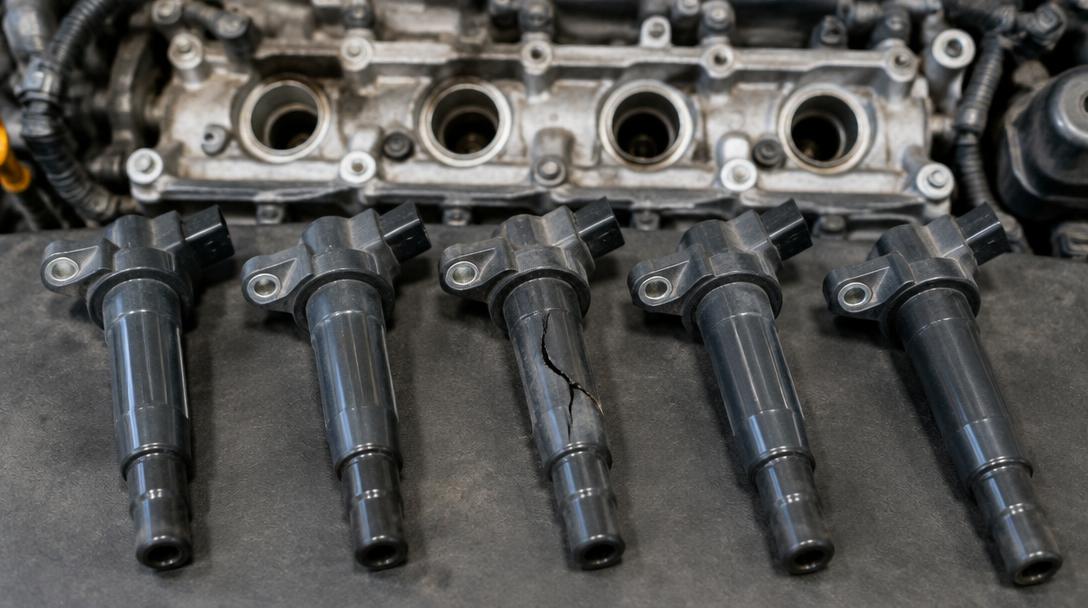
Quick answer: P0300 means the computer detected random or multiple-cylinder misfires; P0301 through P0306 identify detected misfires associated with cylinders one through six. These codes describe uneven combustion, not a guaranteed failed part. A flashing warning, severe shaking, fuel smell, or major power loss calls for stopping safely rather than continuing to drive.
Reading the numbers without ordering parts
A gasoline engine depends on each cylinder contributing power at the right time. When a cylinder does not burn its mixture effectively, its contribution drops. The driver may feel shaking or hesitation, but the computer can sometimes detect a problem before it becomes obvious from the seat.
The final digit in P0301 through P0306 identifies the affected cylinder number, not a firing-order position or the location of a coil on a parts diagram. P0302 does not mean the second cylinder you see when standing in front of the car. Cylinder numbering varies by engine design and manufacturer.
P0300 is broader. It can reflect misfires distributed across cylinders or a pattern the computer classifies as random or multiple. It does not necessarily mean every cylinder is failing equally. A technician needs the vehicle's diagnostic information and operating data to understand the pattern.
Engines with more than six cylinders can have additional cylinder-specific codes beyond this article's range. Conversely, a four-cylinder engine has no cylinder six to inspect. Before interpreting any code, confirm the vehicle, engine, and full code exactly as recorded rather than relying on a remembered number.
How the computer notices uneven combustion
Many systems infer misfire activity from small changes in crankshaft speed. A healthy power stroke accelerates the rotating assembly in an expected way. When that contribution is missing or weaker, the computer can recognize a pattern and associate it with a cylinder under the appropriate conditions.
That is an indirect measurement. The computer is not looking inside the combustion chamber and photographing a failed spark. It compares signals and applies diagnostic logic. This distinction explains why a misfire code cannot, on its own, prove that a spark plug, ignition coil, injector, or valve has failed.
Stored information may include engine speed, load, temperature, and other conditions when the fault was detected. Misfire counters or manufacturer-specific data can show whether activity is concentrated in one cylinder or appears across several. Not every basic reader displays these details, and their availability varies.
The EPA's onboard-diagnostics guide identifies engine misfire as a condition that can lead to serious damage. The purpose of recording the fault is early warning, not simply turning on a reminder that maintenance might be due sometime later.
Spark is only one of the necessary ingredients
A cylinder needs an appropriate air-fuel mixture, ignition, compression, and correct timing. Problems in any of these areas can reduce its contribution. Worn or contaminated plugs and faulty coils are possibilities, but so are injector faults, intake leaks, fuel-delivery problems, and mechanical sealing concerns.
A single-cylinder code often gives the technician a useful place to begin. The next step is to compare evidence, not replace every ignition component on that side of the engine. Oil or coolant entering a plug well, a damaged connector, or wiring rubbed through nearby can change the repair entirely.
Multiple-cylinder activity may suggest something shared, such as fuel supply or an air leak, but that is not a rule. Several worn components can also produce multiple faults. A code pattern organizes the investigation; it does not remove the need to test individual explanations.
Recent work matters. A hose left disconnected, an incompletely seated electrical connector, or an incorrect part can create a new problem immediately after service. Tell the technician what changed, even if the work seemed unrelated. A factual timeline is more valuable than assigning blame before the vehicle is examined.
Why conditions matter on western-suburb trips
A misfire that appears only during a cold start presents a different testing opportunity from one that happens after a long, warm drive. Chicago winter mornings can expose marginal systems under starting conditions, but cold weather alone does not identify a bad coil or establish that fuel is contaminated.
Likewise, a fault under heavy load can become noticeable while joining I-290 rather than while idling in a driveway. Do not deliberately repeat a dangerous merge to prove the symptom. Describe the original event: engine temperature, approximate speed, whether you were accelerating, and whether the warning flashed.
Short trips around Berkeley or Hillside can leave little time to observe a pattern. Keep a brief note after parking: cold or warm engine, damp or dry weather, light or heavy acceleration, and whether the shaking stopped. Avoid building a complicated diary that distracts from getting a severe fault assessed.
If the engine behaves normally when the appointment begins, the complaint still deserves attention. Intermittent problems often need the original conditions or recorded data to become clear. A symptom disappearing in the parking lot does not erase a confirmed code or mean the owner imagined it.
What you can safely check before service
Start with information, not disassembly. Record the complete code list and any warning message. Note whether the light is steady or flashing and whether the engine shakes. If you already own a reader, save its results before clearing anything. Do not use a phone or scanner while driving.
With the engine off and cool, a simple visual inspection may reveal an obviously displaced intake hose or a connector disturbed during recent work. Limit the check to accessible areas you recognize. Keep hands away from belts and fans, and do not touch high-voltage ignition components with the engine running.
Check the owner's manual for relevant operating instructions and warnings. An official manufacturer manual library is a useful route to model-specific information. Procedures that suit an older exposed ignition system may be inappropriate for an engine with fragile connectors, hidden plugs, or special access requirements.
Do not pull plug wires or unplug coils on a running engine to find a weak cylinder. That approach creates shock and component-damage risks and may send additional unburned fuel into the exhaust. Likewise, spraying flammable liquids around an intake is not an appropriate driveway leak test.
When to stop instead of trying one more trip
A flashing malfunction indicator commonly warns of an active misfire severe enough to threaten the catalytic converter. Reduce demand, leave traffic safely, and stop rather than testing whether harder acceleration clears it. Follow the owner's manual and arrange assistance when the vehicle is running badly or the warning persists.
Unburned fuel can enter the exhaust and create excessive heat. The absence of loud noises does not make continued operation harmless. A car that still moves under its own power may be causing expensive damage while losing the reliable acceleration needed to navigate traffic safely.
Severe shaking, repeated stalling, a strong raw-fuel smell, smoke, or substantial power loss also warrants stopping. If the vehicle is in a dangerous location, prioritize getting people out of immediate traffic danger. Do not stand beside moving traffic to inspect the engine or record a video.
A steady light with normal operation usually offers more room to arrange prompt diagnosis, but it is not clearance for a long trip. Report the symptoms when arranging service. Avoid towing loads, hard acceleration, and unnecessary driving until you know whether the fault remains active and what the manufacturer recommends.
Testing a suspected cylinder rather than guessing
A professional investigation confirms cylinder numbering and checks related codes first. A lean-condition code, injector-circuit code, or timing-related fault may change the order of testing. Ignoring those clues and replacing a coil solely because P0303 appears can leave the root problem untouched.
An ignition evaluation may include inspecting plugs and boots, examining wiring, and comparing component behavior. Under controlled conditions, a technician might move a suitable component and see whether the misfire follows it. That is a test with a predicted outcome, not a reason for an owner to shuffle parts without a plan.
If ignition evidence is weak, fuel delivery and mechanical condition deserve attention. Injector testing, fuel-pressure evaluation, compression testing, or a cylinder leak-down test may be appropriate. These are not interchangeable procedures. Each answers a particular question about whether the cylinder receives fuel or can seal effectively.
Explain any limits before approving more work. An intermittent fault may require additional observation, and a mechanical concern may need targeted testing beyond an initial scan. Ask which finding supports the next step and what outcome would confirm or rule out the suspected cause.
Why a reset is not a repair
Clearing codes can remove useful context and make an intermittent problem harder to reproduce. It may also reset readiness information. The light staying off for the first few minutes afterward is weak evidence because the conditions that exposed the fault may not have happened again.
Repair verification should match the original complaint without exposing anyone to unnecessary risk. A technician may monitor misfire data, recheck relevant conditions, and confirm that associated faults do not return. If the symptom appeared only after a cold soak, a warm idle in the shop may not be sufficient verification.
For local emissions planning, Illinois Air Team explains how OBD testing uses readiness and warning status. This article is not a testing checklist, but the practical point is simple: do not erase a misfire fault merely to get through an inspection. Resolve the underlying problem first.
It is also reasonable to check the VIN through NHTSA's recall lookup, particularly when researching a known vehicle-specific concern. A recall search does not diagnose an individual misfire. It adds safety information that should be considered separately from wear, maintenance, and the actual test results.
Making a focused plan with Rios Auto Service
Rios Auto Service provides check-engine diagnostics at 4218 Roosevelt Rd, Hillside, IL 60162. The independent, family-run shop is owned by Juan Rios. When asking about diagnostic service, lead with the code numbers and whether the engine is currently shaking or the warning is flashing.
An evidence-led discussion should distinguish the detected symptom from the failed part. Ask what the inspection found, whether the misfire was reproduced, and how any proposed replacement relates to that evidence. Showing a damaged component or relevant test result is more useful than treating every misfire as an automatic tune-up sale.
If the car is unsafe to drive, discuss that before setting off. Walk-ins are welcome, but a severe active misfire should not be driven across town just because an appointment is not required. Call (708) 632-4808 or use the contact page to explain the situation.
The shop's hours are Monday through Friday, 8 AM–6 PM, and Saturday, 8 AM–4 PM; it is closed Sunday. Bring recent repair records if available. Knowing which plugs, coils, or fuel-system parts were recently changed can prevent duplicated work and help identify an installation-related problem.
Short FAQ about P0300 through P0306
Does P0301 always mean a bad ignition coil?
No. It identifies detected misfire activity associated with cylinder one. Ignition, fuel, air, wiring, and mechanical causes remain possible. The coil becomes a justified replacement when inspection or testing supports that conclusion, not simply because it sits near the affected cylinder.
Can the code stay stored after the shaking stops?
Yes. A stored fault can remain as a record even when the condition is not currently occurring. Tell the technician when the symptoms last appeared and avoid clearing the record. Intermittent operation changes the testing strategy, not the need to understand the fault.
Should all six coils be replaced together?
Not automatically. A confirmed failed coil does not prove the others have failed. Maintenance requirements and component condition should be considered separately. Ask whether a recommendation addresses a demonstrated defect, a manufacturer requirement, or optional preventive work.
Is it safe if the car only misfires for a few seconds?
Duration alone cannot establish safety. Repeated brief faults can still matter, particularly with a flashing warning or severe shaking. Arrange evaluation and describe exactly when it happens rather than assuming a short event cannot cause damage.
Related question
For help describing an unfamiliar sound without guessing at the part, read Diagnosing Strange Noises.