
Tune-Ups & Maintenance
Cabin Air Filters and Spring Allergies
A clean cabin air filter can reduce incoming pollen, but it cannot cure allergies. Learn what Hillside drivers should check before spring commutes begin.
By the team at Rios Auto Service, Hillside, IL · · 9 min read
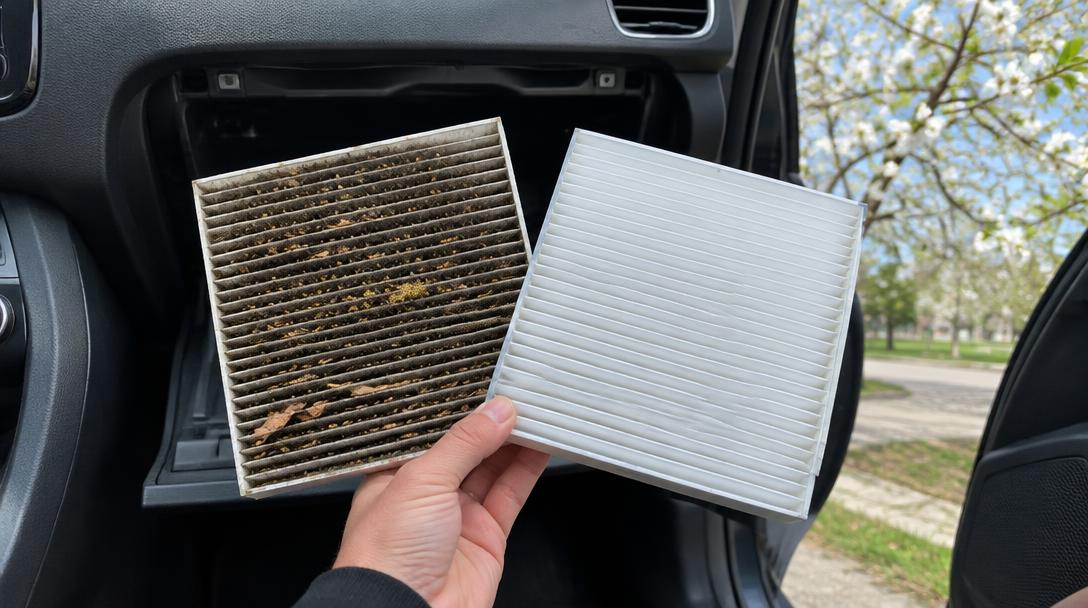
Quick answer: A correctly fitted cabin air filter can reduce pollen and other particles entering through your vehicle’s ventilation system, making spring drives more comfortable. It cannot cure allergies or keep out everything, and replacing it will not fix every odor or airflow problem. Check your vehicle’s maintenance schedule and inspect the filter rather than assuming every spring requires the same service.
What the cabin filter actually catches
The cabin filter sits in the heating and air-conditioning airflow path on vehicles equipped with one. Its pleated material captures particles as air passes through. Depending on the vehicle’s design, it filters incoming outside air, recirculated cabin air, or both. The housing and its seals matter because air that slips around the filter avoids the filtering material entirely.
This is not the engine air filter. The engine filter protects the engine’s air supply; the cabin filter serves the passenger compartment. Replacing one does not replace the other. When discussing an estimate, use the full name so you know which filter is being inspected and why.
Particle capture varies by filter construction and particle size. A basic particulate filter and a carbon-containing filter do not make identical claims. Carbon media may reduce certain odors or gases within its limits, but it is not a guarantee against traffic fumes. Neither type turns an ordinary car into a sealed clean room.
Ford’s cabin-filter guidance identifies allergies, dusty roads, and heavily polluted driving environments as reasons replacement may be needed more often. Its mileage advice is Ford-specific, not a universal interval for every make. Your own model’s schedule remains the starting point.
Why spring sneezing can persist with a fresh filter
A filter only treats the air that passes through it. Open a window on a mild afternoon and pollen has another route inside. Particles also arrive on coats, shoes, bags, pets, and passengers. Once those particles settle on seats and carpeting, a new filter cannot simply pull them all back out.
That distinction prevents an expensive misunderstanding: better ventilation filtration is an exposure-management step, not medical treatment. If your eyes itch every time you sit down, the filter may be only part of the situation. Cleaning interior surfaces and reducing what enters through open windows may matter as much as replacing a loaded element.
The EPA’s explanation of air-cleaner limitations, written for indoor environments, makes a useful general distinction: particles resting on surfaces cannot be removed by an air cleaner unless they become airborne. It also explains that ordinary particle filters do not remove gases. Those principles help set realistic expectations, although the page is not a performance test of your vehicle’s filter.
If driving triggers wheezing, breathing difficulty, or significant symptoms, seek medical advice rather than treating an automotive part as the solution. A mechanic can evaluate the ventilation system; a clinician evaluates your health. Neither a dark-looking filter nor a newly installed one establishes why a particular person is sneezing.
Spring driving around Hillside changes the exposure
A commute along Roosevelt Road can combine fresh-air ventilation, roadside dust, and frequent stops. On I-290, nearby traffic adds another reason drivers sometimes choose recirculation. These conditions do not establish an exact replacement interval, but they explain why two identical vehicles may accumulate different filter loads over the same mileage.
Parking habits matter too. A car left beneath trees may collect leaves and plant debris around the exterior air-intake area near the windshield. Material can build up even when the odometer barely moves. A low-mileage car used for errands between Hillside and Bellwood is not automatically free of ventilation-maintenance needs.
After a Chicago winter, inspect for debris rather than assuming road salt has ruined the cabin filter. Salt on the road and pollen in the ventilation system are different issues. Similarly, a pothole impact does not ordinarily establish that the filter needs replacement. Keep the explanation tied to what is actually found.
For a spring trip to Oakbrook Center, closing the windows during heavy pollen exposure can reduce one entry route. Brief recirculation may help limit incoming outside particles, depending on the system. Use it thoughtfully: passengers still need comfortable ventilation, and window fogging or stale air is a reason to adjust the controls rather than leave one setting selected indefinitely.
Read the symptoms without blaming everything on pollen
Reduced airflow at several vents can be consistent with a heavily loaded cabin filter. Compare similar settings: the same fan speed, vent selection, and temperature mode. A system that feels weak only at one outlet may have a distribution issue rather than a filter restriction. A blower that does not operate needs a different investigation.
An odor also needs context. A filter holding damp organic debris may contribute to a smell, but moisture in the HVAC system, a water leak, or contaminated interior material can smell too. Replacing a dry filter without investigating wet carpeting or repeated mustiness may leave the real problem untouched.
A squeal, scraping noise, or ticking that changes with blower speed is worth reporting separately. Leaves near the blower, a damaged component, or another fault can require attention beyond routine filter replacement. Do not push a tool through a vent to chase a noise. You can damage parts without reaching its source.
Temperature and airflow are separate observations. If air moves strongly but never becomes cool, a new filter is not a diagnosis of the cooling problem. Likewise, warm air from the heater does not prove the cabin filter is clean. Describe what changes when you adjust the controls instead of simply asking for an allergy fix.
A safe owner check starts with the manual
Find the filter location and replacement instructions for your exact year and model. Some filters are behind the glove compartment; others require different access. Some older vehicles lack a replaceable cabin filter altogether. Manufacturer resources such as Ford’s owner-manual library illustrate the right place to look, but owners of other makes should use their own manufacturer’s instructions.
Park securely, switch the vehicle off, and follow its shutdown guidance before reaching into the filter area. Empty the glove compartment if the procedure requires lowering it. Plastic stops, dampers, and retaining tabs can break if forced, especially when cold. If access involves unfamiliar electrical components or substantial disassembly, stop and leave it to a technician.
Before removing anything, note the filter’s orientation and the housing arrangement. An arrow marked “airflow” is not necessarily the same as an arrow marked “up.” Follow the housing markings and the part instructions rather than assuming every arrow points toward the roof. A quick photograph can help preserve the original arrangement for reference.
Lift the filter out carefully so loose debris does not fall into the blower area. Look for packed leaves, heavy loading, tears, collapsed pleats, dampness, or a distorted frame. Wear gloves if needed and avoid shaking dust into your face. If you find nesting material or droppings, stop rather than blowing or vacuuming the contamination into the air.
Choose a replacement that fits, not just a stronger claim
A filter must match the vehicle’s application and housing dimensions. A slightly wrong shape can leave gaps or prevent the cover from closing. Do not cut a household filter to fit, stack two elements, or force a thick replacement into a shallow housing. The system needs both filtration and sufficient airflow.
A gray element is not automatically worn out. Some filters contain dark carbon media when new. Appearance is useful, but compare it with the product’s original construction and the maintenance record. Packed debris, damage, moisture, elapsed service time, and airflow symptoms provide better context than color alone.
Unless the manufacturer specifically identifies the filter as washable, treat it as a replaceable element. Rinsing or scrubbing disposable media can damage its structure. Compressed air can spread trapped dust and harm the pleats. A filter that looks cleaner afterward may no longer perform as intended.
After installation, make sure the element is seated and the cover is secured correctly. Restore any glove-compartment damper or stop according to the instructions. Run the ventilation system and listen for an unexpected noise. If airflow remains weak, avoid buying another filter on the assumption that the first replacement was not expensive enough.
When a ventilation concern should not wait
A dirty filter without other symptoms usually allows time for a planned maintenance visit. Dampness that returns, water entering the passenger compartment, or persistent odors deserve a closer inspection. A soaked filter may indicate more than overdue replacement; identifying where the moisture comes from helps prevent a repeat.
Poor windshield clearing raises the urgency. NHTSA’s winter-driving guidance includes checking defrosters, a reminder that climate-control performance also affects visibility. Spring rain can fog glass too. If you cannot keep a clear view, stop somewhere safe instead of continuing because the problem seems like a minor comfort issue.
Burning smells, smoke, or electrical trouble are not routine pollen symptoms. Stop using the affected system and seek appropriate help. If you suspect exhaust is entering the cabin, stop driving safely and have the vehicle evaluated; a cabin filter is not protection against carbon monoxide. Recirculation is not a safe workaround for an exhaust leak.
For a normal appointment, bring specific observations: whether airflow changes on recirculation, whether the smell appears only at startup, and when the filter was last replaced. Mention any wet carpet or recent water intrusion. These details are more useful than guessing that the entire ventilation system needs cleaning.
Discussing cabin-filter service at Rios Auto Service
Rios Auto Service provides tune-ups and maintenance at 4218 Roosevelt Rd, Hillside, IL 60162. The independent, family-run shop is owned by Juan Rios. Bring the vehicle’s maintenance history and describe whether your concern is seasonal pollen exposure, weak airflow, an odor, or more than one of those things.
Ask for an honest inspection and to see what was found. A useful discussion separates a scheduled filter replacement from diagnosis of a blower fault or water leak. Ask why a proposed part matches your vehicle and whether any additional work addresses a documented condition. That keeps the visit focused rather than turning allergy season into an open-ended shopping list.
Walk-ins are welcome Monday through Friday, 8 AM–6 PM, and Saturday, 8 AM–4 PM; the shop is closed Sunday. Call (708) 632-4808 or use the contact page to discuss your concern. A filter visit is also a good time to record the installation date and mileage for your own future reference.
Frequently asked questions about spring cabin filters
Should I replace the filter every spring?
Not automatically. Spring is a convenient reminder to review the schedule and condition, but the correct interval depends on your vehicle and use. If the filter is already due or heavily loaded, replace it. If it was recently installed and remains sound, the calendar alone does not prove it needs another replacement.
Will a carbon filter eliminate traffic smells?
It may reduce some odors, depending on the filter and exposure, but it will not remove every gas or make heavy traffic harmless. Correct fit still matters. Persistent exhaust-like smells need investigation, not a succession of more heavily advertised filters or an air freshener that masks the warning.
Can I drive temporarily without the filter?
Do not treat removing it as a repair for weak airflow. Depending on the design, running without the intended element allows debris into areas it should protect. Follow the manufacturer’s directions and reinstall the correct filter. Continued airflow trouble calls for diagnosis rather than permanently bypassing filtration.
Why do I still sneeze with the windows closed?
Pollen may already be on clothing, seats, or carpeting, and some outside air can still enter the vehicle. A damaged seal or incorrect filter fit can also limit performance. Check the automotive basics, clean the interior appropriately, and discuss ongoing symptoms with a healthcare professional rather than expecting a filter to provide medical treatment.
Related question
For a broader look at choosing scheduled work, read 30k, 60k, 90k-Mile Services Without Dealer Prices.